Government, opposition trade blame after attack on van carrying political prisoners in Pakistan

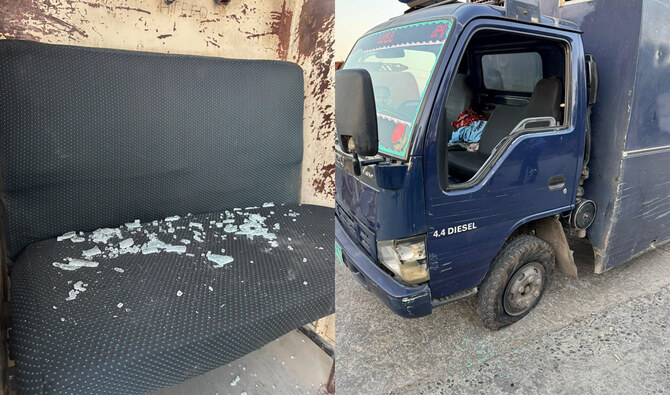
This combination of photos created on October 25, 2024 shows one of the prisoner vans carrying 82 prisoners that came under attack on the outskirts of Islamabad on October 25, 2024. (Photo courtesy: Social Media)
Short Url
Updated 25 October 2024
Follow

Government, opposition trade blame after attack on van carrying political prisoners in Pakistan

  • Information minister accuses Imran Khan’s party of making ‘botched attempt’ to free its supporters
  • Khan’s PTI blames the government of orchestrating the attack with police help to discredit the party

ISLAMABAD: A war of words erupted between the government and Imran Khan’s Pakistan Tehreek-e-Insaf (PTI) party on Friday, shortly after three prison vans came under attack on the outskirts of Islamabad, with both sides accusing each other of orchestrating the incident, allegedly aimed at freeing 82 PTI prisoners.
The incident occurred near the Sangjani Toll Plaza on the historic Grand Trunk Road between Islamabad and Taxila as PTI workers, arrested during recent protests in the federal capital, were being transported back to Attock Jail after a court appearance.
Pakistan’s Information Minister Attaullah Tarar condemned the incident in a televised statement, blaming the PTI and its “history of violence” for the incident, while a PTI spokesperson accused the government of orchestrating the attack to discredit the party.
“The attack on the prisoner vans was a premeditated action,” the minister said.
“When the prison van slowed down near Sangjani Toll Plaza, armed workers in four vehicles attacked and attempted to free the 82 prisoners,” he added. “But all 19 escapees have been apprehended.”
Tarar claimed the son of a PTI lawmaker in Khyber Pakhtunkhwa (KP) province was part of the plan and had been taken into custody. He noted that the attackers were equipped with weapons and shot at the police during the “botched attempt” to free the prisoners.
“Strict action will be taken,” he said. “Arrests will be made, and an example will be set so that no one attempts such an escape again.”
A PTI spokesperson, Shaikh Waqas Akram, however, said in a video clip the police broke the windows of the prison vans, opened their doors and forced all prisoners to step out.
“Police pushed them to run, but the PTI prisoners refused to escape,” he maintained.
In response, the information minister called the party’s narrative “laughable.”
“It sounds like a movie story where the police open the door and say, ‘Run away, we are setting you free,’ and then vandalize everything themselves,” he said. “All the CCTV footage [of the incident] is available.”
Tarar said the police were interrogating the arrested suspect to trace the mastermind of the incident, adding that the writ of the state would be enforced at all costs.
Earlier, local media reports said the attackers shot at the tires of the prison vans, causing them to burst.
Pakistan has witnessed significant political turbulence since the ouster of ex-premier Khan in a parliamentary no-confidence vote in April 2022.
The former PM has been imprisoned for over a year on various charges, including corruption and sedition, which his party claims are politically motivated to sideline him from the national political landscape.
PTI has held demonstrations and rallies to pressure the government and secure his release. The latest protests in the capital, which led to the arrests of its workers and provincial lawmakers from Khyber Pakhtunkhwa province, were also part of the same campaign.


Pakistan’s finance chief says country shifting from aid to trade, investment with Gulf nations

Updated 5 sec ago
Follow

Pakistan’s finance chief says country shifting from aid to trade, investment with Gulf nations

  • Aurangzeb says remittances from the GCC topped $38 billion last fiscal year, projected at $42 billion this time
  • He tells an international media outlet discussions on a free trade agreement with the GCC are at an advanced stage

ISLAMABAD: Pakistan is no longer seeking aid-based support and is instead pivoting toward trade- and investment-led partnerships, Finance Minister Muhammad Aurangzeb said in an interview with an international media outlet circulated by the finance division on Monday, acknowledging longstanding economic backing from Gulf countries.

Aurangzeb spoke to CNN Business Arabia at a time when Pakistan seeks to consolidate macroeconomic stability after a prolonged crisis marked by soaring inflation, currency pressure and external financing gaps.

Aurangzeb said the government’s economic direction, articulated by Prime Minister Shehbaz Sharif, aims to replace reliance on external assistance with sustainable growth driven by investment and exports, particularly from partners in the Gulf Cooperation Council (GCC), which includes Saudi Arabia, the United Arab Emirates, Qatar, Kuwait, Oman and Bahrain.

“We are not looking for aid flows anymore,” he said. “For us, we are very clear ... that going forward is really trade and investment, which is going to bring sustainability and be win-win for our longstanding bilateral partners in GCC and for Pakistan.”

“This FDI [foreign direct investment] is going to help us in terms of GDP growth [and] more employment opportunities as we go forward,” he continued. “So, you know, all hands are on deck at this point in time to make this materialize.”

Aurangzeb said Pakistan’s shift was underpinned by improving macroeconomic indicators following an 18-month stabilization program.

He noted that inflation, which peaked at 38 percent in 2023, has fallen to single-digit levels, while the country has posted primary fiscal surpluses and kept the current account deficit within targeted limits, adding that foreign exchange reserves now cover about 2.5 months of imports.

The finance chief described recent international assessments as external validation of the government’s reform path.

“All three international credit rating agencies are now aligned in terms of their upgrades and outlook for Pakistan this year,” he said, adding that the successful completion of the second review under the International Monetary Fund’s loan program, approved by the lending agency’s executive board, reinforced confidence in Pakistan’s economic management.

The finance minister said reforms across taxation, energy, state-owned enterprises, public finance and privatization were central to consolidating stability and supporting growth.

He pointed out Pakistan’s tax-to-GDP ratio had risen to about 10.3 percent from 8.8 percent at the start of the reform program and is on track to reach 11 percent, driven by efforts to widen the tax base to include under-taxed sectors such as real estate, agriculture and wholesale and retail trade, while tightening compliance through technology-based monitoring.

Aurangzeb also highlighted the role of the GCC in supporting Pakistan’s external position, particularly through remittances.

He said inflows reached about $38 billion last fiscal year and are projected to rise to nearly $42 billion this time, with more than half originating from GCC states, reflecting the contribution of Pakistani nationals working in the region.

The finance chief said Pakistan was actively engaging Gulf partners to attract investment in sectors including energy, oil and gas, mining, artificial intelligence, digital infrastructure, pharmaceuticals and agriculture, while discussions on a free trade agreement with the GCC were at an advanced stage.