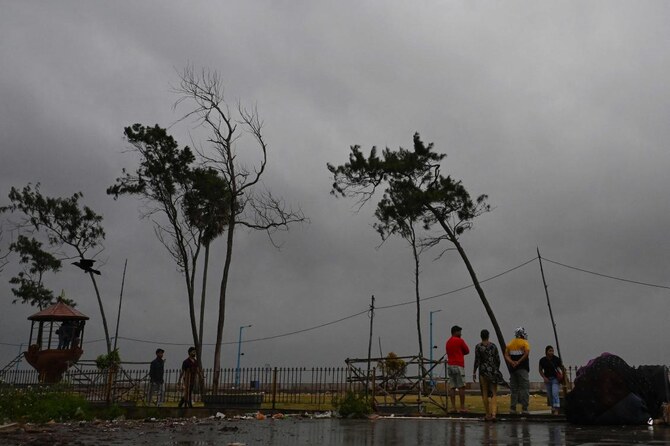
KOLKATA: Cyclone Dana uprooted trees and power lines after making landfall on India’s east coast, with officials warning of more fierce weather on Friday.
Cyclones — the equivalent of hurricanes in the North Atlantic or typhoons in the northwestern Pacific — are a regular and deadly menace in the northern Indian Ocean.
At least 1.1 million people in the states of Odisha and West Bengal were relocated to storm shelters before the eye of the cyclone reached the coast just after midnight.
District official Siddarth Swain said that the storm had left a “trail of destruction” in the coastal town of Puri.
“Many trees and electric poles are uprooted,” he added. “Makeshift shops on the sprawling beach have been blown away.”
No casualties have been reported so far.
Dana flooded parts of the coast after triggering a surge in sea levels of up to 1.15 meters (3.75 feet).
On landfall the storm had gusting winds up to 120 kilometers per hour, Kolkata-based weather bureau forecaster Somenath Dutta said.
The Sundarbans, the largest mangrove forest in the world, was hit by a “gale force wind” that caused hundreds of trees to be uprooted, West Bengal minister Bankim Chandra Hazra said.
“The cyclone also damaged hundreds of homes, blowing off roofs in coastal areas,” he added.
Major airports have been shut since Thursday night in Kolkata, India’s third-biggest city and a key travel hub, which was lashed by heavy rains.
Scientists have warned that storms are becoming more powerful as the world heats up due to climate change driven by burning fossil fuels.
Warmer ocean surfaces release more water vapor, which provides additional energy for storms, strengthening winds.
A warming atmosphere also allows storms to hold more water, boosting heavy rainfall.
But better forecasting and more effective evacuation planning have dramatically reduced death tolls.
In May, Cyclone Remal killed at least 48 people in India and at least 17 people in Bangladesh, according to government figures.


![]()

Trees and power lines flattened as Cyclone Dana hits India
Short Url
https://arab.news/z8e9m
Trees and power lines flattened as Cyclone Dana hits India
- Cyclones are a regular and deadly menace in the northern Indian Ocean
- At least 1.1 million people in the states of Odisha and West Bengal were relocated to storm shelters


Latest updates





© 2026 SAUDI RESEARCH & PUBLISHING COMPANY, All Rights Reserved And subject to Terms of Use Agreement.