

IMF official calls on international community to bring end to Lebanon conflict

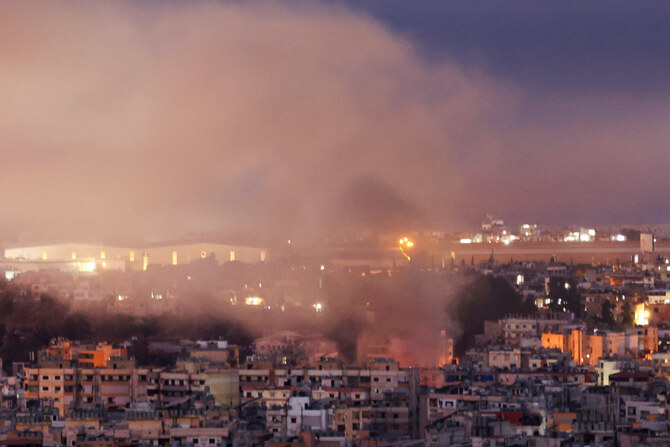
Smoke billows over Beirut's southern suburbs after an Israeli strike, as seen from Baabda, Lebanon, on October 22, 2024. (REUTERS)
Short Url
Updated 25 October 2024
Follow

IMF official calls on international community to bring end to Lebanon conflict

  • A recent United Nations Development report estimated that Lebanon’s GDP would be 9.2 percent smaller as a “direct consequence” of the conflict

WASHINGTON: The international community should work to end the conflict in the Middle East and address the “huge” humanitarian crisis that has engulfed countries in the region, the head of the IMF’s Middle East and Central Asia department said Thursday.
Jihad Azour spoke to AFP in Washington, where the annual meetings of the International Monetary Fund and the World Bank are currently taking place.
In updated economic estimates, the Fund slightly downgraded its outlook for economic growth in the Middle East and North Africa to 2.1 percent this year, while maintaining its 4.0 percent growth outlook for 2025.
However, these estimates do not take into account the economic impact of the recent escalation of conflict in southern Lebanon, where Israel has invaded to fight Hezbollah.
Azour, a former Lebanese finance minister, noted that the most severely affected places, including Lebanon and the Palestinian territories, were facing a “huge humanitarian problem” which has devastated their economies.
“You have massive loss in output, you have a massive destruction in infrastructure, and you have a huge set of needs for additional spending, for shelter, for health and so on,” he said.
“We expect that growth will be negative in those cases, and we expect that the recovery would take longer to materialize,” he added.
The IMF has suspended its forecasts for the Lebanese economy, citing an “unusually high degree of uncertainty.” But a recent United Nations Development report estimated that the country’s GDP would be 9.2 percent smaller as a “direct consequence” of the conflict.
“You have massive destruction of infrastructure in a large region, which is the south, and mass destruction of livelihood, because this is an agricultural region that was severely affected,” Azour said, adding that almost 20 percent of Lebanon’s population had been displaced.
“We encourage the international community, we encourage the friends of Lebanon, to provide grants,” he continued, calling on the international community “to put its utmost effort in order to solve the problem, in order to reduce the suffering of people.”

For countries indirectly affected by the conflict, like Jordan and Egypt, the impact of Israel’s ongoing military campaigns in Gaza and Lebanon has been felt differently.
While Egypt has been hit hard by a 70 percent fall in revenues from ships traversing the Suez Canal, Jordan’s economy has suffered from a steep decline in tourism, Azour said.
The IMF recently expanded an existing loan program with Egypt from $3 billion to $5 billion, in return for painful and wide-ranging economic reforms, including a shift to a more flexible exchange rate and an emphasis on tackling inflation and high debt levels.
Azour said that while the Fund was currently focused on helping countries in the region address immediate concerns, it also had a role to play in bringing the region together to help with post-conflict reconstruction.
“We think that there is a regional play here, whereby countries could trade and exchange more and can grow better together,” he said.


Afghan barbers under pressure as morality police take on short beards

Updated 57 min 9 sec ago
Follow

Afghan barbers under pressure as morality police take on short beards

KABUL: Barbers in Afghanistan risk detention for trimming men’s beards too short, they told AFP, as the Taliban authorities enforce their strict interpretation of Islamic law with increasing zeal.
Last month, the Ministry for the Propagation of Virtue and Prevention of Vice said it was now “obligatory” to grow beards longer than a fist, doubling down on an earlier order.
Minister Khalid Hanafi said it was the government’s “responsibility to guide the nation to have an appearance according to sharia,” or Islamic law.
Officials tasked with promoting virtue “are obliged to implement the Islamic system,” he said.
With ministry officials patrolling city streets to ensure the rule is followed, the men interviewed by AFP all spoke on condition of anonymity due to security concerns.
In the southeastern province of Ghazni, a 30-year-old barber said he was detained for three nights after officials found out that one of his employees had given a client a Western-style haircut.
“First, I was held in a cold hall. Later, after I insisted on being released, they transferred me to a cold (shipping) container,” he said.
He was eventually released without charge and continues to work, but usually hides with his clients when the patrols pass by.
“The thing is that no one can argue or question” the ministry officials, the barber said.
“Everyone fears them.”

 This photograph taken on February 11, 2026 shows an Afghan barber trimming a customer's hair along a sidewalk in Kabul. (AFP)

He added that in some cases where both a barber and clients were detained, “the clients have been let out, but they kept the barber” in custody.
Last year, three barbers in Kunar province were jailed for three to five months for breaching the ministry’s rules, according to a UN report.

‘Personal space’

Alongside the uptick in enforcement, the religious affairs ministry has also issued stricter orders.
In an eight-page guide to imams issued in November, prayer leaders were told to describe shaving beards as a “major sin” in their sermons.
The religious affairs ministry’s arguments against trimming state that by shaving their beards, men were “trying to look like women.”
The orders have also reached universities — where only men study because women have been banned.
A 22-year-old Kabul University student said lecturers “have warned us... that if we don’t have a proper Islamic appearance, which includes beards and head covering, they will deduct our marks.”

 This photograph taken on February 11, 2026 shows an Afghan barber trimming a customer's hair along a sidewalk in Kabul. (AFP)

In the capital Kabul, a 25-year-old barber lamented that “there are a lot of restrictions” which go against his young clients’ preference for closer shaves.
“Barbers are private businesses, beards and heads are something personal, they should be able to cut the way they want,” he said.
Hanafi, the virtue propagation minister, has dismissed such arguments, saying last month that telling men “to grow a beard according to sharia” cannot be considered “invading the personal space.”

Business slump

In Afghanistan, the majority are practicing Muslims, but before the Taliban authorities returned to power in 2021, residents of major cities could choose their own appearance.
In areas where Taliban fighters were battling US-backed forces, men would grow beards either out of fear or by choice.
As fewer and fewer men opt for a close shave, the 25-year-old Kabul barber said he was already losing business.
Many civil servants, for example, “used to sort their hair a couple of times a week, but now, most of them have grown beards, they don’t show up even in a month,” he said.
A 50-year-old barber in Kabul said morality patrols “visit and check every day.”
In one incident this month, the barber said that an officer came into the shop and asked: “Why did you cut the hair like this?“
“After trying to explain that he is a child, he told us: ‘No, do Islamic hair, not English hair’.”