JAKARTA: About 146 Rohingya, including children, came ashore in Indonesia’s North Sumatra province on Thursday, an official said, the second wave of arrivals to the Southeast Asian country within a week.
A boat carrying 64 men, 62 women and 20 children landed early on Thursday morning, in the Deli Serdang area of North Sumatra, Raphael Sandhy Cahya Priambodo, the head of regional police, told Reuters.
“The Rohingya were swimming from the boat to reach the shore,” Raphael said, adding they were temporarily placed in a local administration office.
“All of them survived and are now in a good condition.”
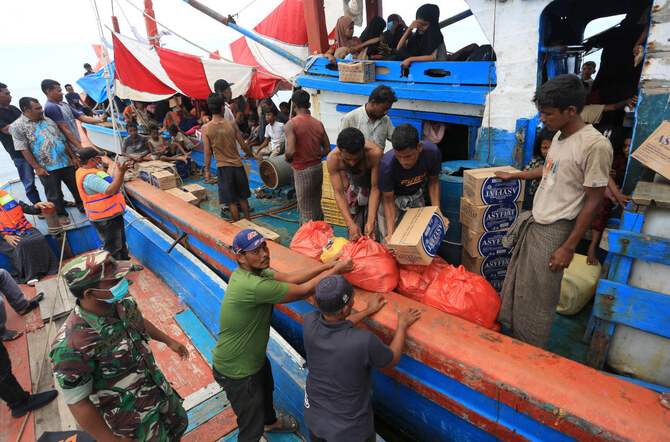
Their arrival came after another boat also carrying about 150 Rohingya, a minority group who have faced persecution in Myanmar, had been stranded in Indonesia’s Aceh province for a week after local residents refused to let it come ashore.
The boat, which arrived in Indonesian waters on Oct. 17, was finally allowed to land on Thursday, the head of fishing community in South Aceh Muhammad Jabal told Reuters, after an appeal from the UN refugee agency to the Indonesian government.
From October to April, when the seas are calmer, many Rohingya Muslims leave Myanmar on rickety boats for Thailand, Muslim-majority Indonesia, Malaysia and Bangladesh.
More than 2,300 Rohingya arrived in Indonesia last year, UNHCR data showed, more than the combined total of arrivals in the previous four years.
They have faced increasing rejection in Indonesia as locals grow frustrated at the number of arrivals.


![]()


Boats carrying Rohingya land in Indonesia’s North Sumatra and Aceh
Short Url
https://arab.news/656dz
Boats carrying Rohingya land in Indonesia’s North Sumatra and Aceh
- A boat carrying 64 men, 62 women and 20 children landed early on Thursday morning, in the Deli Serdang area of North Sumatra, Raphael Sandhy Cahya Priambodo, the head of regional police, told Reuters


Costa Rica’s Grynspan pledges reform in bid for UN chief job
GENEVA: Rebeca Grynspan is upbeat about her chances of becoming the next head of the United Nations, which she insists must become more agile in tackling the world’s crises.
The Costa Rican former vice president said she wanted to rebuild global trust in the United Nations if she becomes its next secretary-general.
“We are very optimistic. I think that I am more than a viable candidate,” Grynspan said on Friday, her last working day before stepping aside as head of the UN trade and development agency UNCTAD to focus on her campaign.
The second term of current UN chief Antonio Guterres expires at the end of the year.
“My profile is right for this moment. I know the UN enough to reform it and enough to defend it,” she told the UN correspondents’ association ACANU.
“I have a lot of experience in my political life, taking decisions under a lot of stress and in complex situations. I have been in the highest positions in the UN.”
It is Latin America’s turn next for the top UN job and two other candidates are running: former Chilean president Michelle Bachelet, and Rafael Grossi, the Argentinian head of the International Atomic Energy Agency.
Founded in 1945, the UN has never had a woman secretary-general.
Grynspan, an economist, is not looking to be chosen on that basis.
“I don’t need any favors to be elected for the secretary-general; I just need people not to discriminate me for being a woman,” the 70-year-old said.
“If the competition will be fair, with no biases, I will make it. I have the CV; I have the merits.”
- Rebuilding trust -
Last month, Guterres warned that the UN was facing financial collapse and could run out of cash by July, with member states neither paying in full nor or time.
“The UN has to change,” said Grynspan.
There are far greater capacities in civil society and the private sector than in 1945, “and we need to be able to harness that: we don’t have to do everything in the UN.”
As for peace and security, “prevention and mediation are essential. But they need agility and flexibility from the structures of the UN. And I don’t think we have that right now.”
US President Donald Trump has slashed funding to some UN agencies and has repeatedly questioned the UN’s relevance and attacked its priorities, setting up his own “Board of Peace.”
“The UN is unique because it’s the only legitimate, universal organization,” said Grynspan.
“We need to rebuild trust with the member states. We need to regain the belief that the UN is useful to solve problems,” she said, vowing to bring her personal qualities to the task.
“I am able to reach to people not only with logic, but also with inspiration, optimism and hope,” she said.
“We need more of that too, because we need to connect again much more with people. We will need to conquer the hearts and minds again.”
- Leadership style -
The UNCTAD chief said her leadership style revolved around being “direct, honest, and evidence-based... There have to be reasons, not only emotions.”
Grynspan recounted that her parents, who were from Poland, “barely survived” World War II. Her maternal grandparents were killed in the Holocaust.
Her parents went “with nothing” to Costa Rica, a country that “allowed them to have a good life.”
“Costa Rica has taught me a lot. It’s a country that I not only love dearly, but I admire,” she said.
“I am not an impetuous person. I think things through. I have the serenity not to lose it under tension and under pressure. I consult. I hear. And I am brave. I take risks.”
rjm/ceg
The Costa Rican former vice president said she wanted to rebuild global trust in the United Nations if she becomes its next secretary-general.
“We are very optimistic. I think that I am more than a viable candidate,” Grynspan said on Friday, her last working day before stepping aside as head of the UN trade and development agency UNCTAD to focus on her campaign.
The second term of current UN chief Antonio Guterres expires at the end of the year.
“My profile is right for this moment. I know the UN enough to reform it and enough to defend it,” she told the UN correspondents’ association ACANU.
“I have a lot of experience in my political life, taking decisions under a lot of stress and in complex situations. I have been in the highest positions in the UN.”
It is Latin America’s turn next for the top UN job and two other candidates are running: former Chilean president Michelle Bachelet, and Rafael Grossi, the Argentinian head of the International Atomic Energy Agency.
Founded in 1945, the UN has never had a woman secretary-general.
Grynspan, an economist, is not looking to be chosen on that basis.
“I don’t need any favors to be elected for the secretary-general; I just need people not to discriminate me for being a woman,” the 70-year-old said.
“If the competition will be fair, with no biases, I will make it. I have the CV; I have the merits.”
- Rebuilding trust -
Last month, Guterres warned that the UN was facing financial collapse and could run out of cash by July, with member states neither paying in full nor or time.
“The UN has to change,” said Grynspan.
There are far greater capacities in civil society and the private sector than in 1945, “and we need to be able to harness that: we don’t have to do everything in the UN.”
As for peace and security, “prevention and mediation are essential. But they need agility and flexibility from the structures of the UN. And I don’t think we have that right now.”
US President Donald Trump has slashed funding to some UN agencies and has repeatedly questioned the UN’s relevance and attacked its priorities, setting up his own “Board of Peace.”
“The UN is unique because it’s the only legitimate, universal organization,” said Grynspan.
“We need to rebuild trust with the member states. We need to regain the belief that the UN is useful to solve problems,” she said, vowing to bring her personal qualities to the task.
“I am able to reach to people not only with logic, but also with inspiration, optimism and hope,” she said.
“We need more of that too, because we need to connect again much more with people. We will need to conquer the hearts and minds again.”
- Leadership style -
The UNCTAD chief said her leadership style revolved around being “direct, honest, and evidence-based... There have to be reasons, not only emotions.”
Grynspan recounted that her parents, who were from Poland, “barely survived” World War II. Her maternal grandparents were killed in the Holocaust.
Her parents went “with nothing” to Costa Rica, a country that “allowed them to have a good life.”
“Costa Rica has taught me a lot. It’s a country that I not only love dearly, but I admire,” she said.
“I am not an impetuous person. I think things through. I have the serenity not to lose it under tension and under pressure. I consult. I hear. And I am brave. I take risks.”
rjm/ceg
Latest updates


© 2026 SAUDI RESEARCH & PUBLISHING COMPANY, All Rights Reserved And subject to Terms of Use Agreement.