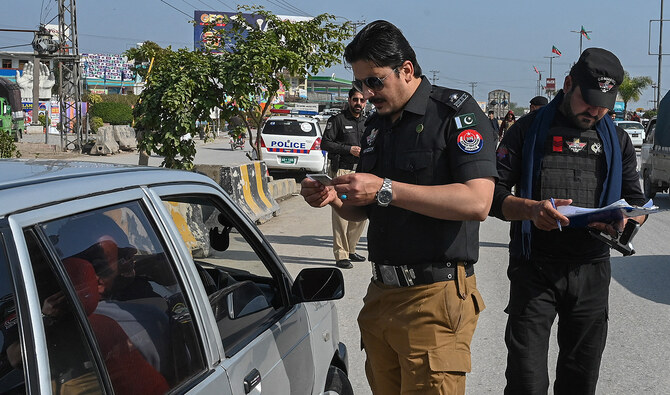
PESHAWAR: Pakistan’s Khyber Pakhtunkhwa (KP) government has decided to bolster security in the northwestern province bordering Afghanistan by creating an additional 1,356 police positions, the chief minister’s office said on Wednesday, amid a surge in militant attacks targeting police and law enforcers in recent months.
Over 82 policemen have been killed in attacks, ambushes and targeted killings in KP province so far this year, according to official data. Pakistan has seen a surge in militant attacks in the province ever since its fragile truce with the Tehreek-e-Taliban Pakistan, or the Pakistani Taliban broke down in November 2022.
Unidentified gunmen on Tuesday shot dead constable Mansoor Khan in his hometown Lakki Marwat district, police said. Meanwhile, attacks targeting police sparked protests in the province’s Lakki Marwat and Bannu districts last month.
“In view of the current law and order situation, 1356 new police posts of various ranks have been created for southern districts [of KP],” the CM Office said after Chief Minister Ali Amin Gandapur chaired a meeting related to the province’s police matters.
“Of these, 1200 the recruitment process of constables is in its final stages and appointment letters will be issued soon.”
Apart from constables, the new hirings would include sub-inspectors, assistant sub-inspectors and head constables, the statement said. It added that the quota for the recruitment of slain police officers’ children had been increased from 5 percent to 12.5 percent.
Gandapur told senior police officials at the meeting that strengthening the police force and stabilizing the law and order situation in the province was his government’s topmost priority.
“All resources will be provided on a priority basis to enable the police force to deal with the current situation,” the chief minister was quoted as saying.
‘SERIOUS SECURITY DYNAMICS’
Syed Akhtar Ali Shah, a security analyst and former inspector-general of police, described the move as a “commendable” one for the long run but said the province required an immediate solution to its security woes.
“The new recruitment of police officers is a long-drawn process while the province is in urgent need to combat militant attacks,” Shah told Arab News.
“Trained police officers should be deputed on the newly created posts which will help fill the vacuum,” he added.
Shah said the northwestern province was facing “different and serious security dynamics” which were completely different from organized crimes.
He called on provincial authorities to mobilize other forces, such as the paramilitary Frontier Constabulary (FC) and Frontier Reserve Police (FRP) forces, saying they would enable police to operate from an offensive position rather than a defensive one.
“Similarly, along with new recruitments, different departments need close liaison and seamless coordination with the backing of strong intelligence,” Shah said. “This way, we will be able to control the situation.”


![]()

Pakistan’s KP province to recruit over 1350 new cops to tackle surging militancy
Short Url
https://arab.news/4sr6x
Pakistan’s KP province to recruit over 1350 new cops to tackle surging militancy
- Militants have killed over 82 policemen through various attacks in Khyber Pakhtunkhwa this year
- Security analyst appreciates move but says province in dire need of urgent remedy to security woes
Latest updates


© 2026 SAUDI RESEARCH & PUBLISHING COMPANY, All Rights Reserved And subject to Terms of Use Agreement.