Pakistan says ‘about time’ concrete steps are taken to operationalize loss and damage fund

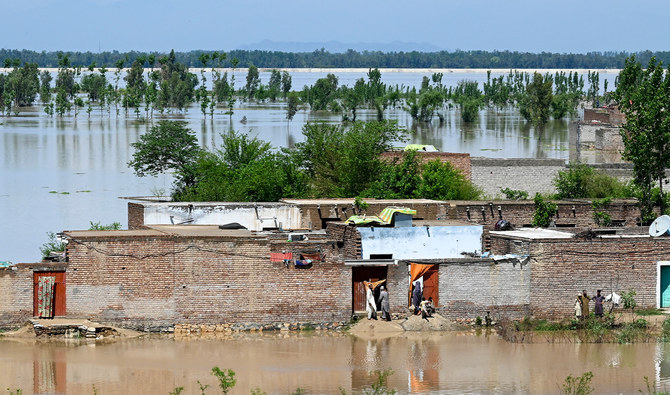
People stand at their deluged houses after heavy rains in Nowshera district, Khyber-Pakhtunkhwa province on April 16, 2024. (AFP/File)
Short Url
Updated 23 October 2024
Follow

Pakistan says ‘about time’ concrete steps are taken to operationalize loss and damage fund

  • Finance Minister Muhammad Aurangzeb attends Vulnerable Twenty (V20) Group meeting in United States
  • Fund compensates developing countries for losses and damages due to natural disasters triggered by climate change

ISLAMABAD: Pakistan’s Finance Minister Muhammad Aurangzeb this week urged the international community to take “concrete steps” to ensure the climate loss and damage fund is operationalized, warning that countries were falling into debt traps due to natural disasters.
Pakistan joined hands with other developing nations in 2022 at a major climate conference, COP27, in Egypt, to call for the Loss and Damage Fund to mitigate the impacts of climate-induced disasters. While the fund was set up, developing and developed countries have been at odds over questions on which entity should oversee the fund, who should pay and which countries would be eligible to receive funding.
Pakistan’s efforts followed the disastrous floods of 2022 in which over 1,700 people were killed and critical infrastructure was damaged, costing Islamabad over $30 billion after unusually heavy monsoon rains wreaked havoc in the country.
“Loss & damage fund was discussed but it is about time concrete steps are taken to operationalize it,” Aurangzeb was quoted as saying by the Climate Vulnerable Forum (CVF).
The Pakistani minister was speaking during a meeting of the Vulnerable Twenty (V20) Group, which comprises the finance ministers of the CVF, a dedicated cooperation initiative by economies vulnerable to climate change. The V20 works through dialogue and action to tackle global climate change.
Pakistan has repeatedly urged the international community to ensure a fair deal in assisting developing countries such as itself in coping with the adverse impacts of climate change, warning that loans for this purpose were debt traps or “death traps.”
“There is an urgent need to reform global finance to make debt work for climate,” Aurangzeb noted. “Countries may be getting into a climate debt trap.”
The finance minister announced Pakistan was developing its Climate Prosperity Plan, the Associated Press of Pakistan (APP) said, without sharing its details.
Aurangzeb is in the United States to attend the annual International Monetary Fund (IMF) and World Bank meetings from Oct. 21-26. Leading the Pakistani delegation, he has met counterparts from several countries and senior IMF officials, briefing them about Pakistan’s macroeconomic reforms related to energy, tax and state-owned enterprises.


Pakistan high court pauses tree-cutting in Islamabad until Feb. 2

Updated 10 sec ago
Follow

Pakistan high court pauses tree-cutting in Islamabad until Feb. 2

  • Islamabad High Court asks CDA to ‘explain and justify’ tree-cutting at next hearing
  • CDA officials say 29,000 trees were cut due to allergies, deny felling in green belts

ISLAMABAD: The Islamabad High Court has ordered an immediate halt to tree-cutting in the federal capital until Feb. 2, seeking justification from civic authorities over the legality of a large-scale felling drive that has seen thousands of trees removed in recent months.

The interim order, issued by a single-judge bench led by Justice Khadim Hussain Soomro, came during proceedings on a petition challenging the Capital Development Authority’s (CDA) tree-cutting operations in Islamabad’s Shakarparian area and H-8 sector.

At the outset of the hearing, the petitioner’s counsel argued that trees were being felled in violation of the Pakistan Environmental Protection Act 1997, the Islamabad Wildlife Ordinance 1979 and the city’s master plan.

“Respondents shall not cut trees till the next date of hearing,” Justice Soomro said in the court order released on Friday while referring to CDA officials.

“Respondents are directed to come fully prepared and to file paragraph-wise comments before the next date of hearing, along with a comprehensive report explaining the justification and legal basis for the cutting of trees,” he added.

According to the court order, the petitioner maintained that the CDA had not made any public disclosure regarding the legal basis for the operation and that the felling was causing environmental harm.

The petition sought access to the official record of tree-cutting activities and called for the penalization of CDA officials responsible for the act under relevant criminal and environmental laws.

It also urged the court to impose a moratorium on infrastructure projects in Islamabad, order large-scale replanting as compensation and constitute a judicial commission headed by a retired Supreme Court judge to probe the alleged violations.

CDA officials acknowledge around 29,000 paper mulberry trees have been cut in the capital in recent months, arguing that the species triggers seasonal allergies such as sneezing, itchy eyes and nasal congestion.

They also maintain that no trees have been removed from designated green belts and that the number of replacement trees planted exceeds those felled.

Designed in the 1960s by Greek architect Constantinos Doxiadis, Islamabad was conceived as a low-density city with green belts and protected natural zones at its core.

Critics, however, say the recent felling has extended beyond paper mulberry trees and question whether authorities are adhering to the city’s master plan and the legal protections governing forested and green areas.

The court has adjourned its hearing until Feb. 2, 2026.