



RIYADH: Industrial policies pursued in isolation could lead to supply chain issues and fragmentation across the sector, a top Saudi official has warned.
Speaking at the two-day Multilateral Industrial Policy Forum in Riyadh, the Kingdom’s Minister of Industry and Mineral Resources, Bandar Alkhorayef, said International partnerships and deep cooperation are required to achieve goals in the industrial sector and create employment opportunities.
The second edition of MIPF comes as the Kingdom works on its National Industrial Strategy, which aims to build a sector that attracts investment, enhances economic diversification, and develops its gross domestic product and non-oil exports.
“We all share common imperatives. We must strengthen resilience, national security, build competitive advantages and prepare for the jobs of the future, driven by the rapid transformation of the industrial sector. No country can achieve these global goals alone. International partnerships and deep cooperation across sectors are essential,” said Alkhorayef.
He added: “However, the formation of these partnerships is becoming increasingly challenging as industrial strategies pursued in isolation can lead to further fragmentation and instability in the global supply chain, undermining opportunities for growth opportunities for growth.”
During his speech, Alkhorayef said that governments have a crucial role in fostering the industrial sector by strengthening human capital and developing regulations that encourage innovation and investments, both in the physical space and digital infrastructure.
“By aligning our policies and fostering synergy, we can complement each other’s strengths, create more resilience by change, and open new market opportunities. We also can learn from each other’s best practices. We can address common challenges and build a stronger industrial landscape,” said the minister.
He added that Saudi Arabia’s industrial sector has undergone a significant transformation, and it has become more diverse with the Kingdom providing more opportunities to private entities and small and medium enterprises.
“This evolving landscape fosters research, development and innovation, ensuring sustainable growth of the sector,” said Alkhorayef.
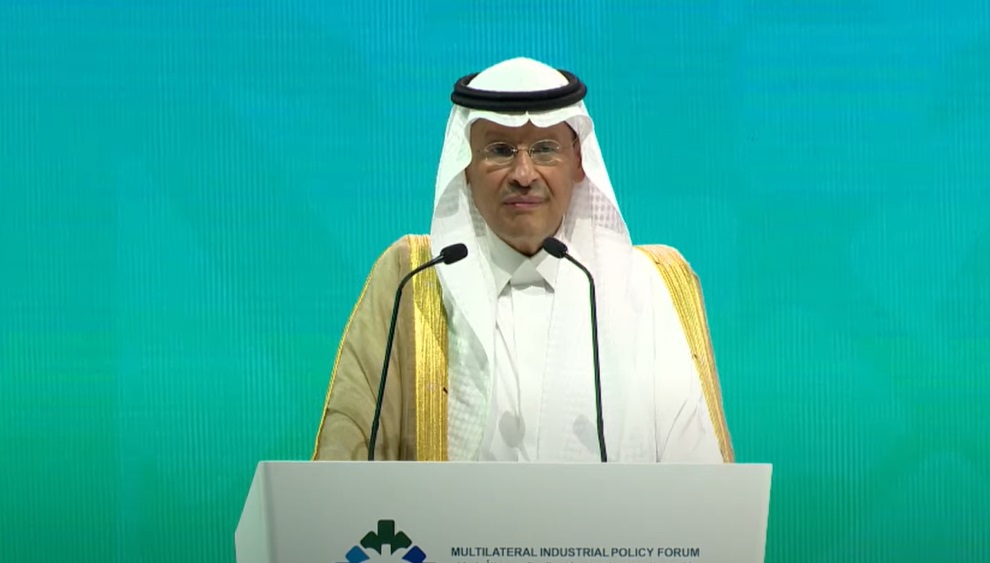
Prince Abdulaziz bin Salman, Saudi Arabia’s energy minister. AN
During the same event, Prince Abdulaziz bin Salman, Saudi Arabia’s energy minister, said that the international economy is currently facing considerable challenges due to geopolitical tensions, which could ultimately affect the global supply chain.
The minister added that developing nations are more vulnerable to supply chain issues than developed countries.
“I honestly believe that the biggest victim of this supply chain issue will be the least developing nations,” said the energy minister.
During his speech, Prince Abdulaziz also highlighted that Saudi Arabia is pursuing its industrial advancement journey in a sustainable manner. He also discussed the various measures taken by the Kingdom to ensure a green future.
“We’re engaged in so many things, including carbon capture, gas and renewables. We are doing everything to reduce greenhouse gas emissions; this will help the industry in achieving the sustainability of ambitions and enhance energy system resilience while supporting the National Industrial Strategy,” said Prince Abdulaziz.
He added: “The Kingdom is also developing policies and regulations that are instrumental in new energy sectors, such as clean hydrogen. We have introduced policies to improve energy efficiency that they said, and enhance feedstock utilization, particularly in energy-intensive sectors.”
Gerd Muller, director general of the UN Industrial Development Organization, told the forum that global challenges, including population growth and food scarcity, could only be resolved by implementing sustainable industrialization.
“Industry is not the problem. Industry is a key part of the solution to reach our sustainable development goals. Sustainable industrialization is needed for job creation, economic growth, and fighting poverty and capital creation. It provides an answer to the challenges of growing population and increasing food and energy demand,” said Muller.
The UNIDO director general added that the second edition of MIPF is not about simply conveying challenges. Instead, the event will concentrate on sharing solutions.
Muller also underscored the importance of having a robust and transparent industrial strategy for every country to accelerate sustainable progress in this sector.
“A clear industrial strategy in every country is a framework for investments, as well as political and legal stability and peace. Moreover, huge investments are necessary over the next decade in infrastructure, technology and education. It is clear, without investments, there is no industrialization,” he said.
Lauding Saudi Arabia’s green initiatives, the UNIDO official added that the world requires innovative solutions to foster economic growth and maintain lower emissions.
“We need a green transition in industry, energy and agriculture, promoting decarbonization and carbon capture technologies, investing in renewable energies such as green hydrogen and circular economy,” Muller said.


