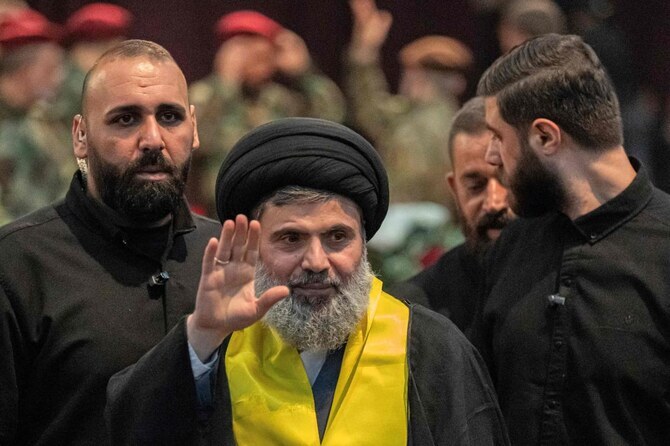
JERUSALEM: Israel’s army confirmed Tuesday it “eliminated” Hezbollah’s Hashem Safieddine, apparent successor of slain leader Hassan Nasrallah, in a strike in a southern Beirut suburb three weeks ago.
“It can now be confirmed that in an attack approximately three weeks ago, Hashem Safieddine, the head of Hezbollah’s Executive Council, and Ali Hussein Hazima, the head of Hezbollah’s Intelligence Directorate, were killed along with other Hezbollah commanders,” the army said in a statement.
Hezbollah has not yet issued a statement regarding the claim.
On October 8, Israeli Prime Minister Benjamin Netanyahu said that the military has “taken out” Safieddine, without specifically naming him.
In an address to the people of Lebanon, Netanyahu said Israeli forces “took out thousands of terrorists, including (Hezbollah leader Hassan) Nasrallah himself and Nasrallah’s replacement and the replacement of his replacement.”
Late on Tuesday, the army said that Israel’s air force “conducted a precise, intelligence-based strike on Hezbollah’s main intelligence headquarters,” in the southern Beirut suburb of Dahiyeh, Hezbollah’s stronghold in the Lebanese capital three weeks ago.
The statement added that over 25 Hezbollah militants were present in the headquarters during the strike, “including Bilal Saib Aish, who was in charge of aerial intelligence gathering.”
A member of Hezbollah’s decision-making body and a distant relative of Nasrallah, Safieddine was out of contact since Israeli strikes on Beirut weeks ago, a high-level Hezbollah source said at the time.
A source close to Hezbollah told AFP in early October that the deeply religious cleric Safieddine, who had good relations with Hezbollah backer Iran, was the “most likely” candidate for the party’s top job.
Grey-bearded and bespectacled, Safieddine bore a striking resemblance to his distant cousin Nasrallah, but was several years his junior, aged in his late 50s or early 60s.
“We have reached Nasrallah, his replacement and most of Hezbollah’s senior leadership,” the Israeli army’s chief Lt. Gen. Herzi Halevi said in a statement late on Tuesday after the confirmation of Safieddine’s death.
After nearly a year of war with Palestinian Islamist movement Hamas in Gaza, Israel shifted its focus to Lebanon in late September, vowing to secure its northern border threatened by cross-border fire from Hamas’s Lebanese ally Hezbollah.
Israel ramped up its air strikes on Hezbollah strongholds around the country and sent in ground troops late last month, in a war that has killed at least 1,552 people since September 23, according to an AFP tally of Lebanese health ministry figures.
The Israeli military issued new calls for residents to evacuate areas in the southern suburbs of capital Beirut on Tuesday evening, warning of imminent attacks.
In recent days the military has targeted Hezbollah’s financial assets across the country.
Hezbollah, meanwhile, has continued to fire rockets and missiles at Israel.
“As of 23:00 (2000 GMT), approximately 140 projectiles that were fired by the Hezbollah terrorist organization have crossed from Lebanon into Israel today,” the military said in a statement late on Tuesday.


![]()

Israel confirms killing Hashem Safieddine, potential successor of slain Hezbollah chief Nasrallah
Short Url
https://arab.news/nuakw
Israel confirms killing Hashem Safieddine, potential successor of slain Hezbollah chief Nasrallah
- The Israeli army also confirmed the killing of Ali Hussein Hazima, the head of Hezbollah’s Intelligence Directorate


Latest updates


© 2026 SAUDI RESEARCH & PUBLISHING COMPANY, All Rights Reserved And subject to Terms of Use Agreement.