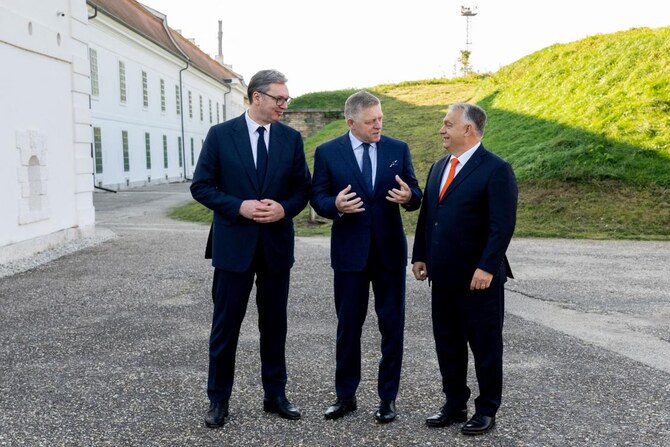
KOMARNO, Slovakia: Hungary, Slovakia and Serbia will continue joint efforts to curb illegal migration into the European Union, their leaders said on Tuesday, adding that more EU funds were needed.
Meeting in Komarno, Slovakia, on the Hungarian border, the leaders recognized their efforts to cut the number of migrants, mainly from the Middle East and Africa, who have come via the so-called Balkan route that passes through Serbia and into the EU via Hungary.
Migrants typically move on to richer countries in western Europe, like Germany.
“This year, there are 80 percent fewer migrants (in Serbia) than last year,” Serbian President Aleksandar Vucic said after meeting his Slovak and Hungarian counterparts Robert Fico and Viktor Orban.
“We will continue to work together and I believe that the results will be good.”
Illegal migration remains a key political problem across Europe nearly a decade after the crisis in 2015, when around 1 million people arrived in the bloc. Arrivals last year were around a third of that figure.
Orban said asylum applications must be assessed before someone is allowed to enter the EU, saying this model, used in Hungary, was the only one that worked against illegal migration.
Hotspots set up in the last safe countries for migrants, for example in Africa, could be a mass solution, he said.
Italy last week began working with EU non-member Albania by sending migrants there to have their asylum requests processed, a scheme to deter boat crossings which other EU leaders have said could be a model.
Vucic said Serbia, which is not an EU member, would never agree to create hotspots for illegal migrants on its territory.
The number of illegal crossings in the western Balkans fell 79 percent year-on-year to just under 17,000 in the first nine months of 2024, according to data from border agency Frontex.
Fico, who hosted the summit, called the fight against illegal migration an absolute priority and said illegal migration had negative effects on Europe.
“It was a topic of discussion today that in planning the next EU budget after 2027 we have to insist that a substantial part of the budget needs to be devoted to fight illegal migration, because it is seriously threatening us,” he said.


![]()

Hungary, Slovakia, Serbia vow to carry on fight against illegal migration
Short Url
https://arab.news/98kwf
Hungary, Slovakia, Serbia vow to carry on fight against illegal migration
- The leaders recognized their efforts to cut the number of migrants, mainly from the Middle East and Africa
- Migrants typically move on to richer countries in western Europe, like Germany


Latest updates





Recommended


© 2026 SAUDI RESEARCH & PUBLISHING COMPANY, All Rights Reserved And subject to Terms of Use Agreement.