WASHINGTON: Global finance chiefs will gather in Washington this week amid intense uncertainty over wars in the Middle East and Europe, a flagging Chinese economy and worries that a coin-toss US presidential election could ignite new trade battles and erode multilateral cooperation.
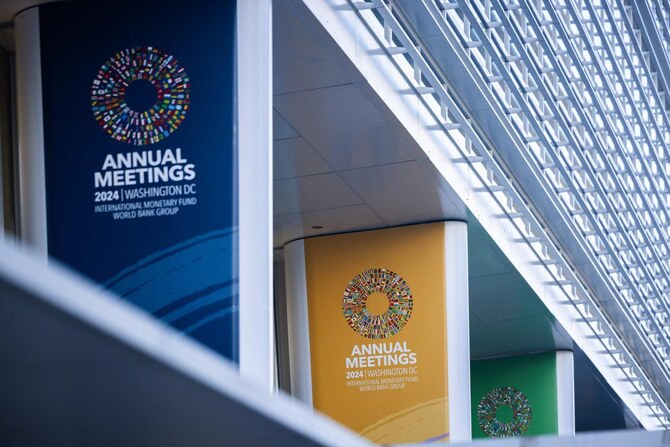
The International Monetary Fund and World Bank annual meetings are scheduled to draw more than 10,000 people from finance ministries, central banks and civil society groups to discuss efforts to boost patchy global growth, deal with debt distress and finance the green energy transition.
But the elephant in the meeting rooms will be the potential for a Nov. 5 election victory by US Republican presidential candidate Donald Trump to upend the international economic system with massive new US tariffs and borrowing and a shift away from climate cooperation.
“Arguably the most important issue for the global economy — the outcome of the US election — is not on the official agenda this week, but it’s on everyone’s mind,” said Josh Lipsky, a former IMF official who now heads the Atlantic Council’s GeoEconomics Center.
The election “has huge implications on trade policy, on the future of the dollar, on who the next Federal Reserve chair is going to be, and all of those impact every country in the world,” he added.
US Vice President Kamala Harris, the Democratic presidential candidate, is largely expected to continue the Biden administration’s resumption of multilateral cooperation on climate, tax and debt relief issues if she wins next month’s vote.
The meetings, which start on Monday and get into full swing later in the week, will likely be the last for US Treasury Secretary Janet Yellen, who spearheaded much of the Biden administration’s multilateral economic and climate efforts. Yellen has said she is “probably done” with public service at the end of President Joe Biden’s term in office in January.
But growing anti-China trade sentiment and industrial policy plans from wealthy countries, punctuated by the Biden administration’s steep tariff increases on Chinese electric vehicles, semiconductors and solar products, is expected to be a key discussion topic at the meetings.
Lackluster growth
The IMF will update its global growth forecasts on Tuesday. IMF Managing Director Kristalina Georgieva last week flagged a lackluster outlook, saying the world, saddled by high debts, was headed for slow medium-term growth, and pointing to a “difficult future.”
Still, Georgieva said she was “not super-pessimistic” about the outlook, given pockets of resilience, notably in the US and India that are offsetting continued weakness in China and Europe.
While debt defaults among poor countries may have peaked, participants at the annual meetings are expected to discuss the growing problem of scarce liquidity that is forcing some emerging markets saddled with high debt service costs to delay development investments as overseas aid shrinks.
Last year’s IMF and World Bank annual meetings got underway in Morocco as the Palestinian militant group Hamas attacked Israel, killing more than 1,200 people and unleashing conflicts with a death toll of more than 40,000 Gazans, according to Palestinian health authorities.
The economic damage has been largely limited to economies in or adjacent to the conflict: Gaza, the West Bank, Israel, Lebanon, Egypt and Jordan.
“If there was to be an escalation that puts at risk oil and gas delivery, that could have much more significant spillover for the world economy,” Georgieva told Reuters in an interview.
Support for Ukraine also will be a major topic at the meetings, as the G7 wealthy democracies aim to reach a political agreement by the end of October for a $50 billion loan for the Eastern European country backed by frozen Russian sovereign assets. The loan in part is seen as a financial bulwark against a Trump victory next month, as the former US president has threatened to “get out of Ukraine.”
Despite the wall of worry, World Bank and IMF officials intend to spend the week concentrating on the work at hand at the meetings, which coincide with the 80th anniversary of the institutions’ founding in 1944 at Bretton Woods, New Hampshire.
For World Bank President Ajay Banga, that means finding ways to speed up the preparations of projects to use the bank’s expanded lending capacity and refining a new scorecard aimed at improving development outcomes.
“The world is the world right now. And rather than use the meetings to go over what we already seem to know — which is to admire the problem — I’d like to take the annual meetings to doing something about what we can do as institutions,” Banga told reporters last week.


![]()

IMF, World Bank meetings clouded by wars, slow economic growth, US election
Short Url
https://arab.news/bn5fs
IMF, World Bank meetings clouded by wars, slow economic growth, US election
- US election could reshape trade, climate policies
- Anti-China trade sentiment is key topic at meetings


Latest updates



© 2026 SAUDI RESEARCH & PUBLISHING COMPANY, All Rights Reserved And subject to Terms of Use Agreement.