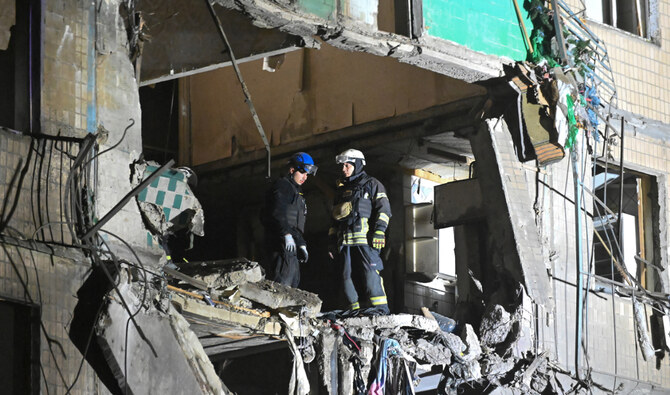
KYIV: Russian strikes late Sunday on the northeast city of Kharkiv wounded nine people and cut power to part of the city, local officials and police said.
The latest barrage came as Ukrainian officials prepare for a new wave of bombardments they think will target the country’s energy network ahead of winter, as Moscow has done the last two years.
Russia has targeted the country’s power supplies to make the harsh winter harder to endure for the country’s civilian population in an effort to put more pressure on the authorities.
Police said in a statement on Telegram that Russia had launched strikes at around 10:00 p.m. (1900 GMT) injuring four women and five men.
Among the buildings hit were residential buildings, garages, service stations, houses and cars, the statement added.
Medical services were mobilized to help the injured, but the strikes cut power to parts of the city, said police.
Governor of the region and city mayor Oleg Synegubov confirmed in a Telegram post that part of the city was without power.
Neither he, nor the police, said how much of the city had been affected by the power cuts, nor which part of the power network had been hit.
Kharkiv, the main city of the northeast region of the same name, is a regular target of Russian strikes. It lies less than 30 kilometers (19 miles) from the Russian border.
In May, Russia’s army tried to push forward in this border region, officially to create a buffer zone to limit Ukrainian attacks against military and industrial targets on Russian soil.
But the offensive has not succeeded in stopping Kyiv from targeting Russian territory on a daily basis.

Nine wounded in Russian strikes on Ukraine’s Kharkiv: local officials
Short Url
https://arab.news/j8zp5
Nine wounded in Russian strikes on Ukraine’s Kharkiv: local officials
Thousands in Kosovo march against war crimes trials on 18th anniversary of independence declaration
- Protesters, many wrapped in red and black Albanian flags, braved cold and snowy weather in the capital, Pristina, to voice their opposition to the proceedings in The Hague
- PM Albin Kurti added that ‘the KLA-led war was pure, liberation (struggle) and an anti-colonial war ... a just struggle of an occupied and oppressed people under apartheid’
PRISTINA, Kosovo: An air of defiance marked Kosovo’s independence celebrations on Tuesday as thousands of people joined a march in support of former fighters who are facing trial at a Netherlands-based court for alleged war crimes during a 1998-1999 separatist war from Serbia.
Protesters, many wrapped in red and black Albanian flags, braved cold and snowy weather in the capital, Pristina, to voice their opposition to the proceedings in The Hague against former president and rebel leader Hashim Thaci and three others accused of atrocities during and after the conflict that killed some 13,000 people.
Earlier on Tuesday, Kosovo’s security forces paraded in Pristina as part of the independence ceremonies, and Parliament held a special session.
The war started in 1998 when the rebel Kosovo Liberation Army launched its struggle for independence and Serbia responded with a brutal crackdown. The war ended after NATO bombed Serbia for 78 days in 1999, eventually forcing it to pull out its troops from the territory.
Serbia still does not recognize the 2008 declaration of independence of Kosovo and this has been a source of persistent tension in the volatile Balkan region. As both Kosovo and Serbia seek European Union membership, they have been told they must normalize ties before joining.
Prosecutors at the Kosovo Specialist Chambers in The Hague — which formally is part of Kosovo’s judicial system although seated abroad — have asked for a maximum 45-year prison sentence for Thaci and the other defendants. Thaci also faces a separate trial on charges of intimidating witnesses that will begin later this month.
Officials and protesters in Kosovo have criticized the proceedings as political and designed to strike a false balance with Serbia whose political and military leaders previously had been tried and convicted of war crimes in Kosovo by a separate UN court.
Protesters at Tuesday’s march held banners reading “History cannot be rewritten” and “Freedom for the liberators.” They arranged metal fences around a landmark independence monument and placed a sign reading ”Kosovo in Prison” on top of it.
President Vjosa Osmani said in a statement that “truth cannot be changed by attempts to rewrite history or to tarnish and devalue the struggle of Kosovo’s people for freedom.”
Prime Minister Albin Kurti added that “the KLA-led war was pure, liberation (struggle) and an anti-colonial war ... a just struggle of an occupied and oppressed people under apartheid.”
In Belgrade, a Serbian government liaison office for Kosovo described the independence declaration 18 years ago as a “flagrant violation of international law.” The statement alleged “systematic terror” and persecution against minority Serbs in Kosovo.
The United States and most EU countries are among more than 100 nations that have recognized Kosovo’s independence while Russia and China have backed Serbia’s claim on the territory.
Thaci resigned from office in 2020 to defend himself against the 10 charges of crimes against humanity and war crimes.
The court and an associated prosecutor’s office were created after a 2011 report by the Council of Europe, a human rights body, following allegations that KLA fighters trafficked human organs taken from prisoners and killed Serbs and fellow ethnic Albanians. The organ harvesting allegations haven’t been included in indictments issued by the court.
Protesters, many wrapped in red and black Albanian flags, braved cold and snowy weather in the capital, Pristina, to voice their opposition to the proceedings in The Hague against former president and rebel leader Hashim Thaci and three others accused of atrocities during and after the conflict that killed some 13,000 people.
Earlier on Tuesday, Kosovo’s security forces paraded in Pristina as part of the independence ceremonies, and Parliament held a special session.
The war started in 1998 when the rebel Kosovo Liberation Army launched its struggle for independence and Serbia responded with a brutal crackdown. The war ended after NATO bombed Serbia for 78 days in 1999, eventually forcing it to pull out its troops from the territory.
Serbia still does not recognize the 2008 declaration of independence of Kosovo and this has been a source of persistent tension in the volatile Balkan region. As both Kosovo and Serbia seek European Union membership, they have been told they must normalize ties before joining.
Prosecutors at the Kosovo Specialist Chambers in The Hague — which formally is part of Kosovo’s judicial system although seated abroad — have asked for a maximum 45-year prison sentence for Thaci and the other defendants. Thaci also faces a separate trial on charges of intimidating witnesses that will begin later this month.
Officials and protesters in Kosovo have criticized the proceedings as political and designed to strike a false balance with Serbia whose political and military leaders previously had been tried and convicted of war crimes in Kosovo by a separate UN court.
Protesters at Tuesday’s march held banners reading “History cannot be rewritten” and “Freedom for the liberators.” They arranged metal fences around a landmark independence monument and placed a sign reading ”Kosovo in Prison” on top of it.
President Vjosa Osmani said in a statement that “truth cannot be changed by attempts to rewrite history or to tarnish and devalue the struggle of Kosovo’s people for freedom.”
Prime Minister Albin Kurti added that “the KLA-led war was pure, liberation (struggle) and an anti-colonial war ... a just struggle of an occupied and oppressed people under apartheid.”
In Belgrade, a Serbian government liaison office for Kosovo described the independence declaration 18 years ago as a “flagrant violation of international law.” The statement alleged “systematic terror” and persecution against minority Serbs in Kosovo.
The United States and most EU countries are among more than 100 nations that have recognized Kosovo’s independence while Russia and China have backed Serbia’s claim on the territory.
Thaci resigned from office in 2020 to defend himself against the 10 charges of crimes against humanity and war crimes.
The court and an associated prosecutor’s office were created after a 2011 report by the Council of Europe, a human rights body, following allegations that KLA fighters trafficked human organs taken from prisoners and killed Serbs and fellow ethnic Albanians. The organ harvesting allegations haven’t been included in indictments issued by the court.
© 2026 SAUDI RESEARCH & PUBLISHING COMPANY, All Rights Reserved And subject to Terms of Use Agreement.