

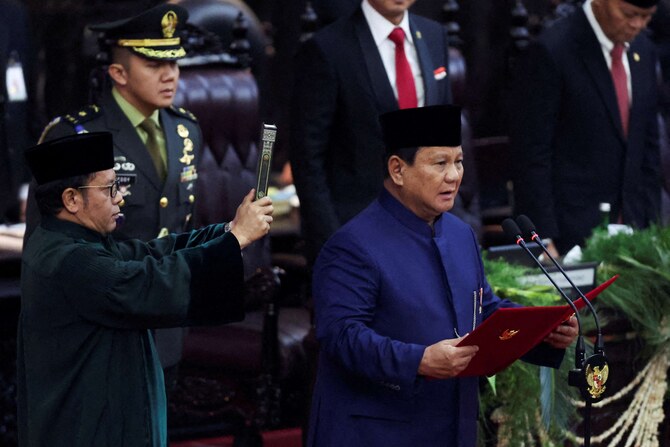
Ex-general Prabowo Subianto takes oath as Indonesia’s 8th president

Indonesia's new President Prabowo Subianto is sworn in during his presidential inauguration at the House of Representatives building in Jakarta, Indonesia on Oct. 20, 2024. (Reuters)
Short Url
Updated 20 October 2024
Follow

Ex-general Prabowo Subianto takes oath as Indonesia’s 8th president

  • Subianto is taking over Indonesian leadership from Joko Widodo, who was president for 10 years
  • In inaugural presidential speech, Subianto reiterated Indonesia’s continued support for Palestinian independence

JAKARTA: Indonesia’s former defense minister Prabowo Subianto was sworn in as the country’s eighth president on Sunday morning, becoming the new leader of the world’s third-largest democracy.

The 73-year-old former special forces commander and former son-in-law of Indonesia’s late dictator Suharto won the Feb. 14 election with almost 60 percent of the vote. He succeeded Joko Widodo, who stepped down on Sunday after serving two five-year terms.

Subianto took the oath of office during a nationally televised special session of the People’s Consultative Assembly, followed by his vice president and Widodo’s eldest son, Gibran Rakabuming Raka.

The ceremony was attended by heads of state and special envoys of more than 30 countries.

In his first presidential speech, Subianto vowed to work toward achieving food and energy security, while promising to eradicate corruption.

“We will lead the leadership of Indonesia … sincerely, by prioritizing the needs of all Indonesians, including those who did not vote for us,” he said.

Indonesia’s new leadership will face a number of challenges, analysts say, including a shrinking middle class and regional security issues.

The Subianto presidency will begin amid a period of democratic backsliding that Widodo oversaw, marked by a rise in old-time patronage and dynasty politics, and a dent in the independence of the judiciary.

DEMOCRACY IN DECLINE

“Our democracy has seriously declined … we are not doing alright at all. There are many democratic institutions that were quashed during Jokowi’s presidency,” constitutional law expert Bivitri Susanti told Arab News.

“I don’t think we can separate between Jokowi and Prabowo. Take note of how Prabowo ran for the presidency three times, and he won only now, after Jokowi gave his son as a running mate ... the upcoming administration will be tied because its victory was guaranteed through unconstitutional acts.”

Susanti was referring to how Raka’s candidacy only became possible after the Constitutional Court, which at the time was headed by Jokowi’s brother-in-law, made a controversial decision to decrease the minimum age requirement for the role.

SHRINKING MIDDLE CLASS

While one of Subianto’s election promises was to accelerate economic growth to 8 percent from a current rate of 5 percent, the number of Indonesians classified as middle class has declined from about 57.3 million people in 2019 to 47.8 million this year, according to data from the Central Statistics Agency.

This decline means more people are in the “aspiring middle class,” which now comprise about 50 percent of the Indonesian population, or more than 137 million people.

The numbers indicate a decrease in purchasing power across Indonesia.

“There is a purchasing power problem we are facing and there’s the raising of the big question about the structure of the Indonesian economy right now, as the industry is slowing down and (there are) a lot of layoffs in the manufacturing sector,” Bhima Yudhistira, director of Jakarta-based think tank the Center of Economic and Law Studies, told Arab News.

‘MORE ACTIVE’ FOREIGN, DEFENSE POLICY

Jokowi, who never attended the UN General Assembly during his time in office, was not known as a “foreign policy president,” as he focused more on economics and domestic developments, said Pieter Pandie, international relations researcher at the Centre for Strategic and International Studies in Jakarta.

But that leadership style is likely to change under Subianto, who has already visited a number of countries as president-elect, including China, Australia and Saudi Arabia.

“In the transition to Prabowo, we’ll see a more active president, a more hands-on president in foreign policy and defense policy,” Pandie said.

Indonesia’s active support for Palestine, which under Widodo was driven by the foreign minister, Retno Marsudi, is also likely to continue. In his inaugural speech, Subianto again declared Indonesia’s support for Palestinian independence.

“I think the difference will be Prabowo will likely be a little more active in inserting a role for Indonesia in the region, although it remains to be seen what kind of role.”

As Indonesia holds control over critical sea lanes, including in the Malacca Strait, Lombok Strait and Sunda Strait, the government will need to prepare for possible regional security issues such as conflict in the South China Sea or Taiwan Strait.

Beijing has overlapping claims over the South China Sea with a number of countries, and has increased its activities over the strategic waters, despite a 2016 international tribunal ruling that rejected Chinese claims.

The East Asian giant also has claims over self-governed Taiwan, and has launched major military drills around the island, sparking concerns of a bigger conflict.

“We’ve seen increasing incidents between China, the Philippines, Vietnam and others that could very well erupt into a conflict,” Pandie said, adding that conflict spillover, refugee crises and disruptions to maritime routes are several potential issues that Indonesia may have to contend with.

“Given our non-alignment and neutrality we won’t be involved directly in a conflict, but should a conflict arise so close to our borders … many things could happen.”


Coast Guard is pursuing another tanker helping Venezuela skirt sanctions, US official says

Updated 4 sec ago
Follow

Coast Guard is pursuing another tanker helping Venezuela skirt sanctions, US official says

  • US oil companies dominated Venezuela’s petroleum industry until the country’s leaders moved to nationalize the sector, first in the 1970s and again in the 21st century under Maduro and his predecessor, Hugo Chávez

WEST PALM BEACH, Florida: The US Coast Guard on Sunday was pursuing another sanctioned oil tanker in the Caribbean Sea as the Trump administration appeared to be intensifying its targeting of such vessels connected to the Venezuelan government.
The pursuit of the tanker, which was confirmed by a US official briefed on the operation, comes after the US administration announced Saturday it had seized a tanker for the second time in less than two weeks.
The official, who was not authorized to comment publicly about the ongoing operation and spoke on the condition of anonymity, said Sunday’s pursuit involved “a sanctioned dark fleet vessel that is part of Venezuela’s illegal sanctions evasion.”
The official said the vessel was flying a false flag and under a judicial seizure order.
The Pentagon and Department of Homeland Security, which oversees the US Coast Guard, deferred questions about the operation to the White House, which did not offer comment on the operation.
Saturday’s predawn seizure of a Panama-flagged vessel called Centuries targeted what the White House described as a “falsely flagged vessel operating as part of the Venezuelan shadow fleet to traffic stolen oil.”
The Coast Guard, with assistance from the Navy, seized a sanctioned tanker called Skipper on Dec. 10, another part of the shadow fleet of tankers that the US says operates on the fringes of the law to move sanctioned cargo. It was not even flying a nation’s flag when it was seized by the Coast Guard.
President Donald Trump, after that first seizure, said that the US would carry out a “blockade” of Venezuela. It all comes as Trump has ratcheted up his rhetoric toward Venezuelan President Nicolás Maduro.
This past week Trump demanded that Venezuela return assets that it seized from US oil companies years ago, justifying anew his announcement of a “blockade” against oil tankers traveling to or from the South American country that face American sanctions.
Trump cited the lost US investments in Venezuela when asked about his newest tactic in a pressure campaign against Maduro, suggesting the Republican administration’s moves are at least somewhat motivated by disputes over oil investments, along with accusations of drug trafficking. Some sanctioned tankers already are diverting away from Venezuela.
US oil companies dominated Venezuela’s petroleum industry until the country’s leaders moved to nationalize the sector, first in the 1970s and again in the 21st century under Maduro and his predecessor, Hugo Chávez. Compensation offered by Venezuela was deemed insufficient, and in 2014, an international arbitration panel ordered the country’s socialist government to pay $1.6 billion to ExxonMobil.
Maduro said in a message Sunday on Telegram that Venezuela has spent months “denouncing, challenging and defeating a campaign of aggression that goes from psychological terrorism to corsairs attacking oil tankers.”
He added: “We are ready to accelerate the pace of our deep revolution!”
Sen. Rand Paul, R-Kentucky, who has been critical of Trump’s Venezuela policy, called the tanker seizures a “provocation and a prelude to war.”
“Look, at any point in time, there are 20, 30 governments around the world that we don’t like that are either socialist or communist or have human rights violations,” Paul said on ABC’s’ “This Week.” ”But it isn’t the job of the American soldier to be the policeman of the world.”
The targeting of tankers comes as Trump has ordered the Defense Department to carry out a series of attacks on vessels in the Caribbean and eastern Pacific Ocean that his administration alleges are smuggling fentanyl and other illegal drugs into the United States and beyond.
At least 104 people have been killed in 28 known strikes since early September. The strikes have faced scrutiny from US lawmakers and human rights activists, who say the administration has offered scant evidence that its targets are indeed drug smugglers and that the fatal strikes amount to extrajudicial killings.
Trump has repeatedly said Maduro’s days in power are numbered. White House chief of staff Susie Wiles said in an interview with Vanity Fair published last week that Trump “wants to keep on blowing boats up until Maduro cries uncle.”
Sen. Tim Kaine, D-Virginia, told NBC’s “Meet the Press” on Sunday that Trump’s use of military to mount pressure on Maduro runs contrary to Trump’s pledge to keep the United States out of unnecessary wars.
Democrats have been pressing Trump to seek congressional authorization for the military action in the Caribbean.
“We should be using sanctions and other tools at our disposal to punish this dictator who is violating the human rights of his civilians and has run the Venezuelan economy into the ground,” Kaine said. “But I’ll tell you, we should not be waging war against Venezuela. We definitely should not be waging war without a vote of Congress.