

Palestinian, Jordanian cadets among several others graduate from Pakistan Military Academy

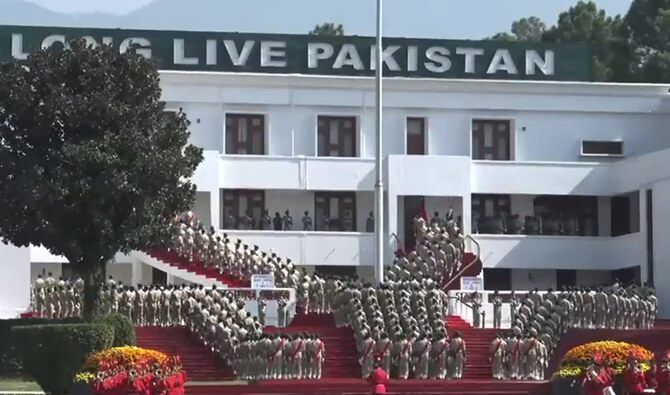
This screengrab, taken from a handout video released by Pakistan’s Inter-Service Public Relations (ISPR) on October 19, 2024, shows group of fresh graduates take part in passing out parade at the Pakistani Military Academy in Kakul, Abbottabad. (Photo courtesy: ISPR)
Short Url
Updated 19 October 2024
Follow

Palestinian, Jordanian cadets among several others graduate from Pakistan Military Academy

  • Pakistan hosts cadets from friendly countries each year to undergo specialized military training
  • Passed-out cadets hailed from Iraq, Jordan, Maldives, Sri Lanka, Nepal, Palestine, Sudan and Yemen

ISLAMABAD: A passing-out parade of cadets from different training courses was held at the Pakistan Military Academy in Abbottabad, the Pakistani military said on Saturday, with trainees from Palestine, Jordan and several other friendly nations graduating from the prestigious institution.
The parade included cadets from 150th PMA Long Course, 69th Integrated Course, 24th Lady Cadet Course and 36th Technical Graduate Course, according to the Inter-Services Public Relations (ISPR), the military’s media wing.
Chairman Joint Chiefs of Staff Committee (CJCSC) General Sahir Shamshad Mirza, graced the occasion as chief guest, who reviewed the parade and gave awards to distinguished cadets.
“Cadets from several friendly countries including Iraq, Jordan, Maldives, Sri Lanka, Nepal, Palestine, Sudan and Yemen were also graduated from Pakistan Military Academy,” the ISPR said in a statement.
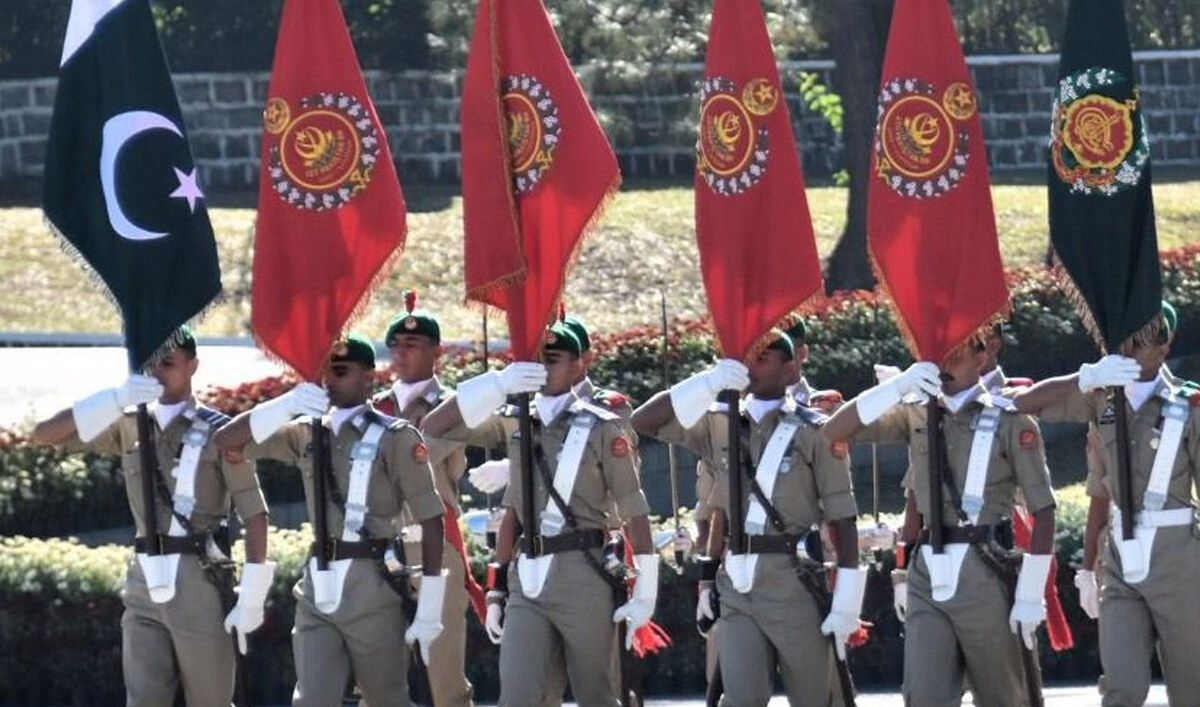


This screengrab, taken from a handout video released by Pakistan’s Inter-Service Public Relations (ISPR) on October 19, 2024, shows group of fresh graduates take part in passing out parade at the Pakistani Military Academy in Kakul, Abbottabad. (Photo courtesy: ISPR)

The coveted ‘Sword of Honor’ was awarded to Battalion Senior Under Officer Abdullah Afzal of 150th PMA Long Course, while the President’s Gold Medal was given to Battalion Senior Under Officer Babar Ullah Aman of 150th PMA Long Course. Chairman Joint Chiefs of Staff Committee Overseas Gold Medal went to Senior Under Officer Kshitij Gurung of 150th PMA Long Course from Nepal, according to the ISPR.
Chief of Army Staff Cane was awarded to Course Junior Under Officer Muhammad Umar Sheraz of 36th Technical Graduate Course, while Commandant’s Canes were awarded to Course Junior Under Officer Muhammad Suleman of 69th Integrated Course and Course Under Officer Pakeeza Yaqoob of 24th Lady Cadet Course.
Pakistan, which has fought back militancy for decades, hosts cadets from friendly countries each year to undergo specialized military training.
The South Asian country routinely holds joint air, ground and sea exercises with friendly nations to help foster interoperability and joint deployment concepts to counter threats to regional and global peace.


Pakistan urges concessional finance for developing nations to boost clean energy security

Updated 6 sec ago
Follow

Pakistan urges concessional finance for developing nations to boost clean energy security

  • Pakistan has emerged as one of world’s fastest growing solar markets, with 12GWs of off-grid and 6GWs of net-metered capacity in 2025
  • PM’s aide says Islamabad remains committed to Paris Agreement, looks for continued support in building a resilient and low-carbon future

ISLAMABAD: Pakistan has urged international partners to scale up concessional financing for developing countries, the country’s Press Information Department (PID) said on Sunday, citing an aide to Prime Minister Shehbaz Sharif.

The call was made by Sharif’s coordinator on climate change, Romina Khurshid Alam, while delivering Pakistan’s national statement at the 16th International Renewable Energy Agency (IRENA) Assembly in Abu Dhabi.

Pakistan has emerged as one of the world’s fastest growing solar markets, with 12 gigawatts (GWs) of off-grid and over 6GWs of net-metered solar capacity by the end of 2025. Last fiscal year, renewables accounted for a historic 53 percent of total electricity generation, according to Alam.

The prime minister’s aide stressed that affordable funding for developing nations is critical to accelerating their transition to clean energy and strengthening energy security amid rising climate and economic challenges.

“Alam reaffirmed Pakistan’s target of achieving 60 percent renewables in the power mix by 2030,” the PID said in a statement.

“In her call to action, she urged IRENA and Member States to increase concessional finance for developing nations, treat technologies such as energy storage and green hydrogen as global public goods, and strengthen regional cooperation for shared energy security.”

IRENA is a global intergovernmental agency for energy transformation that serves as the principal platform for international cooperation, supports countries in their energy transition, and provides state of the art data and analyzes on technology, innovation, policy, finance and investment. Its membership comprises 170 countries and the European Union (EU).

The 16th session of the IRENA Assembly is taking place on Jan. 10-12 in Abu Dhabi and focuses on the theme of “Powering Humanity: Renewable Energy for Shared Prosperity.” The session has gathered global leaders and energy decision-makers to discuss strategies and underline necessary actions for the acceleration of renewable energy across countries, regions, and the world, driving economic inclusion, equity, and human well-being.

Alam shared that Pakistan is taking action against energy poverty through initiatives like the Punjab Solar Panel Scheme 2026, which provides free or subsidized systems to low-income households.

She highlighted how distributed solar kits have restored power and livelihoods in flood-affected communities and offer a replicable model for climate-resilient recovery.

“Pakistan remains fully committed to the Paris Agreement and looks to IRENA for continued technical and financial support in building a resilient, inclusive, and low-carbon future,” Alam said.

Adopted in 2015 to combat climate change, the Paris Agreement binds nations to hold “the increase in the global average temperature to well below 2°C above pre-industrial levels” and pursue efforts “to limit the temperature increase to 1.5°C above pre-industrial levels.”