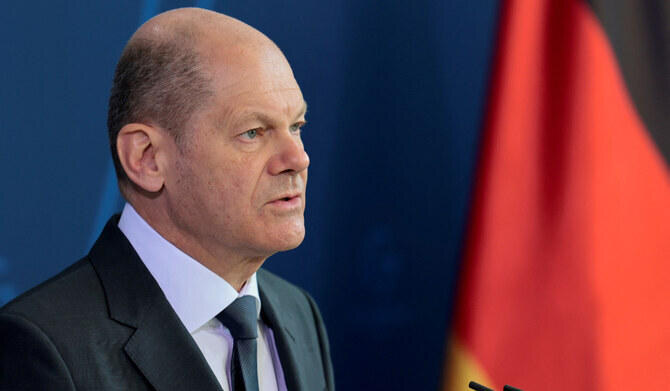
ISTANBUL: German Chancellor Olaf Scholz was due to meet Turkish President Recep Tayyip Erdogan on Saturday to discuss the escalating Middle East crisis and migration.
Scholz arrived in Istanbul on Friday night after a meeting with US President Joe Biden and the leaders of France and Britain in Berlin.
The West is hoping that the killing of Hamas leader Yahya Sinwar by Israel will lead to a ceasefire in Gaza after a year of conflict.
A fierce critic of Israel’s Gaza campaign, Erdogan has often criticized Western capitals for supporting Israel which he brands a “terror state.”
Berlin is a strong supporter of Israel and has defended its right to self-defense.
Scholz on Friday said he hoped Sinwar’s death would pave the way for a ceasefire. Sinwar was considered the architect of the October 7, 2023, attack on Israel which sparked the Gaza conflict.
Erdogan has forged close ties with the Palestinian Islamist movement Hamas.
His foreign minister Hakan Fidan on Friday held talks with Hamas officials in Istanbul and offered “condolences” over Sinwar’s death.
They also discussed “the state of recent negotiations for a ceasefire deal allowing the exchange of hostages and prisoners,” Fidan’s ministry said.
Turkiye’s relations with Germany — home to Europe’s largest Turkish diaspora of some three million people — are sensitive. Berlin has voiced concerns over the state of human rights and democracy under Erdogan especially after a failed 2016 coup.
Migration is expected to figure high on the agenda of the talks between Scholz and Erdogan.
Scholz’s government has been under heightened pressure over the issue after a series of violent crimes and extremist attacks committed by asylum seekers.
Turkiye will also expect progress on its plans to buy 40 Eurofighter Typhoons which are built by a four-nation consortium including Germany.
Scholz last visited Turkiye in March 2022 a few months after taking office.

Scholz in Turkiye to discuss Mideast crisis, migrants
https://arab.news/rrrga
Scholz in Turkiye to discuss Mideast crisis, migrants
Britain needs ‘AI stress tests’ for financial services, lawmakers say
- Lawmakers urge AI-specific stress tests for financial firms
LONDON: Britain’s financial watchdogs are not doing enough to stop artificial intelligence from harming consumers or destabilising markets, a cross-party group of lawmakers said on Tuesday, urging regulators to move away from what it called a “wait and see” approach.
In a report on AI in financial services, the Treasury Committee said the Financial Conduct Authority and the Bank of England should start running AI-specific stress tests to help firms prepare for market shocks triggered by automated systems.
The committee also called on the FCA to publish detailed guidance by the end of 2026 on how consumer protection rules apply to AI, and on the extent to which senior managers should be expected to understand the systems they oversee.
“Based on the evidence I’ve seen, I do not feel confident that our financial system is prepared if there was a major AI-related incident and that is worrying,” committee chair Meg Hillier said in a statement.
TECHNOLOGY CARRIES ‘SIGNIFICANT RISKS’
A race among banks to adopt agentic AI, which unlike generative AI can make decisions and take autonomous action, runs new risks for retail customers, the FCA told Reuters late last year.
About three-quarters of UK financial firms now use AI. Companies are deploying the technology across core functions, from processing insurance claims to performing credit assessments.
While the report acknowledged the benefits of AI, it warned the technology also carried “significant risks” including opaque credit decisions, the potential exclusion of vulnerable consumers through algorithmic tailoring, fraud, and the spread of unregulated financial advice through AI chatbots.
Experts contributing to the report also highlighted threats to financial stability, pointing to the reliance on a small group of US tech giants for AI and cloud services. Some also noted that AI-driven trading systems may amplify herding behavior in markets, risking a financial crisis in a worst-case scenario.
An FCA spokesperson said the regulator welcomed the focus on AI and would review the report. The regulator has previously indicated it does not favor AI-specific rules due to the pace of technological change.
The BoE did not respond to a request for comment.
Hillier told Reuters that increasingly sophisticated forms of generative AI were influencing financial decisions. “If something has gone wrong in the system, that could have a very big impact on the consumer,” she said.
Separately, Britain’s finance ministry appointed Starling Bank CIO Harriet Rees and Lloyds Banking Group ‘s Rohit Dhawan as “AI Champions” to help steer AI adoption in financial services.


