TORONTO: Ottawa’s accusations this week detailing a deadly Indian campaign against its Canada-based critics may have further derailed bilateral relations — but to Sikh activists, the striking disclosures brought validation.
Canada has accused India of orchestrating the 2023 killing in Vancouver of 45-year-old naturalized Canadian citizen Hardeep Singh Nijjar, a prominent campaigner for “Khalistan,” the fringe separatist movement for an independent Sikh homeland in India’s Punjab state.
In public comments this week, Prime Minister Justin Trudeau and the national police said India’s targeting of Canadian Khalistan activists went beyond Nijjar’s killing, and has included a broad campaign of intimidation, violence and other threats.
India has dismissed the allegations.
“It was very validating,” Harinder Sohi told AFP at a thinly attended protest on Friday outside the Indian consulate in Toronto.
“This is something that we believed in for years and people weren’t listening to us,” the 42-year-old Khalistan activist said.
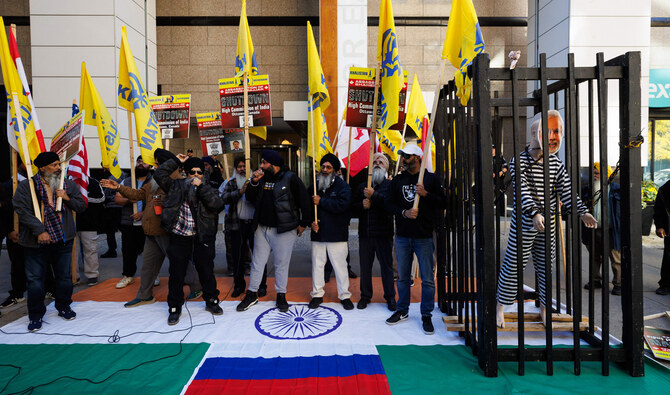
The dozens of protesters at Friday’s rally waved yellow flags with “Khalistan” written in bold blue letters and repeated a chant branding Indian Prime Minister Narendra Modi “a terrorist.”
They also erected a prison cell around an effigy of the Indian leader.
Sohi said it was meaningful that Canada has now publicly affirmed the “danger” India poses to people living across Canada.
It “is shocking that we as Canadian citizens have to live in fear of a foreign government,” he said.
Testifying Wednesday at an inquiry on foreign interference, Trudeau made clear his government was not looking to blow up relations with a major trading partner with whom Canada has deep ties.
But he said when faced with clear evidence the Indian government had directed acts of violence inside Canada and breached Canadian “sovereignty,” he and the Royal Canadian Mounted Police resolved to go public in the interest of public safety.
The Khalistan campaign dates back to India’s 1947 independence and within India today any support for the movement faces a swift crackdown.
Jatinder Singh Grewal, a director with the Sikhs for Justice advocacy group and a Khalistan supporter, argued that Modi’s government is intent on silencing support for the movement abroad because it fears discussion among the Sikh diaspora could fuel a movement at home.
“If you allow the Canadian Sikhs, or the American Sikhs or the British Sikhs to openly talk about this, you will eventually make the Punjabi Sikh say, ‘Why can’t I talk about this openly?’“
Grewal praised Trudeau’s public disclosures and Canada’s decision to expel Indian diplomats but said more was needed, endorsing the closure of Indian consulates in Toronto and Vancouver, arguing they have been used to coordinate violence against Sikhs.
There are roughly 770,000 Sikhs in Canada, about two percent of the population, the largest Sikh community outside of India.
Sikhs are heavily concentrated in suburban areas, notably around Toronto and Vancouver, and the community’s vote has been pivotal in past national elections.
Last year, days after Trudeau first accused Indian agents of killing Nijjar, one former government foreign policy adviser charged that domestic politics had influenced Trudeau’s decisions on Sikh affairs.
Writing in The Globe and Mail, the former adviser Omer Aziz said Trudeau’s Liberal party was worried about losing votes to the left-wing New Democrats, led by Jagmeet Singh, who is Sikh.
Trudeau’s poll numbers are plummeting and with an election due in the coming months, questions have again surfaced about Trudeau’s efforts to shore up Sikh votes.
Holding a Khalistan flag at Friday’s protest, Inderjeet Singh Gosal dismissed any such political motive.
“I don’t think it’s about that,” he told AFP. “I just think that Justin Trudeau is just following his principles. He believes in rights and he believes in keeping his Canadian citizens safe.”


![]()

‘Validation’ for Sikh activists after Canada slams Indian tactics
Short Url
https://arab.news/wbrmc
‘Validation’ for Sikh activists after Canada slams Indian tactics
- Canada has accused India of orchestrating the 2023 killing in Vancouver of 45-year-old naturalized Canadian citizen Hardeep Singh Nijjar
- Nijjar was a prominent campaigner for “Khalistan,” the fringe separatist movement for an independent Sikh homeland in India’s Punjab state
Latest updates


© 2026 SAUDI RESEARCH & PUBLISHING COMPANY, All Rights Reserved And subject to Terms of Use Agreement.