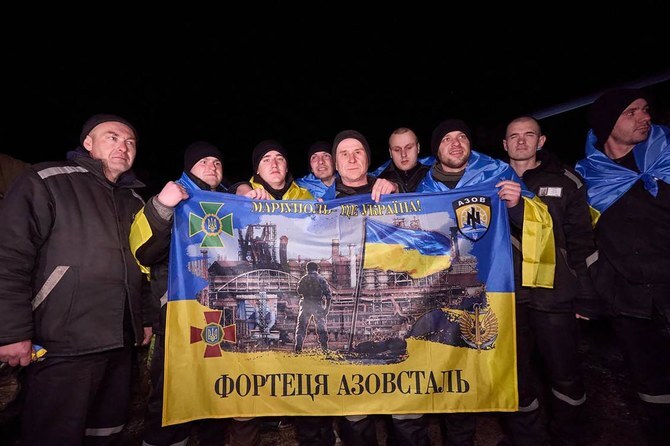
Russia, Ukraine each swap 95 prisoners of war, Russian Defense Ministry says

Russia and Ukraine each swapped 95 prisoners of war on Friday in an agreement completed with the help of the United Arab Emirates acting as mediator, the Russian Defense Ministry said. (AFP/File)
Short Url
Updated 18 October 2024
Follow

Russia, Ukraine each swap 95 prisoners of war, Russian Defense Ministry says

  • The returning Russian service members were undergoing medical checks in Belarus
  • There was no immediate word of the exchange from Ukrainian authorities

MOSCOW: Russia and Ukraine each swapped 95 prisoners of war on Friday in an agreement completed with the help of the United Arab Emirates acting as mediator, the Russian Defense Ministry said.
The ministry, in a post on the Telegram messaging app, said the returning Russian service members were undergoing medical checks in Belarus, one of Russia’s closest allies in the more than 2-1/2-year-old war.
There was no immediate word of the exchange from Ukrainian authorities.
A private Russian group which says it looks after the interests of prisoners of war published a list of returnees and said most of those being brought home were captured in the Kursk region, where Ukrainian forces staged an incursion in August.
Those forces remain in Kursk, though Russia’s military says its forces have clawed back some of the captured territory.
Ukrainian officials gave no immediate confirmation of the swap.
The last swap — involving 103 prisoners from both sides — took place in September.
The Ukrainian state body looking after the interests of prisoners of war said that was the 57th exchange conducted since Russia’s February 2022 full-scale invasion.


Nepal’s rapper-turned-politician takes early lead in key polls

Updated 5 sec ago
Follow

Nepal’s rapper-turned-politician takes early lead in key polls

  • The polls are one of the most hotly contested elections in the Himalayan republic of 30 million people since the end of a civil war in 2006

Nepal’s centrist party of rapper-turned-politician Balendra Shah took an early lead in the high-stakes parliamentary election on Friday, as slow counting continued after the first polls since last year’s deadly uprising.
But despite Shah’s party loyalists dancing on the streets of Katmandu in celebration — the numbers of votes counted remain too low to be confident that it will translate into concrete wins.
By Friday afternoon, 24 hours after polls closed, early trends issued by the Election Commission put Shah’s Rastriya Swatantra Party ahead.

HIGHLIGHT

Alongside Shah, key figures vying for power include Marxist leader KP Sharma Oli, four-time prime minister who was ousted by the September 2025 anti-corruption protests, and the newly elected leader of the Nepali Congress party, Gagan Thapa.

Alongside Shah, key figures vying for power include Marxist leader KP Sharma Oli, four-time prime minister who was ousted by the September 2025 anti-corruption protests, and the newly elected leader of the Nepali Congress party, Gagan Thapa.
At 5:00 p.m. (1115 GMT), RSP was leading in more than half of the 165 constituencies.
But there were only two declared results, and RSP had been confirmed only in one, the same as Nepali Congress.
Prakash Nyupane, a spokesman for the Election Commission, said that counting was ongoing “in a peaceful manner” across the Himalayan nation, from snowbound high-altitude mountain regions to the hot plains bordering India.
Voters have chosen who replaces the interim government in place since the September 2025 uprising, in which at least 77 people were killed, and parliament and scores of government buildings were torched.
Youth-led protests under a loose Gen Z banner began as a demonstration against a brief social media ban, but were fed by wider grievances at corruption and a woeful economy.
Kunda Dixit, publisher of the weekly Nepali Times, told AFP that if trends did reflect final wins, the political shift was dramatic.
“This is even a bigger upset than we expected — it underscores the level of public disenchantment with the old parties for under-performance, as well as anger over the events of September,” he said.

 ‘Fate of the country’ 

The polls are one of the most hotly contested elections in the Himalayan republic of 30 million people since the end of a civil war in 2006.
All eyes are watching the results in the key head-to-head battleground constituency of Jhapa-5, a usually sleepy eastern district, where 35-year-old Shah challenged directly the veteran Oli, aged 74.
Shah, better known as Balen, snappily dressed in a black suit and sunglasses, has cast himself as a symbol of youth-driven political change.
At 5 p.m. local time, at 10 percent of the votes counted in Jhapa-5, Shah was ahead by nearly five times as many votes as Oli.
Soldiers with armored trucks manned barbed wire barricades around the counting center in Jhapa.
“I hope this result changes the fate of the country for the better,” Bhagawati Adhikari, 38, told AFP, who was among a crowd of dozens at Jhapa gathered outside the security cordon.
“The country should be peaceful and secure, youth should get opportunities, corruption should stop — that’s my appeal.”

’Rest peacefully’ 

More than 3,400 candidates ran for 165 seats in direct elections to the 275-member House of Representatives, the lower chamber of parliament, with 110 more chosen via party lists. Turnout was 59 percent.
Full nationwide tallies could take several days.
Dixit raised the possibility that Shah’s RSP could stage a dramatic win.
“If RSP hits the magic 138 seats, Balen will become prime minister — and hopefully a cabinet of technocrats,” added Dixit.
Sushila Karki, the interim prime minister, praised the peaceful conduct of a vote she has said was critical in “determining our future.”
Karki, a 73-year-old former chief justice who reluctantly left retirement to lead the nation, now faces the challenge of managing the reaction to results.
The election saw a wave of younger candidates promising to tackle Nepal’s dismal economy, challenging veteran politicians who have dominated for decades and argue that their experience guarantees stability and security.
In Jhapa, 68-year-old shopkeeper Ved Prasad Mainali sat listening to a radio.