King Charles arrives in Australia for landmark tour

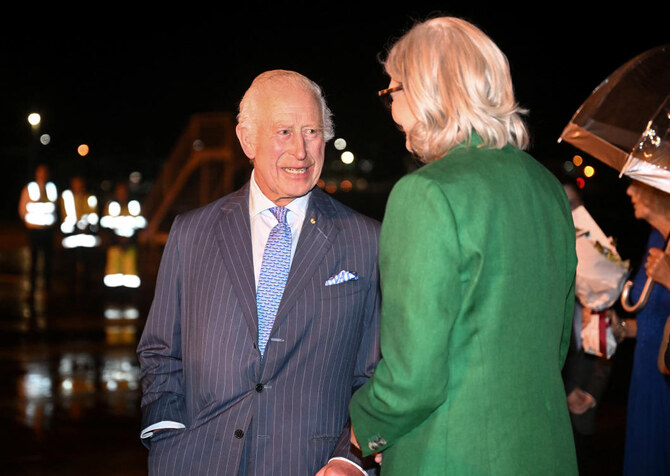
King Charles III is greeted by the Governor-General of the Commonwealth of Australia, Sam Mostyn while arriving at Sydney Airport on Oct. 18, 2024. (Reuters)
Short Url
Updated 18 October 2024
Follow

King Charles arrives in Australia for landmark tour

  • The king is on a nine-day tour of his far-flung Australian and Samoan realms
  • His long-planned trip is designed to bolster the monarchy among an increasingly ambivalent Australian public

SYDNEY: King Charles III touched down in Australia Friday, kicking off the most strenuous foreign trip since his life-changing cancer diagnosis eight months ago.
After a grueling 20-plus hour journey, the 75-year-old monarch and his wife Queen Camilla landed in a rain-sodden Sydney, and were greeted by local dignitaries and posy-bearing children.
“We are really looking forward to returning to this beautiful country to celebrate the extraordinarily rich cultures and communities that make it so special,” the couple said in a social media post ahead of their arrival.
The king is on a nine-day tour of his far-flung Australian and Samoan realms that will feature a public barbecue, famed landmarks and reminders about pressing climate dangers.
He is the first reigning sovereign to set foot Down Under since 2011, when thronging crowds flocked to catch a white-gloved wave from his mother Queen Elizabeth II.
His long-planned trip is designed to bolster the monarchy among an increasingly ambivalent Australian public, whose British heritage is now just one element in a melting-pot nation.
There was an early hiccup, however. Plans to project a montage of images of Charles onto the sails of Sydney’s famed Opera House were briefly delayed because a cruise ship called the Queen Elizabeth was blocking the view.
“I think most people see him as a good king” said 62-year-old Sydney solicitor Clare Cory, who like many Australians is “on the fence” about the monarchy’s continued role in Australian life.
“It’s a long time. Most of my ancestors came from England, I think we do owe something there,” she said, before adding that Australia now looks more to the Asia-Pacific region than a place “on the other side of the world.”
Still, Australia is a land of many happy memories for Charles and the trip is said to be personally important to him after a period of cancer treatment.
He first visited as a gawky 17-year-old in 1966, when he was shipped away to the secluded alpine Timbertop school in regional Victoria.
“While I was here I had the Pommy bits bashed off me,” he would later remark, describing it as “by far the best part” of his education.
Bachelor Charles was famously ambushed by a bikini-clad model on a later jaunt to Western Australia, who pecked him on the cheek in an instantly iconic photo of the young prince.
He returned with wife Diana in 1983, drawing mobs of adoring fans eager to see the “people’s princess” at landmarks like the Sydney Opera House.
In 1994, a would-be gunman fired two blanks at Charles as he gave a speech on Sydney harbor — a mock assassination staged as a human rights protest.
With six days in Australia and five more in Samoa, it will be Charles’s longest overseas tour since starting treatment for an undisclosed form of cancer.
He made a brief trip to France this year for D-Day commemorations.
Prime Minister Anthony Albanese, a lifelong republican, has made no secret of his desire to one day sever ties with the monarchy.
Following the death of Queen Elizabeth, his government replaced the monarch’s visage on the country’s $5 note with an Indigenous motif.
A recent poll showed about a third of Australians would like to ditch the monarchy, a third would keep it and a third are ambivalent.
For now, at least, the question of a republic is a political non-starter.
Charles’s looming presence has so far done little to stoke republican sentiment.
He carefully tiptoed around the question on the eve of his arrival, reportedly saying it was ultimately a “matter for the Australian public to decide.”


Abiy’s vision of Ethiopia includes a seaport in Eritrea. Some see a looming conflict

Updated 8 sec ago
Follow

Abiy’s vision of Ethiopia includes a seaport in Eritrea. Some see a looming conflict

KAMPALA: To his supporters, Ethiopia’s prime minister is a renaissance man trying to reimagine the old greatness of his country.
To some others, Abiy Ahmed is a provocateur who could light a fire in the restive Horn of Africa region as he pushes for sovereign access to the sea via an unfriendly neighbor.
In a stadium in southern Ethiopia last Sunday, Abiy staged a provocative parade of Ethiopia’s special forces as they demonstrated maneuvers in a spectacle widely seen as intended for neighboring Eritrea to see. A banner proclaimed Ethiopia would not remain landlocked whether “you like it or not,” with imagery showing a soldier breaking a door while aiming for the port of Assab.
Assab has been part of Eritrea since 1993, when it broke away from Ethiopia after decades of guerrilla warfare. Most of Ethiopia’s trade goes through the port of Djibouti, incurring high fees to the tune of $1.5 billion per year, a sum until recently greater than the country’s entire foreign exchange reserves, according to the London-based Africa Practice consulting firm.
It’s one reason Abiy sought a controversial deal for sea access with Somaliland two years ago. That deal angered Somalia, which claims authority over the semiautonomous Somaliland, and raised regional tensions.
Abiy has his eye on the seaport
While the Somaliland dispute has cooled, Abiy’s stance over Assab raises genuine fears of an outbreak of war that would pit him against Eritrean President Isaias Afwerki and his allies, possibly including the rebellious leaders of the northern Ethiopian region of Tigray.
Although such “a catastrophic turn of events is by no means inevitable,” without international intervention the belligerents “could find themselves party to a new regional war that would prove difficult to contain or end,” the International Crisis Group concluded in its most recent assessment.
At the center of tensions is Abiy, who as a 41-year-old rose from relative obscurity to power in 2018 as a reform-minded pragmatist.
Ties with Eritrea had been cold since the 1990s, and his efforts to repair relations with Afwerki helped him win the 2019 Nobel Peace Prize. A year later, he confounded expectations by launching a military operation against the rebellious leaders of Tigray in what eventually became a brutal civil war.
Ethiopia’s military and its allies, including Eritrea, teamed up against the Tigray People’s Liberation Front, or TPLF, the group that administers the region. That conflict, marked by sexual violence and other crimes by both sides, ended with a peace agreement in 2022.
This time, Abiy’s ambition over sovereign access to Assab has provoked a military buildup along the border with Eritrea, according to analysts.
Tigray’s rebellious leaders and Eritrea are apparently “coordinating” against Ethiopian forces, according to Kjetil Tronvoll, a professor of peace and conflict studies at Oslo New University College.
United Nations Secretary-General António Guterres has urged Eritrea and Ethiopia to respect the border treaty signed 25 years ago. Others in the region have called for talks.
Meantime, there is a war of words as well as sporadic clashes within Ethiopian territory.
Tigrayan officials accuse the Ethiopian federal forces of carrying out drone attacks. Ethiopia claims Eritrea is “actively preparing to wage war against it” and that its forces are in Tigray, which shares a border with Eritrea. Eritrea warns that Ethiopia has a “long-brewing war agenda” to seize Assab, an allegation that Abiy seemed to confirm with the military parade in Hawassa that was witnessed by top government and military officials.
The prime minister’s ambitious agenda
After Abiy took office, he saw himself as a philosopher of Ethiopia’s renewal. With his theory of “medemer,” an Amharic word that refers to strength in unity, the Ethiopian prime minister spoke of the “beautiful symphony of progress.”
As the leader of the ruling Prosperity Party, Abiy wanted the timely completion of the mega power dam on the Nile that is strongly opposed by Egypt over concerns about water volumes going north. He wanted to turn Addis Ababa, the federal capital, into a beautiful city, with verdant patches and stylish blocks. There are plans for a nuclear power program and 1.5 million housing units. And earlier this year, he launched the construction of what would be Africa’s largest airport, a project worth $10 billion, outside Addis Ababa.
Restoring Ethiopia’s access to the sea
But he has two big problems: Ethiopia, with more than 130 million people, is the world’s most populous landlocked nation. There is also ethnic discord, with conflicts ongoing in the regions of Amhara and Oromia, where federal troops are battling militants.
Going to war over a seaport would set back Abiy’s ambitious infrastructure goals by committing troops and resources to yet another armed conflict with Eritrea, whose officials dismiss Abiy as foolish.
They say Abiy’s public provocations mask his own internal problems and that his infrastructure projects are at odds with reports of hunger in parts of Ethiopia. Yemane Gebremeskel, the Eritrean government spokesman, routinely describes Abiy’s Prosperity Party as the “Potemkin party.”
That party “continues to spew and ramp up, at almost every public occasion, toxic and provocative vitriol against the sovereignty and territorial integrity” of neighboring nations, he charged in a statement Monday.