India foreign minister’s Pakistan visit a ‘good beginning’, Nawaz Sharif says

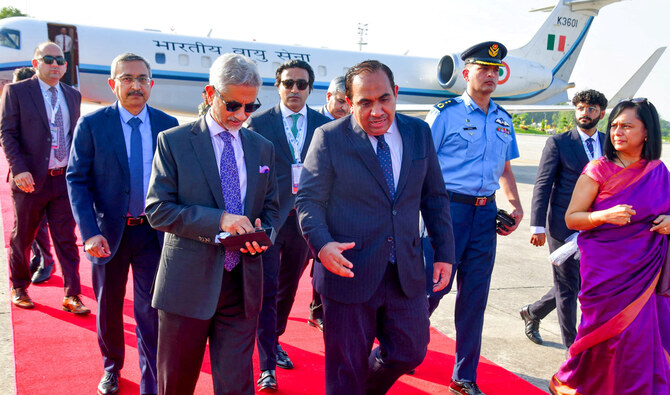
Indian Foreign Minister Subrahmanyam Jaishankar arrives to attend Shanghai Cooperation Organization (SCO) in Islamabad on October 15, 2024. (PID/File)
Short Url
Updated 18 October 2024
Follow

India foreign minister’s Pakistan visit a ‘good beginning’, Nawaz Sharif says

  • Indian Foreign Minister Subrahmanyam Jaishankar was in Pakistan for a meeting of the Shanghai Cooperation Organization
  • Jaishankar and his counterpart Ishaq Dar had an ‘informal interaction,’ an official in Pakistani foreign ministry said on Thursday

MUMBAI: The visit of India’s foreign minister to Pakistan earlier this week was a “good beginning” that could lead to a thaw in relations between the two rivals, former Pakistan Prime Minister Nawaz Sharif was quoted as saying by Indian media on Friday.
Indian Foreign Minister Subrahmanyam Jaishankar was in Pakistan on Tuesday and Wednesday for a meeting of governments of the Shanghai Cooperation Organization, with the capital city under tight lockdown.
“This is how talks move forward. Talks should not stop,” Sharif, the president of the ruling Pakistan Muslim League — Nawaz (PML-N), and the brother of Prime Minister Shehbaz Sharif, told a group of visiting Indian journalists, the Indian Express newspaper reported.
Jaishankar was among nearly a dozen leaders participating in the gathering in Islamabad, nearly a decade since an Indian foreign minister has visited amid frosty relations between the two nuclear powers.
Jaishankar and his counterpart Ishaq Dar had an “informal interaction,” an official in Pakistani foreign ministry said on Thursday, but New Delhi denied that any sort of meeting had taken place.
“We had made it very clear that this particular visit is for SCO head of government meeting. Other than that, there were some pleasantries exchanged on the sidelines of the meeting,” Indian foreign ministry spokesperson Randhir Jaiswal said on Thursday.
“We have lost the last 75 years and it is important we don’t lose the next 75 years,” Sharif was quoted as saying in the Times of India newspaper.


Pakistan launches double-decker buses in Karachi after 65 years to tackle transport woes

Updated 11 sec ago
Follow

Pakistan launches double-decker buses in Karachi after 65 years to tackle transport woes

  • Karachi citizens will be able to travel in double-decker buses from Jan. 1, says Sindh government
  • City faces mounting transport challenges such as lack of buses, traffic congestion, poorly built roads

ISLAMABAD: The government in Sindh province on Wednesday launched double-decker buses in the provincial capital of Karachi after a gap of 65 years, vowing to improve public transport facilities in the metropolis. 

Double-decker buses are designed to carry more passengers than single-deck vehicles without taking up extra road space. The development takes place amid increasing criticism against the Sindh government regarding Karachi’s mounting public transport challenges and poor infrastructural problems. 

Pakistan’s largest city by population faces severe transportation challenges due to overcrowding in buses, traffic congestion and limited bus options. Commuters, as a result, rely on private vehicles or unregulated transport options that are often unsafe and expensive.

“Double-decker buses have once again been introduced for the people of Karachi after 65 years,” a statement issued by the Sindh information ministry said. 

Sindh Transportation Minister Sharjeel Inam Memon and Local Government Minister Syed Nasir Hussain Shah inaugurated the bus service. The ministry said the facility will be available to the public starting Jan. 1. 

The statement highlighted that new electric bus routes will also be launched across the entire province starting next week. It added that the aim of introducing air-conditioned buses, low-fare services, and fare subsidies is to make public transport more accessible to the people.

The ministry noted that approximately 1.5 million people travel daily in Karachi using the People’s Bus Service, while around 75,000 passengers use the Orange Line and Green Line BRT services.

“With the integration of these routes, efforts are being made to benefit up to 100,000 additional people,” the ministry said.