Pakistan PM advocates economic empowerment on World Poverty Day

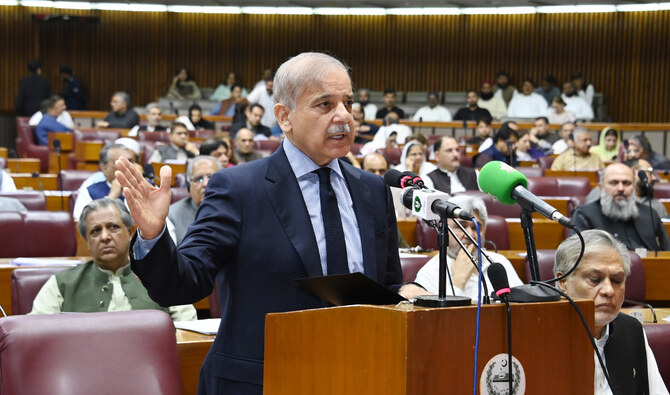
In this handout photograph, taken and released by Pakistan’s Press Information Department, Pakistan Prime Minister Shehbaz Sharif speaks during a parliament session in Islamabad on August 2, 2024. (PID/File)
Short Url
Updated 17 October 2024
Follow

Pakistan PM advocates economic empowerment on World Poverty Day

  • Shehbaz Sharif terms poverty eradication a cornerstone for achieving sustainable development
  • He says government wants to bring down the cost of living amid global economic uncertainties

ISLAMABAD: Prime Minister Shehbaz Sharif said on Thursday efforts to alleviate poverty must focus on long-term solutions that lead to economic independence, according to an official statement issued to mark the International Day for the Eradication of Poverty.
The day, observed globally on October 17, raises awareness about the need to eliminate poverty and improve living conditions worldwide. In September last year, the World Bank reported that nearly 40 percent of Pakistan’s population was living below the poverty line due to the country’s ongoing economic challenges.
“We believe that lifting people out of poverty is not just about immediate relief but about creating sustainable pathways to economic empowerment,” the prime minister said. “Eradicating poverty is not just a moral duty but a fundamental cornerstone for achieving sustainable development and ensuring peace and prosperity for all.”
Reaffirming Pakistan’s commitment to the global community in ensuring a world where successful opportunities were not limited to a person’s background or circumstances, he said the government was making efforts for poverty alleviation.
“Our targeted efforts aim at empowering communities, especially women and children, and giving them the tools they need to build a better future,” he added. “As we face global challenges, including inflation and economic uncertainty, the Government of Pakistan remains committed to making life more affordable for its people.”
The prime minister noted Pakistan would continue collaboration with global partners in the inclusive growth, education, health care and environmental sustainability sectors.
“Poverty eradication is also at the forefront of the 17 Sustainable Development Goals (SDGs), which Pakistan remains fully committed to achieving,” he said. “We are also proud of the progress made in empowering women and ensuring that their contributions are integral to the nation’s economic and social fabric.”
Sharif expressed confidence in Pakistan’s “unwavering dedication” to alleviating poverty, urging people to join their efforts of building a more “equitable and inclusive” world.
“On this day, I extend my deepest appreciation to all those, both in Pakistan and around the world, who are working tirelessly to eradicate poverty,” the prime minister concluded.


Pakistan finance minister touts debt discipline, export focus at Davos panel

Updated 5 sec ago
Follow

Pakistan finance minister touts debt discipline, export focus at Davos panel

  • Aurangzeb says debt must fund exports, not consumption, for sustainable growth
  • He says Pakistan used fiscal buffers to respond to floods without external appeals

KARACHI: Pakistan’s Finance Minister Muhammad Aurangzeb said on Wednesday disciplined borrowing, export-led growth and careful debt management were central to stabilizing the country’s economy, as Islamabad looks to unlock new sources of growth amid rising global debt levels.

Speaking at a panel discussion on the sidelines of the World Economic Forum (WEF) in Davos, he said debt was not inherently harmful if used productively, but warned that emerging economies such as Pakistan could not afford to deploy borrowed funds for consumption.

“For countries like Pakistan, debt must be channeled into investments that generate exportable surplus,” Aurangzeb said, according to a statement circulated by the Finance Division. “It is not about the availability of debt or funding, but how wisely and effectively it is steered to create long-term economic value.”

Pakistan has been pursuing fiscal reforms as part of an International Monetary Fund-backed stabilization program, including cutting subsidies, broadening the tax base and restructuring state-owned enterprises, as the government seeks to restore macroeconomic stability and revive growth.

Aurangzeb said Pakistan had reduced its debt-to-GDP ratio to 70 percent from 75 percent, achieved a primary fiscal surplus and brought inflation down from a peak of 38 percent to single digits, allowing the central bank to cut its policy rate to 10.5 percent.

He also flagged ongoing debt-management reforms, including liability management operations and buybacks, and said Pakistan plans to enter China’s capital markets with its first Panda bond, structured as a green bond.

Addressing climate risks, Aurangzeb said building fiscal buffers had allowed Pakistan to respond to recent floods using domestic resources rather than international emergency appeals, underscoring the need for resilience in climate-vulnerable economies.

He added that public-private partnerships and capital markets were playing a growing role in financing development, citing a $3.6 billion syndicated financing for a major copper mining project expected to generate $2.8 billion in annual exports from 2028.

The finance minister is part of Pakistan’s delegation visiting Davos for the annual gathering of global leaders and investors.

The delegation is led by Prime Minister Shehbaz Sharif, who highlighted the country’s shift toward an export-driven growth model, with a focus on minerals, information technology, artificial intelligence and digital services, while speaking at a breakfast event on the sidelines of the forum.