

Pakistan’s Sindh approaches high court for judicial inquiry into killing of blasphemy suspect

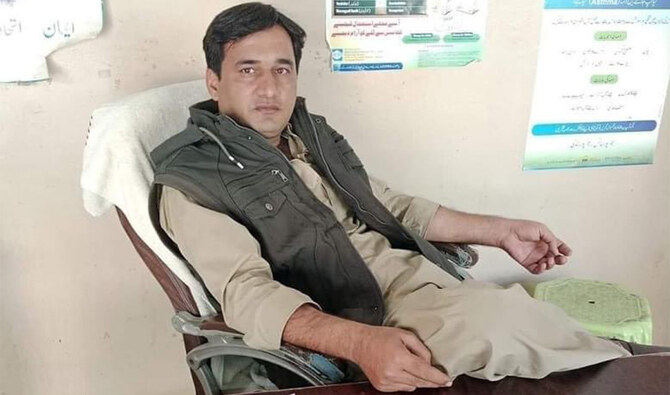
The undated picture shows Dr. Shahnawaz Kanbhar, a blasphemy suspect who was allegedly killed in police custody. (Social media)
Short Url
Updated 16 October 2024
Follow

Pakistan’s Sindh approaches high court for judicial inquiry into killing of blasphemy suspect

  • Dr. Shahnawaz Kanbhar’s family alleges he was killed in police custody last month after being blasphemy allegations
  • An inquiry committee constituted by Sindh’s inspector general determined doctor was killed in “fake encounter” 

KARACHI: Pakistan’s Sindh government on Wednesday approached a high court for a judicial inquiry into the alleged police killing of a doctor after he was accused of committing blasphemy. 

Dr. Shahnawaz Kanbhar, accused of sharing blasphemous content online, was arrested last month in Sindh’s Umerkot district and killed hours later by police in a purported shootout. According to media reports, police said Dr. Kanbhar was killed unintentionally when cops asked two men on a motorcycle to stop but one of them opened fire, prompting police to shoot back. Police said it was only after the shooting that they learned the slain man was the doctor being sought by them for alleged blasphemy. 

His family disputes the police account, claiming he was murdered in custody. A subsequent inquiry committee constituted by Sindh’s inspector general of police determined that the encounter was a “fake” one.

The incident has sparked widespread condemnation from Pakistani rights activists, who have demanded a transparent investigation into the incident. One person was killed and dozens arrested last week in Karachi after opposing protests by rights activists and an ultraconservative party in Pakistan over the issue triggered clashes with police. 

“It has now become imperative that Judicial Inquiry may be conducted into the subject matter incident in order to ascertain the real facts and fix responsibility on the delinquent police officers/officials and individuals in the interest of justice,” a copy of a letter sent by Sindh’s Home Department to the Sindh High Court’s registrar said. 

“Foregoing in view, it is requested that Judicial Inquiry may be ordered to be conducted in the subject matter by a serving Judge of High Court under intimation to this department.”

Blasphemy accusations are common in Pakistan and under the country’s blasphemy laws, anyone found guilty of insulting Islam or Islamic religious figures can be sentenced to death. While no one has been executed on such charges, often just an accusation can cause riots and incite mobs to violence, lynching and killings.

In August 2023, thousands of people set churches and homes of Christians on fire in Jaranwala, a district in Punjab province, over blasphemy allegations in what was one of the worst incidents of violence against Christians in Pakistan. 

Human rights groups and civil society organizations have urged the Pakistani government to repeal the country’s blasphemy laws, which they argue contribute to discrimination and violence. They have also called for a comprehensive review of law enforcers’ response to blasphemy accusations.


Pakistan discovers new oil, gas reserves in push to cut costly imports

Updated 5 sec ago
Follow

Pakistan discovers new oil, gas reserves in push to cut costly imports

  • Exploration firm announces modest discovery of 225 barrels of oil, 1.01 MMSCFD of gas per day
  • Multiple discoveries together could boost domestic production and reduce reliance on imports

ISLAMABAD: Pakistan has announced a modest discovery of new oil and gas reserves in its northwestern Khyber Pakhtunkhwa (KP) province, state media reported on Friday, amid the country efforts to boost exploration to cut costly imports.

Pakistan faces a widening energy gap due to rising demand and limited domestic output, forcing reliance on costly fuel imports that expose the economy to global price swings. Its petroleum, oil, and lubricants import bill fell 4.39 percent to $9.046 billion in July 2025-January 2026.

The discovery was made at Lumshiwal Formation of Baragzai X-01 exploratory well. During Cased Hole Drill Stem Test (CHDST-04) conducted in the Hangu and Lumshiwal formations, the well produced 225 barrels of oil per day (BOPD) and 1.01 million standard cubic feet per day (MMSCFD) of gas through a 32/64’’ choke at a wellhead flowing pressure of 190 psig.

“Baragzai X-01 (Slant) was spudded on December 30, 2024, as an exploratory well to assess the hydrocarbon potential of multiple formations, including Lockhart, Hangu, Lumshiwal, Samana Suk, Shinawari, Datta and Kingriali.

The well was successfully drilled to a total depth of 5,170 meters into the Kingriali Formation,” the state-run APP news agency reported, citing the Oil and Gas Development Company (OGDC).

“Based on wireline log evaluations, three earlier cased hole drill stem tests were conducted in the Kingriali, Datta, and Samana Suk plus Shinawari formations, which also resulted in oil and gas discoveries. The latest test over Lumshiwal further confirms the commercial viability and hydrocarbon prospectivity of the block.”

The discovery was made under the Nashpa Exploration License. OGDC has a 65 percent working interest in the license, in partnership with Pakistan Petroleum Limited (30 percent) and Government Holdings Private Limited (5 percent).

“This discovery will strengthen Pakistan’s energy security by enhancing indigenous hydrocarbon production,” the exploration firm said. “It will add to the reserves base of OGDC and its joint venture partners while contributing toward narrowing the country’s energy supply-demand gap.”

Pakistan has reported several oil and gas discoveries recently. Although modest individually, their combined potential could boost domestic production and reduce reliance on imported energy.

In January, a discovery regarding an exploratory well, flowing at the rate of 4,100 barrels of oil per day (BOPD) and 10.5 million standard cubic feet per day (MMSCFD) of gas, was made in Kohat. In September 2025, Pakistan Petroleum Limited announced a discovery in Attock district, while Mari Energies reported a new gas find in North Waziristan.

Pakistan’s Sindh province dominates gas production with a 62 percent share and contributes 40 percent to oil output, while Khyber Pakhtunkhwa accounts for 41 percent of crude oil production. Punjab produces 18 percent of the nation’s oil, and Balochistan contributes just one percent, according to Topline Securities.