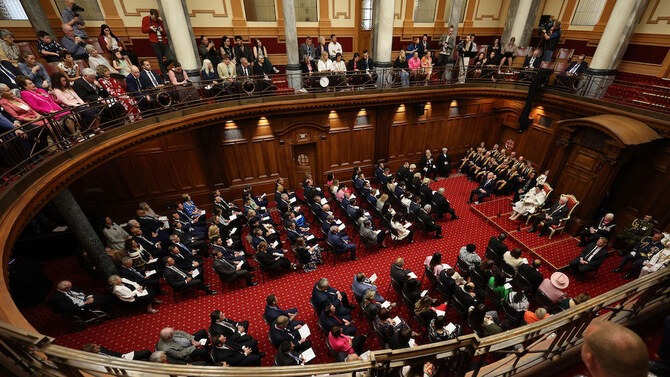
WELLINGTON: Victims of domestic violence in New Zealand will be allowed to cut ties to abusive spouses more quickly after lawmakers unanimously voted Wednesday to exempt them from a mandatory two-year separation period before divorce can be sought.
The required cooling-off period before a couple in New Zealand can file for divorce — during which they must also live apart — is the longest among no-fault divorce laws in comparable countries, including Australia, Britain, Canada and most states in the US.
Wednesday’s change means a victim of domestic violence can seek dissolution of their marriage or civil partnership as soon as a protection order against their spouse is granted. Lawmakers said in speeches at parliament in the capital, Wellington, that some survivors had told them the long reflection period made leaving an abusive relationship difficult and increased the chance they would return to a violent partner.
“Two years holds the tie. It binds the victim to their abuser,” said Deborah Russell, the lawmaker who sponsored the bill. “That should not be the case.”
All 123 members of parliament voted for the change, in a rare show of political unity.
Lawmakers cited New Zealand’s domestic violence figures, which are widely considered one of the country’s most entrenched and thorny social problems. Police figures for the year to June 2023 recorded more than 177,000 family harm investigations in the country of 5 million people, a 49 percent increase since 2017.
Some said more law changes were needed to ensure those leaving violent marriages were not rushed through property division or custody agreements while emotions were high. Others suggested more forms of evidence that abuse had taken place should be accepted. Currently a formal protection order must be granted before an expedited divorce is allowed.
New Zealand has permitted no-fault divorce, in which a couple need not state a reason for splitting, since 1980.
In neighboring Australia, a couple must separate for 12 months before divorcing but they can choose to remain under the same roof.
The UK introduced no-fault divorces in 2022, with a 20-week waiting period. Until then, couples had to cite a reason, including infidelity or abuse, to be granted a dissolution.
All 50 US states allow for no-fault divorce, with some requiring separation periods — most shorter than New Zealand’s. In recent years, conservative commentators and lawmakers in a handful of states have urged reversals of no-fault divorce laws.
Lawmakers credited three women, all survivors of abusive marriages, with prompting New Zealand’s shift.
Ashley Jones had approached her local MP, Chris Bishop, after leaving an abusive marriage in 2020 and later took a petition to parliament on the matter. It took more than 1,000 days after she left her husband for Jones to be granted a divorce, she said in 2023.
“We get a lot of grief in this place, probably sometimes fairly, about being fixated on things that don’t actually matter that much,” Bishop told parliament Wednesday. “But this matters, this legislation matters and this issue matters and today we’re doing something about it.”


![]()

New Zealand exempts abuse victims from a forced two-year wait before they can seek divorce
Short Url
https://arab.news/jjpza
New Zealand exempts abuse victims from a forced two-year wait before they can seek divorce
- The required cooling-off period before a couple in New Zealand can file for divorce is the longest among no-fault divorce laws in comparable countries


Latest updates


Recommended


© 2026 SAUDI RESEARCH & PUBLISHING COMPANY, All Rights Reserved And subject to Terms of Use Agreement.