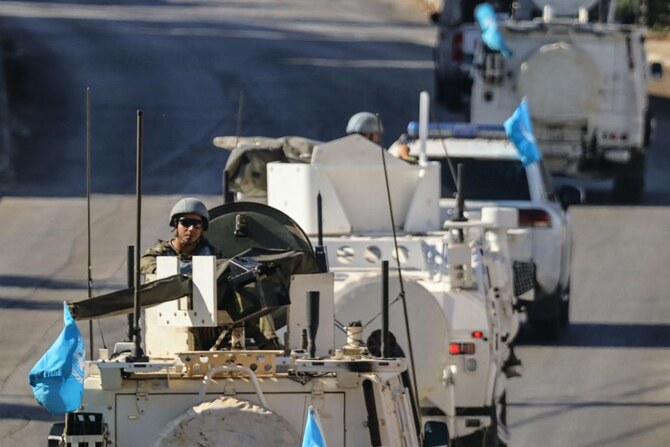
ANKARA: Turkish President Recep Tayyip Erdogan on Monday hit out at the United Nations for failing to prevent Israel from firing at its peacekeepers in southern Lebanon.
At least five UNIFIL peacekeepers have been wounded in recent days as fighting ranges between Israeli troops and Hezbollah militants in Lebanon.
Erdogan said the UN was also to blame for failing to sanction Israel over its wars with Hezbollah and with Hamas in Gaza.
“The image of the UN which cannot protect its own personnel is shameful and worrying,” Erdogan, a fierce critic of Israel, said in a televised address.
“Frankly, we ask ourselves what the (UN) Security Council is waiting for to stop Israel.
“Can you believe it? The Israeli tanks penetrate into the UNIFIL zone, attack peacekeeping soldiers, even wounding some of them, but the UN Security Council decides to just watch all this criminality from its stands — that’s what we call powerlessness.”
The UN condemned the attacks with Secretary-General Antonio Guterres saying they “may constitute a war crime.”
He said that Israeli soldiers had “deliberately breached” a UNIFIL compound.
Israeli Prime Minister Benjamin Netanyahu on Sunday called on Guterres to move peacekeepers out of “harm’s way,” saying Hezbollah was using them as “human shields.”
UNIFIL, a mission of about 9,500 troops of various nationalities created following Israel’s 1978 invasion of Lebanon, has refused to leave its positions.
It has accused the Israeli military of “deliberately” firing on its positions.

Turkiye’s Erdogan blasts UN over Israeli attacks on peacekeepers
https://arab.news/26hvj
Turkiye’s Erdogan blasts UN over Israeli attacks on peacekeepers
- Erdogan said the UN was also to blame for failing to sanction Israel over its wars with Hezbollah and with Hamas in Gaza
- “The image of the UN which cannot protect its own personnel is shameful and worrying,” Erdogan said
Syrian army declares Daesh-linked camp ‘closed security zone’
- Al-Hol is the largest camp for suspected Daesh relatives
- A military source said the army’s measure aimed to control security around the camp
DAMASCUS: Syria’s army announced Friday that a camp housing suspected relatives of Daesh group fighters was closed to the public, a measure a military source said was meant to bolster security around the facility.
Earlier this month, the army entered the vast Al-Hol camp after the withdrawal of the Kurdish-led Syrian Democratic Forces (SDF).
In a statement Friday, it said the area was a “closed security zone.”
Located in a desert region of Hasakah province, Al-Hol is the largest camp for suspected Daesh relatives and is home to some 24,000 people, mostly women and children, including 6,200 foreigners.
A military source told AFP the army’s measure aimed to control security around the camp and maintain order within it.
Some camp residents fled during the “security vacuum” between when the SDF withdrew and the army took control, two former employees of organizations working at the site told AFP last week.
In recent days, new reports emerged of attempts to flee the camp.
In the latest issue of its official Al-Naba publication — translated by the SITE monitoring group — Daesh called on supporters to free women held captive in Al-Hol.
In 2014, Daesh swept across Syria and Iraq, committing massacres and forcing women and girls into sexual slavery, but backed by a US-led coalition, the Kurdish-led SDF ultimately defeated the militants in Syria five years later.
The SDF went on to jail thousands of suspected militants and detain tens of thousands of their relatives in camps.
When the Syrian army took control of the camp, most humanitarian organizations withdrew, and aid has only been trickling in since.
The Save the Children charity warned on Friday that the humanitarian situation in the camp was “rapidly deteriorating as food, water and medicines run dangerously low.”
After Syrian government forces advanced against Kurdish forces, Washington said it would transfer 7,000 Daesh suspects, previously held by Syrian Kurdish fighters, to Iraq.
The transfer is still underway.


