



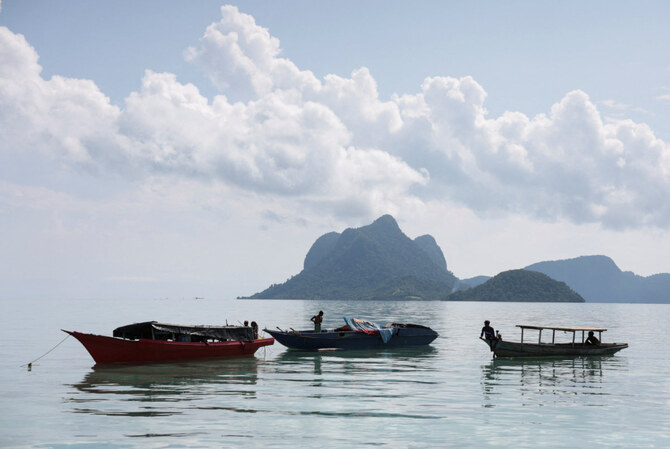

SEMPORNA, Malaysia: Patches of palm thatch entwined with a few forlorn stilts sticking out of the emerald waters in a Malaysian marine park off the island of Borneo are the only traces remaining of the homes of hundreds of sea nomads.
Robin, one of those left homeless among a community that inspired the fictional ‘Metkayina’ tribe in the 2022 film ‘Avatar: The Way of Water’, took to a boat with his children to flee the Malaysian officials who razed their home.
“I don’t know where to go now,” he told Reuters from the deck of a wooden houseboat festooned with drying clothes, where he lives with a cousin and their eight children after the demolition drive razed structures deemed illegal.
His indigenous sea-faring community, known as the Bajau Laut, is famed for the ability to dive underwater for lengthy periods unassisted by equipment.

Three generations of an indigenous seaborne Bajau Laut community family spend their evening together at their stilt house built over the sea in Semporna, Malaysia, on August 20, 2024. (REUTERS)
They have lived in the area for centuries, but are still seen as migrants by the authorities, since most of them lack basic paperwork to prove their names, ages and nationality.
Sometimes known as Sama Bajau elsewhere in Southeast Asia, many face impoverished, precarious lives and are denied access to health, education or financial services without such documents.
“We can’t buy food because our gold pawn tickets were damaged during the demolition,” said Robin’s cousin, Indasaini. “We have no money. The children are sick and we don’t have money to buy medicine.”
Malaysian authorities must take a more compassionate approach and consult the community before evictions or resettlements, said Vilashini Somiah, an anthropologist at the University of Malaya.
“These programs do not work because there’s no consultation with them in which you recognize the community as people,” she said, referring to previous efforts.
Many sea nomads settled around islands in the Tun Sakaran Marine Park, popular with divers and tourists off Malaysia’s eastern state of Sabah, but a crackdown on cross-border crime since June has demolished hundreds of homes.

A general view of stilt houses of the indigenous seaborne Bajau Laut community in Semporna, Malaysia. (Reuters)
Another reason for the drive was national security concerns, as the waters of the Sulu archipelago between Sabah and the southern Philippines are a stronghold of Abu Sayyaf, a militant group notorious for piracy and kidnapping that is linked to Islamic State.
Like many undocumented Bajau Laut, Robin goes by one name and does not know his exact age. But he said he can trace his family’s history in the area, with his grandparents buried on an islet in the government-protected park.
To earn his livelihood, Robin said he used to fish and gather wood from the islands to sell on the mainland, but has been unable to do so since he was evicted.
Growing scrutiny
Reuters was unable to verify Robin’s account, but state officials confirmed the campaign to remove intruders from protected areas of the park in the Semporna district.
“The Sabah government will take all necessary action to help,” Hajjiji Noor, the state’s chief minister, told Reuters, adding that authorities had found another coastal area in Semporna to resettle the community.

Houseboats of the indigenous seaborne Bajau Laut community anchor in the waters of Semporna, Malaysia, on August 20, 2024. (REUTERS)
A fifth of the roughly 28,000 Bajau Laut identified by the government in Sabah are Malaysian citizens, though analysts believe the figure could be higher.
The state has an estimated 1 million undocumented residents, including stateless indigenous communities and economic migrants from neighboring Philippines and Indonesia.
The evictions of the Bajau Laut come amid growing scrutiny of Malaysia’s treatment of migrants. In March, New York-based Human Rights Watch said authorities had detained about 45,000 undocumented people since May 2020.
The move has sparked outrage and debate in Malaysia, with some activists calling for citizenship for the community to ensure better protection, though some voiced concern over national security.
Bilkuin Jimi Salih, 20, a Bajau Laut youth born in Sabah, said a Malaysian identity document was key to securing better education and job opportunities.
“I had many ambitions ... to become a policeman, a soldier, but I can’t because I don’t have documents,” said Bilkuin, who now teaches at Iskul Sama DiLaut, a non-government body that educates stateless children.
His efforts to build a career were hampered by the lack of a birth certificate and identity card, he added.
“It’s costly to take a pregnant woman to hospital, and that’s how I realized why I wasn’t born in a hospital,” he added. “My family was too poor to afford it.”
Winning citizenship may be difficult, however, Vilashini said, in view of the community’s disputed origins and a lengthy history of squabbles over resources between undocumented people and the residents of one of Malaysia’s poorest states.
She urged the authorities to better engage with the community to resolve the issue, adding, “It has to be consensual, it has to be respectable.”
Without documents, life feels truly unfair, Bilkuin said. “We want to have documents so that ... our children won’t experience what we’ve been through.”




