

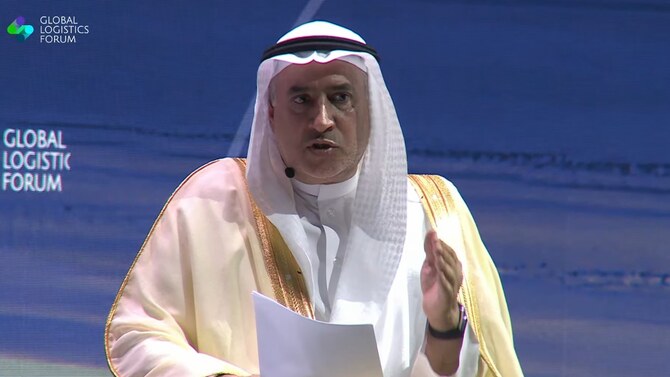
Saudi Arabia aims for global logistics hub status by 2030 with tech investments 

Abdullah Al-Dubaikhi, assistant minister at the Ministry of Investment, highlighted the Kingdom’s efforts to train a workforce capable of adapting to the sector’s technological advancements. 
Short Url
Updated 14 October 2024
Follow

Saudi Arabia aims for global logistics hub status by 2030 with tech investments 

RIYADH: The King Salman International Airport Development Co., a Saudi wealth sovereign fund-owned company, announced it had signed an agreement with ewpartners, a firm specializing in private investment, strategic alliances, and asset initiatives.

The partnership with the Public Investment Fund aims to leverage Saudi Arabia’s location as a link between three continents to drive growth and enhance operational excellence in the logistics sector, reported the Saudi Press Agency.

The parties will explore establishing an economic center for e-commerce and distribution, which is one of the hubs announced by the Ministry of Transport and Logistics Services.

This initiative aims to improve supply chains and facilitate investment and trade, thereby achieving the goals of the National Transport and Logistics Strategy and the objectives of Saudi Vision 2030.

The agreement strives to establish a logistics center at King Salman International Airport, designed to strengthen distribution management ties between China and Saudi Arabia.

This will play a significant role in positioning the Kingdom as a key regional hub for air freight, as per SPA.

The center is expected to enhance the efficiency and capabilities of distribution at the regional and international level, establishing the airport as a global logistics hub and reflecting the strategic role of Saudi Arabia in global services.

Marco Mejia, the acting CEO of KSIADC, commented that this partnership represents an important step toward realizing its vision of making KSIA a primary logistics center that serves regional and global companies and supports the country’s trade expansion.

He added: “Through our collaboration with ewpartners, we aim to enhance the Kingdom’s logistical infrastructure, increase operational efficiency, and create new opportunities that contribute to economic growth in the Kingdom and the region.”

Jerry Li, founder and managing partner of ewpartners, highlighted that the strategic location of the airport, along with its extensive regional commercial capabilities, will open new avenues for growth and innovation in the logistics and e-commerce sectors in the Kingdom.

The news agency underlined that partners would work to enhance various areas, including infrastructure, digital services, advanced manufacturing, and logistics.


Saudi POS transactions see 20% surge to hit $4bn: SAMA

Updated 05 December 2025
Follow

Saudi POS transactions see 20% surge to hit $4bn: SAMA

RIYADH: Saudi Arabia’s total point-of-sale transactions surged by 20.4 percent in the week ending Nov. 29, to reach SR15.1 billion ($4 billion).

According to the latest data from the Saudi Central Bank, the number of POS transactions represented a 9.1 percent week-on-week increase to 240.25 million compared to 220.15 million the week before.

Most categories saw positive change across the period, with spending on laundry services registering the biggest uptick at 36 percent to SR65.1 million. Recreation followed, with a 35.3 percent increase to SR255.99 million. 

Expenditure on apparel and clothing saw an increase of 34.6 percent, followed by a 27.8 percent increase in spending on telecommunication. Jewelry outlays rose 5.6 percent to SR354.45 million.

Data revealed decreases across only three sectors, led by education, which saw the largest dip at 40.4 percent to reach SR62.26 million. 

Spending on airlines in Saudi Arabia fell by 25.2 percent, coinciding with major global flight disruptions. This followed an urgent Airbus recall of 6,000 A320-family aircraft after solar radiation was linked to potential flight-control data corruption. Saudi carriers moved swiftly to implement the mandatory fixes.

Flyadeal completed all updates and rebooked affected passengers, while flynas updated 20 aircraft with no schedule impact. Their rapid response contained the disruption, allowing operations to return to normal quickly.

Expenditure on food and beverages saw a 28.4 percent increase to SR2.31 billion, claiming the largest share of the POS. Spending on restaurants and cafes followed with an uptick of 22.3 percent to SR1.90 billion.

The Kingdom’s key urban centers mirrored the national decline. Riyadh, which accounted for the largest share of total POS spending, saw a 14.1 percent surge to SR5.08 billion, up from SR4.46 billion the previous week. The number of transactions in the capital reached 75.2 million, up 4.4 percent week-on-week.

In Jeddah, transaction values increased by 18.1 percent to SR2.03 billion, while Dammam reported a 14 percent surge to SR708.08 million.

POS data, tracked weekly by SAMA, provides an indicator of consumer spending trends and the ongoing growth of digital payments in Saudi Arabia. 

The data also highlights the expanding reach of POS infrastructure, extending beyond major retail hubs to smaller cities and service sectors, supporting broader digital inclusion initiatives. 

The growth of digital payment technologies aligns with the Kingdom’s Vision 2030 objectives, promoting electronic transactions and contributing to the nation’s broader digital economy.