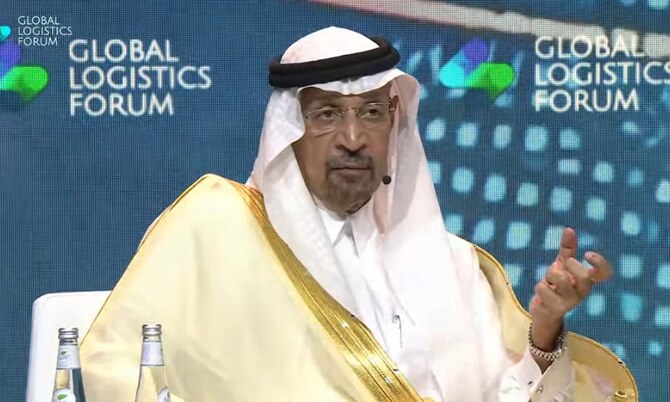

RIYADH: Saudi Arabia is strengthening the role of private entities in the logistics and transport sector through various initiatives, including a new investment law, according to a top minister.
At the Global Logistics Forum in Riyadh, Saudi Investment Minister Khalid Al-Falih announced that the government plans to appoint private operators to manage four airports in the Kingdom in the coming months.
Enhancing the operations of seaports and airports is vital for Saudi Arabia as it aims to establish itself as a strategic regional hub and logistics gateway spanning three continents. The National Logistics Strategy seeks to boost the sector’s contribution to the Kingdom’s gross domestic product from 6 percent to 10 percent by 2030.
“The government is moving away from direct business involvement. Empowering and enabling the private sector is essential,” Al-Falih stated. He highlighted that the Madinah airport, the Kingdom’s most efficient, is managed by a private operator under a long-term concession, while King Abdullah Port, built with no government capital expenditure, is also privately operated.
“In the coming months and years, you will see continued privatization, with four airports entering the market. This is just the beginning,” he added.
Al-Falih emphasized that Saudi Arabia’s entrepreneurial landscape is favorable, and the new investment law is attracting significant investments in logistics and transport. In August, the Kingdom approved an updated investment law aimed at enhancing foreign direct investment.
The law includes stronger protections for investors, ensuring adherence to the rule of law, fair treatment, property rights, robust intellectual property safeguards, and streamlined fund transfers.
Al-Falih emphasized the importance of establishing a regionalized supply chain within the Gulf Cooperation Council. He noted that countries like Saudi Arabia, with their strategic geographical position, have significant opportunities in the transport and logistics sector.
“What is essential for us in the region is the regionalization of global supply chains. While globalization has benefitted humanity and the global economy, it is evolving toward a multi-hub regional logistics and transport system,” Al-Falih stated.
He continued: “The Middle East is at the forefront of developing its logistics and transport sector. We sit at the intersection of north-south and east-west routes, and we are actively creating our own regional logistics hub. We’re not starting from scratch; I anticipate rapid progress.”
Al-Falih also underscored the need to expand shipping ports and lanes to alleviate pressure on existing facilities. “Currently, 30 ports handle 80 percent of maritime traffic, which is too much concentration. This will inevitably change,” he concluded.
The sustainability factor
Talking about sustainability, Al-Falih said that Saudi Arabia consider it as a golden opportunity to develop green energy sources like green hydrogen, and green ammonia to reduce emissions in the sector, which contributes 10 percent to the overall emissions happening globally.
“It is not easy to switch to alternative fuels. But that we must do. From a climate standpoint, and given everybody’s commitment to net zero in the next few decades. The Kingdom, we see it as a huge opportunity. Many people assume we consider it a threat. We see these fuels of the future, whether it is green ammonia, blue ammonia, methanol into shipping as a huge opportunity for the Kingdom and countries in the region,” added Al-Falih.
UAE Minister of Energy and Infrastructure Suhail Al-Mazrouei expressed concerns about the potential pollution from expanding shipping lines, emphasizing the need for alternative connectivity solutions.
“The challenges ahead are significant. We cannot simply expand shipping lines or increase the number of ships, as pollution will become a major issue. We need to explore other means of connectivity,” he stated.
In the same panel, Saeed bin Hamoud Al-Maawali, Oman’s minister of transport, communications, and information technology, highlighted the substantial opportunities in Oman’s renewable energy sector. “Oman is poised to benefit greatly from green initiatives. We have just announced our first LNG terminal for bunkering, and there are vast opportunities for producing green hydrogen due to our favorable natural conditions, including strong wind and solar resources, along with ample available land,” said Al-Maawali.
He further noted that Oman aims to play a pivotal role in the transport and logistics sector, acting as a trade facilitator between East Africa and India.
The vitality of technology
During the session, Al-Falih said that technology is going to play a crucial role in modernizing the transport and logistics sector.
According to the investment minister, e-commerce platforms like Amazon, which uses logistics as a key part of their operations have become one of the biggest companies in the world by leveraging technology wisely.
“The trend is digitalization, data processing and AI (artificial intelligence), and they are huge enablers. The other trend is e-commerce, and we have seen with technology, how disruptive that has been,” said Al-Falih.
Al-Mazrouei also echoed similar views and said that technologies like blockchain are crucial to enhance operations in the transport and logistics sector.
“The future is going to be in the blockchain technology; how can we speed up and how can we eliminate certain processes between the first buyer of a good and the end consumer,” said Al-Mazrouei.
The UAE minister added that the logistics and transport industry should be modernized to meet future demands, and it demands huge capital.
The future outlook
During the panel, Saudi Arabia Transport Minister Saleh Al-Jasser said that the Kingdom is steadily pursuing its goals outlined in Vision 2030, and is on a path to become a global logistics hub.
“Despite the current challenges in the region, I never been as optimistic about the future of logistics in Saudi Arabia and the region,” said Al-Jasser.