

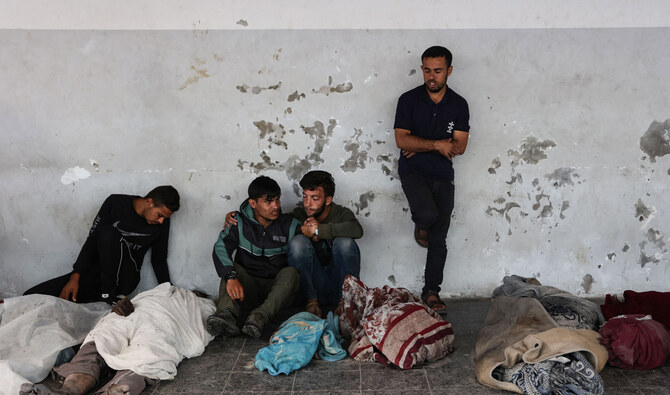

CAIRO: Israeli military strikes on Gaza on Saturday killed at least 29 Palestinians, medics said, and forces kept pushing deeper into the Jabalia area, where international relief agencies say thousands of people are trapped.
Residents said Israeli forces continued to pound Jabalia, in the north of the enclave, the largest of its historic refugee camps, from the air and ground.
Nineteen people were killed in Gaza overnight, and 10 more died on Saturday evening after Israel struck two houses in Jabalia and the Nuseirat camp in central Gaza. The death toll could rise as many of the wounded are in critical condition, medics said.
The Israeli military published new evacuation orders on Saturday to two neighborhoods on the northern edge of Gaza City, which also lies in the north of the enclave, saying the area was a “dangerous combat zone.”
In a statement, Gaza’s Hamas-run interior ministry urged residents not to relocate within northern areas of the enclave and also to avoid heading south “where the occupation is conducting continued bombing and killing every day in the areas it claims to be safe.”
The Israeli military said it had been operating against Hamas fighters who had been using civilian buildings and said clear evacuation instructions had been issued over recent days to areas including the Kamal Adwan Hospital.
It said an evacuation convoy to take patients from the hospital to Gaza City had arrived on Saturday with a supply of fuel for the facility.
In recent days, the military had said that forces operating in Jabalia and nearby areas killed dozens of militants, located weapons and dismantled military infrastructure.
On Saturday, it said more than 20 fighters had been killed by tank fire, close range gunfire and airstrikes as forces continued operations throughout the Gaza Strip.
The operation in this area began a week ago and the military said then it aimed to fight against militants waging attacks and to prevent Hamas from regrouping. Hamas denies that its fighters deliberately use civilian areas as bases.
Palestinian health officials put the number of people killed in Jabalia over the past week at around 150.
SHORTAGES

Displaced Palestinians make their way as they flee areas in the northern Gaza Strip, following an Israeli evacuation order, amid the Israel-Hamas conflict, in Gaza City October 12, 2024. (REUTERS)
Palestinian and United Nations officials say there are no safe areas in Gaza. They have also voiced concerns over severe shortages of food, fuel, and medical supplies in northern Gaza, and said there is a risk of famine there.
Israel’s military campaign in Gaza, aimed at eliminating the militant group Hamas, has killed more than 42,000 Palestinians since it began a year ago, according to Gaza’s health ministry, and has laid waste to the enclave.
The war began after a Hamas-led assault on Oct. 7, 2023, on southern Israeli communities in which 1,200 people were killed and about 250 were taken hostage, according to Israeli tallies.
In a statement on Saturday, Hamas said Israel’s “massacre against the civilians” aimed to punish the residents of Jabalia for refusing to leave their homes. It also said it was a sign of Israel’s military failure to defeat the group.
Israel has denied it targets civilians.
The armed wings of Hamas, the Islamic Jihad, and smaller other factions said their fighters attacked Israeli forces in Jabalia and nearby areas with anti-tank rockets, and mortar fire.
United Nations officials said on Friday an Israeli offensive and evacuation orders in northern Gaza might affect the second phase of its polio vaccination campaign set to start next week.
The territory’s health ministry announced on Saturday that the campaign would begin on Monday in central Gaza Strip areas and would last three days before moving to other territories.
Aid groups carried out an initial round of vaccinations last month after a baby was partially paralyzed by the type 2 poliovirus in August, the first such case in the territory in 25 years.
As in the first phase, humanitarian pauses in the fighting in Gaza are planned, in order to reach hundreds of thousands of children.


