WASHINGTON: Thousands of copies of Donald Trump’s “God Bless the USA” Bible were printed in a country that the former president has repeatedly accused of stealing American jobs and engaging in unfair trade practices: China.
Global trade records reviewed by The Associated Press show a printing company in China’s eastern city of Hangzhou shipped close to 120,000 of the Bibles to the United States earlier this year.
The estimated value of the three separate shipments was $342,000, or less than $3 per Bible, according to databases that track exports and imports. The minimum price for the Trump-backed Bible is $59.99, putting the potential sales revenue at about $7 million.
The Trump Bible’s connection to China reveals a deep divide between the former president’s harsh anti-China rhetoric and his efforts to raise cash while campaigning.
The Trump campaign did not respond to emails and calls seeking comment.
In a March 26 video posted on his Truth Social platform, Trump announced a partnership with country singer Lee Greenwood to hawk the Bibles, inspired by Greenwood’s “God Bless the USA” hit song.
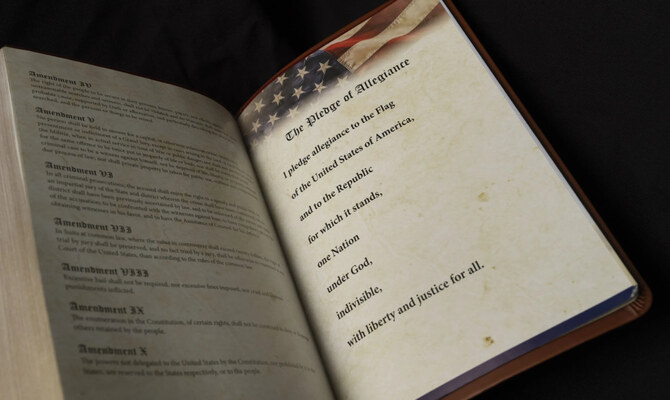
In the video, Trump blended religion with his campaign message as he urged viewers to buy the Bible, which includes copies of the US Constitution, Declaration of Independence, Bill of Rights and Pledge of Allegiance.
“This Bible is a reminder that the biggest thing we have to bring back in America, and to make America great again, is our religion,” Trump said.
Trump didn’t say where the “God Bless the USA” Bibles are printed, what they cost or how much he earns per sale. A version of the $59.99 Bible memorializes the July 13 assassination attempt on the former president in Pennsylvania. Trump’s name is stamped on the cover above the phrase, “The Day God Intervened.”
The Bibles are sold exclusively through a website that states it is not affiliated with any political campaign nor is it owned or controlled by Trump.
The website states that Trump’s name and image are used under a paid license from CIC Ventures, a company Trump reported owning in a financial disclosure released in August. CIC Ventures earned $300,000 in Bible sales royalties, according to the disclosure. It’s unclear if Trump has received additional payments.
AP received no response to questions sent to the Bible website and to a publicist for Greenwood.
For years, Trump has castigated Beijing as an obstacle to America’s economic success, slapping hefty tariffs on Chinese imports while president and threatening even more stringent measures if he’s elected again. He blamed China for the COVID-19 outbreak and recently suggested, without evidence, that Chinese immigrants are flooding the US to build an “army” and attack America.
But Trump also has an eye on his personal finances. Pitching Bibles is one of a dizzying number of for-profit ventures he’s launched or promoted, including diamond-encrusted watches, sneakers, photo books, cryptocurrency and digital trading cards.
The web of enterprises has stoked conflict of interest concerns. Selling products at prices that exceed their value may be considered a campaign contribution, said Claire Finkelstein, founder of the nonpartisan Center for Ethics and the Rule of Law and a law professor at the University of Pennsylvania.
“You have to assume that everything that the individual does is being done as a candidate and so that any money that flows through to him benefits him as a candidate,” Finkelstein said. “Suppose Vladimir Putin were to buy a Trump watch. Is that a campaign finance violation? I would think so.”
There’s a potentially lucrative opportunity for Trump to sell 55,000 of the Bibles to Oklahoma after the state’s education department ordered public schools to incorporate Scripture into lessons. Oklahoma plans to buy Bibles that initially matched Trump’s edition: a King James Version that contains the US founding documents. The request was revised Monday to allow the US historical documents to be bound with the Bible or provided separately.
The first delivery of Trump Bibles was labeled “God Bless USA,” according to the information from the Panjiva and Import Genius databases. The other two were described as “Bibles.” All the books were shipped by New Ade Cultural Media, a printing company in Hangzhou, to Freedom Park Design, a company in Alabama that databases identified as the importer of the Bibles.
Tammy Tang, a sales representative for New Ade, told AP all three shipments were “God Bless the USA” Bibles. She said New Ade received the orders from Freedom Park Design via the WhatsApp messaging service. The books were printed on presses near the company’s office, she said.
Freedom Park Design was incorporated in Florida on March 1. An aspiring country singer named Jared Ashley is the company’s president. He also co-founded 16 Creative, a marketing firm that uses the same Gulf Shores address and processes online orders for branded merchandise.
Ashley hung up on a reporter who called to ask about the Bibles. Greenwood is a client of 16 Creative, according to the firm’s website. He launched the American-flag emblazoned Bible in 2021.
Religious scholars have denounced the merger of Scripture and government documents as a “toxic mix” that would fuel Christian nationalism, a movement that fuses American and Christian values, symbols and identity and seeks to privilege Christianity in public life. Other critics have called the Trump Bible blasphemous.
Tim Wildsmith, a Baptist minister who reviews Bibles on his YouTube channel, said he quickly noticed the signs of a cheaply made book when his “God Bless the USA” Bible arrived in the mail.
It had a faux leather cover, and words were jammed together on the pages, making it hard to read. He also found sticky pages that ripped when pulled apart, and there was no copyright page or information about who printed the Bible, or where.
“I was shocked by how poor the quality of it was,” Wildsmith said. “It says to me that it’s more about the love of money than it is the love of our country.”


![]()

Trump has long blasted China’s trade practices. His ‘God Bless the USA’ Bibles were printed there
Short Url
https://arab.news/zx6ay
Trump has long blasted China’s trade practices. His ‘God Bless the USA’ Bibles were printed there
- Trump didn’t say where the “God Bless the USA” Bibles are printed, what they cost or how much he earns per sale


Latest updates


© 2026 SAUDI RESEARCH & PUBLISHING COMPANY, All Rights Reserved And subject to Terms of Use Agreement.