WASHINGTON: Barack Obama had frank words for Black men who may be considering sitting out the election.
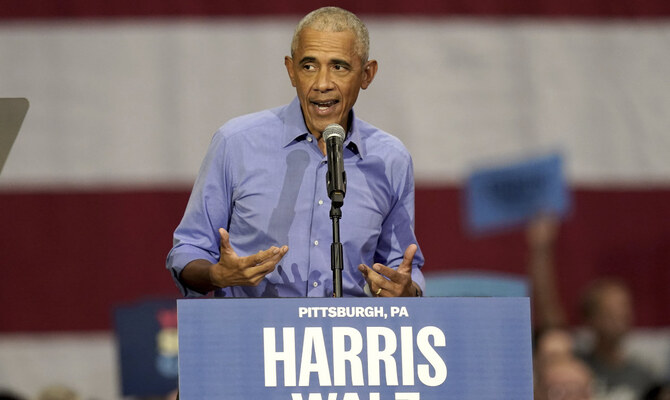
“Part of it makes me think that, well, you just aren’t feeling the idea of having a woman as president, and you’re coming up with other alternatives and other reasons for that,” he said Thursday to Harris-Walz campaign volunteers and officials at a field office in Pittsburgh.
America’s first Black president touched a nerve among Democrats worried about Vice President Kamala Harris’ chances of becoming the second.
Harris is counting on Black turnout in battleground states such as Pennsylvania in her tight race with Republican Donald Trump, who has focused on energizing men of all races and tried to make inroads with Black men in particular.
Obama’s comments belie that Black men still overwhelmingly back Harris. But her campaign and allies have worked hard trying to shore up support with this critical group of voters — and addressing questions about potential misogyny.
Black Americans are the most Democratic-leaning racial demographic in the country, with Black men being outpaced only by Black women in their support for Democrats.
A recent poll conducted by The Associated Press-NORC Center for Public Affairs Research found that about 7 in 10 Black voters had a favorable view of Harris and preferred her leadership to that of Trump on several major policy issues including the economy, health care, abortion, immigration and the war between Israel and Hamas.
There was little difference in support for Harris between Black men and Black women.
But Khalil Thompson, co-founder and executive director of Win With Black Men, said he agreed with what he saw as Obama’s larger point.
“I believe President Obama is speaking to a tangible, visceral understanding of what it means for all men to relate to women in America. Calling out misogyny is not wrong,” said Thompson, whose group raised more than $1.3 million for Harris from 20,000 Black men in the 24 hours after President Joe Biden bowed out of the race in July and made way for Harris.
Win With Black Men has organized weekly calls and events meant to bolster Harris’ standing with Black men. The flurry of activism has focused on combating misinformation in Black communities about Harris, as well as an emphasis on the policy priorities of Black men, which the group found are often centered on greater economic opportunities, safe communities, social justice policies and health care, particularly for the partners and children of Black men.
“We’re not a monolith,” Thompson said. “However, we are just like every other American in this country who wants a good paying job, that we can provide for our children and participate in their lives and the lives of our partner, that we can get them home safely, afford to go to the grocery store, save a little for retirement and have a vacation.”
Harris said she believes the votes of Black men must be earned, like with any group of voters.
Black men “are not in our back pocket,” she told a panel hosted by the National Association of Black Journalists in September.
Harris recently sat down with the “All The Smoke” podcast hosted by former NBA players Matt Barnes and Stephen Jackson to discuss her racial identity and policy issues of interest to Black men. On Tuesday, Harris will appear in Detroit for a live conversation with Charlamagne tha God, a prominent Black media personality.
The Harris campaign is conducting a number of outreach efforts to Black voters, including an tour of homecomings at historically Black colleges and universities, a number of radio and TV ads targeting Black voters in key states, and a get-out-the-vote operation engaging Black communities that complements the work of allied groups such as Win With Black Men.
It has also tapped high-profile surrogates, including politicians, business leaders, professional athletes and musical artists, to court Black men.
“Our Black men, we’ve got to get them out to vote,” said former NBA star Magic Johnson during a recent Harris rally in Flint, Michigan. “Kamala’s opponent promised a lot of things to the Black community that he did not deliver on. And we’ve got to make sure we help Black men understand that.”
The Trump campaign and its allies have held roundtables for Black men and conducted a bus tour through swing states that featured cookouts in cities like Baltimore, Chicago and Philadelphia. The campaign believes the former president’s appeals on issues such as the economy, immigration and traditional gender roles resonate with some Black men.
Trump earlier this year mused that the criminal charges against him in four separate indictments, one of which led to a conviction with another dismissed, made him more relatable to Black people.
“A lot of people said that’s why the Black people like me, because they have been hurt so badly and discriminated against, and they actually viewed me as I’m being discriminated against,” he told a Black conservative audience in South Carolina.
Trump’s support among Black, white, and Hispanic male voters worries senior Harris campaign officials as the election increasingly shapes up as divided along gender lines, with Harris stronger with women and Trump stronger with men.
But the debate over to what degree misogyny plays a role in some Black men not supporting Harris sidesteps a broader conversation on how Black men are engaged as full citizens in politics, argues Philip Agnew, founder of the grassroots political organization Black Men Build.
“To be a Black man in the United States is to be invisible and hypervisible at the same time, and neither one of those is a humanizing viewpoint,” Agnew said.
Agnew’s group traveled to 10 cities across the summer, hosting roundtables with Black men and making the case for civic engagement and a progressive politics. Agnew said many Black men throughout those conversations expressed exasperation toward politics, a sentiment shared by many Americans, in addition to a feeling that their political perspectives were often misunderstood or unappreciated.
“The Black men I know are incredibly concerned with the lives of our families and our communities,” Agnew said. “It’s because of an abundance of love for our sisters that we ask questions, not a lack of love.”


![]()

Obama’s callout to Black men touches a nerve among Democrats. Is election-year misogyny at play?
Short Url
https://arab.news/95dwb
Obama’s callout to Black men touches a nerve among Democrats. Is election-year misogyny at play?
- America’s first Black president touched a nerve among Democrats worried about Vice President Kamala Harris’ chances of becoming the second


Latest updates


Recommended


© 2026 SAUDI RESEARCH & PUBLISHING COMPANY, All Rights Reserved And subject to Terms of Use Agreement.