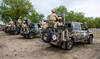
BEIRUT: Two Lebanese soldiers were killed and three others wounded in an Israeli airstrike that hit a building near a Lebanese Army checkpoint in Kafra, Bint Jbeil province, the Lebanese Army said Friday.
Since Israel launched its ground invasion of Lebanon, Israeli forces and Hezbollah militants have clashed along the border while the Lebanese army has largely stood on the sidelines.
As Israeli troops made their first forays across the border and Hezbollah responded with rocket fire, Lebanese soldiers withdrew from observation posts along the frontier and repositioned about 5 km back.
On Oct. 3, a Lebanese soldier was killed and another injured in an Israeli strike in Taybeh during rescue operations. On Sept. 30, another Lebanese soldier was killed by an Israeli drone targeting a Lebanese Army checkpoint in Wazzani.

2 Lebanese soldiers killed and 3 others hurt in airstrike, Lebanese army says
https://arab.news/jjcc5
2 Lebanese soldiers killed and 3 others hurt in airstrike, Lebanese army says
- Israeli forces and Hezbollah militants have clashed along the border while the Lebanese army has largely stood on the sidelines
UN delegation wraps up Lebanon visit with call for international backing for country at 'pivotal’ juncture
- Security Council President Samuel Zbogar urges intensified support for Lebanese Armed Forces; welcomes government commitment to ensuring a state monopoly on arms
- Council highlights ‘strong commitment’ to Lebanon’s stability, territorial independence
NEW YORK: A UN Security Council delegation wrapped up its visit to Lebanon on Friday, saying the trip underscored international backing for the country at what it described as a pivotal moment for maintaining calm along its southern border and advancing implementation of long-standing UN resolutions.
Samuel Zbogar, Slovenia’s ambassador to the UN and president of the Security Council for December, said the delegation had received “warm hospitality” from Lebanese officials, and highlighted the council’s “strong commitment” to Lebanon’s stability and that of the wider region.
“The council regularly deliberates on the situation in Lebanon and along the Blue Line,” Zbogar told reporters in Beirut.
He said the visit is a further demonstration of the council’s commitment, coming at a pivotal time for implementing relevant resolutions and the ceasefire agreement between Israel and Hezbollah brokered in November 2024.
During the trip, the delegation held meetings with Lebanon’s president, parliament speaker, prime minister and foreign minister.
Members were also briefed by the commander of the Lebanese Armed Forces, the head of the UN peacekeeping mission, UN officials in Lebanon, and a US general involved in the ceasefire mechanism.
The delegation also toured the Blue Line area and UNIFIL headquarters.
Zbogar said discussions focused on Lebanon’s political, economic, and security situation, with particular attention to UNIFIL’s work and the Lebanese Armed Force’s role in maintaining stability.
“This mission is a demonstration of the international community’s support for Lebanon and its people,” he said, reaffirming the council’s backing for the country’s territorial integrity, sovereignty, and political independence.
He urged all parties to uphold last year’s ceasefire agreement and noted “progress achieved by Lebanon this year.” He also praised UNIFIL and the UN Special Coordinator’s office for their role in de-escalation efforts, adding that the safety of peacekeepers “must be respected and they must never be targeted.”
Zbogar called for intensified international support to the Lebanese Armed Forces, including for their continued deployment south of the Litani River, and welcomed the government’s commitment to ensuring a state monopoly on arms.
He said the council also used the visit to examine options for implementing Resolution 1701 once UNIFIL leaves Lebanon, saying that the issue will require “thorough conversation during 2026” and that members were awaiting recommendations from the UN secretary-general.
The delegation also reiterated support for Lebanon’s economic and institutional reforms, which international donors have made a condition for unlocking major recovery and reconstruction assistance.