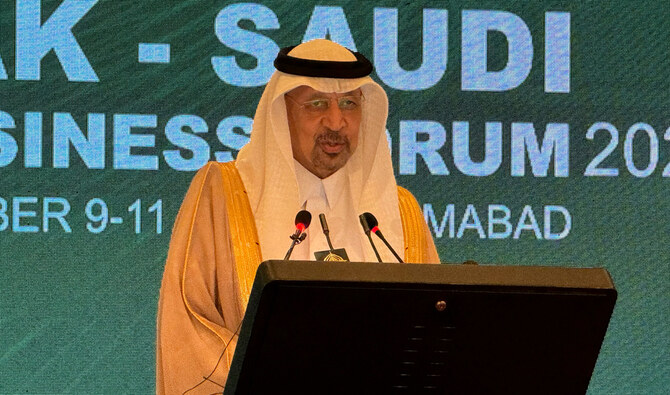
ISLAMABAD: Saudi Investment Minister Khalid bin Abdulaziz Al-Falih said on Friday Riyadh and Islamabad needed to enable private sector investments within existing government-to-government mechanisms like the Saudi-Pakistan Supreme Coordination Council (SPSCC) and Saudi Arabia’s Permanent Coordination Committee for the Development of the Contracting Sector.
Islamabad and Riyadh signed an agreement to establish the SPSCC in 2021 to institutionalize and fast-track decision-making and implementation on political, security, economic and cultural areas of collaboration. The body aims to streamline bilateral cooperation between the two countries, particularly to remove hurdles in investment deals. Separately, Saudi Arabia’s Permanent Coordination Committee for the Development of the Contracting Sector was created in 2022 to work to upgrade the construction sector and tackle project delays and hurdles.
On Thursday, Pakistani Prime Minister Shehbaz Sharif and Al-Falih, who is on a three-day visit to Islamabad, oversaw the signing of over $2 billion in agreements and memorandums of understanding (MoUs) between Saudi and Pakistani businesses.
In comments televised on Pakistan’s state APP news agency on Friday, Al-Falih said Pakistan and Saudi Arabia needed to activate work under existing G2G frameworks such as the Permanent Coordination Committee, which is being led by Mohammad Bin Mazyad Al-Tuwaijri, a Saudi politician and minister-ranked adviser at the Royal Court, with Petroleum Minister Dr. Musadik Malik as his Pakistani counterpart.
“And he [Al-Tuwaijri] has elected to place the Pakistan portfolio within the Royal Court team because he wants to personally have his finger on the pulse of how we are managing [Pakistani investments],” Al-Falih said.
“Within the scope of the G2G, his excellency Al-Tuwaijri and his team have asked MISA [Ministry of Investment for Saudi Arabia] to take the lead on everything about investment, everything about channeling private sector funding, everything about risk mitigation, everything about investment protection, everything about privatization, everything about funding.
“Ultimately what we need to do is enable the private sector.”
The Saudi minister is in Pakistan with a delegation of over 130 businesspeople representing various sectors, including energy, mining, agriculture, tourism, construction, IT and industry. The visit comes as Islamabad seeks closer economic cooperation with friendly countries and regional allies, with the aim to attract foreign investment and shore up its $350 billion economy, beset by a prolonged economic crisis that has drained foreign exchange reserves and weakened the national currency.
Pakistan and Saudi Arabia in particular have been working closely in recent months to increase bilateral trade and investment, with Crown Prince Mohamed bin Salman reaffirming the Kingdom’s commitment earlier this year to expedite a $5 billion investment package for the South Asian country.


![]()

Riyadh calls for enabling private sector investments within existing G2G mechanisms with Pakistan
Short Url
https://arab.news/6czhd
Riyadh calls for enabling private sector investments within existing G2G mechanisms with Pakistan
- Pakistan and Saudi businesses signed over $2 billion in agreements and memorandums of understanding this week
- The deals have been signed during a visit to Islamabad by Saudi Investment Minister Khalid bin Abdulaziz Al-Falih
Latest updates





© 2026 SAUDI RESEARCH & PUBLISHING COMPANY, All Rights Reserved And subject to Terms of Use Agreement.