BEIRUT: Israeli forces clashed with Hezbollah fighters across Lebanon’s southern border on Wednesday as Israel expanded its invasion force with a fourth division.
The two sides exchanged fire early in the day across the Labouneh area, near the coastal border town of Naqoura.
It followed two days of Israeli attempts to infiltrate the towns of Maroun Al-Ras, Adaisseh and Kfar Kila, which were subsequently abandoned after clashes with the militant group.
Hezbollah said on Wednesday that its fighters “targeted an Israeli infantry unit in Ras Al-Naqoura with a missile barrage.”
A military source told Arab News: “The Israeli advances and retreats along the border can be categorized as an assessment of Hezbollah’s strengths and weaknesses in terms of ground confrontation at the primary defense line.”
The Lebanese border region experienced an unprecedented barrage of airstrikes from Tuesday night through Wednesday.
Towns along the border have effectively become military zones devoid of civilian populations, with Khiam enduring about 15 airstrikes within a span of 30 minutes.
Hezbollah said: “While the Israeli enemy’s forces attempted to advance toward Mays Al-Jabal from several locations, the resistance fighters targeted them at 1:30 p.m. with rocket fire and artillery shells, and the clashes are ongoing.”
Hezbollah said in a previous statement: “At 1:20 p.m., a group confronted the forces of the Israeli enemy as they advanced from the Tufa plain toward Mays Al-Jabal and Muhaybib with a barrage of rockets.”
According to its statements this morning, Hezbollah targeted “an Israeli infantry force that tried to infiltrate the Labouneh area with a large missile barrage, killing and wounding them.”
The Israeli army is focused on entering towns situated in highland areas that provide a vantage point into southern Lebanon.
Its activities near Maroun Al-Ras have been particularly significant, with an Israeli unit entering the town between Monday and Tuesday.
During the operation, Israeli soldiers hoisted their national flag on the wall of a garden at the eastern edge of the town after clearing the area and uprooting trees.
Photographs of the event were taken and shared online before the forces withdrew.
Hezbollah acknowledged the Israeli operation.
UNIFIL spokesman Andrea Tenenti described the situation on the ground as “unsafe and unclear.”
The Israeli army on Tuesday launched a new incursion into Lebanon’s western sector led by the 146th Division, which includes the 2nd Brigade and 205th Brigade.
It aims to “execute a targeted ground operation against Hezbollah’s infrastructure,” and follows eight days of aerial bombardment over Lebanese territory and warnings for residents in southern villages to move north of the Litani River.
In Tebnine, an Israeli drone targeted two motorcycles, as well as a car on the road to the town of Shaqra.
For the first time, Israel struck the town of Wardaniyeh in the Iqlim Al-Kharroub region of Mount Lebanon, targeting an apartment.
The area is housing displaced people from southern Lebanon, mainly those who left the border town of Aitaroun.
The Ministry of Health reported that the attack killed four people and injured 10 others, including the principal of a local school and his wife.
Their children sustained severe injuries.
Cautious calm prevailed in Beirut’s southern suburb following a series of raids on Tuesday night that targeted several areas in Laylaki, Haret Hreik and Burj Al-Barajneh.
The attacks were preceded by a warning from Israeli army spokesperson Avichay Adraee, who instructed residents of the targeted areas to leave.
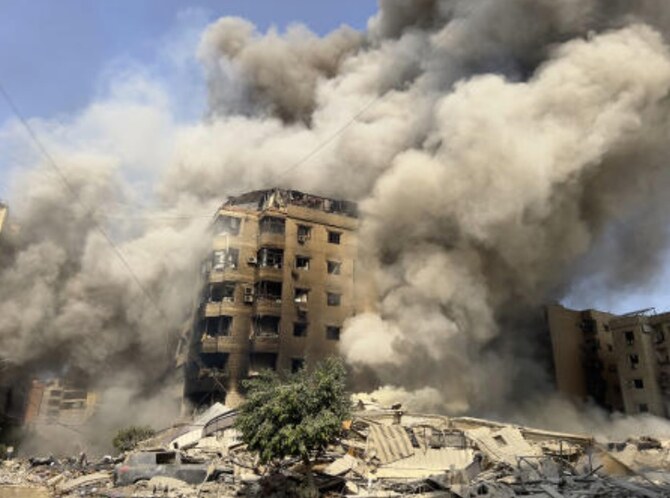
The southern suburb has become a ghost town, with unprecedented destruction visible near neighborhood landmarks, as well as flames rising from the rubble of flattened buildings.
A line of four residential buildings in Burj Al-Barajneh collapsed following the most recent Israeli strikes, and Israeli jets have circled over the area round the clock.
In a statement, the Israeli army claimed that its attacks “targeted a weapon factory and Hezbollah’s intelligence headquarters in Beirut’s southern suburb.”
Saaideh in western Baalbek was also hit by an airstrike, killing a citizen later identified as Hussein Saleh Amhaz and injuring several residents, including three women from the same family — a grandmother, her daughter and her granddaughter.
An Israeli raid also targeted a house in Al-Hallanieh, killing two people and injuring others.
Hezbollah operations targeted Israeli military positions and settlements on and across the border.
Israeli media said that the militant group launched 20 missiles at Kiryat Shmona, killing two people.
Hezbollah said that it targeted “a gathering of the Israeli enemy in the Kiryat Shmona settlement with a rocket salvo.”
Amid Israel’s invasion, Lebanese Prime Minister Najib Mikati said that Arab and international efforts to end Israel’s “aggression” are “ongoing.”
He added: “However, the Israeli intransigence and the efforts by the enemy to achieve what it considers as gains and victories are still obstructing the success of these efforts.
“Lebanon’s friends from the Arab and foreign countries also continue to pressure Israel into implementing a ceasefire for a specified period in order to discuss the main political steps, most importantly implementing Resolution 1701 fully, and compelling the Israeli enemy to implement it.”


Hezbollah repels Israeli incursions as deadly clashes continue
https://arab.news/vmr4r
Hezbollah repels Israeli incursions as deadly clashes continue

- The two sides exchanged fire early in the day across the Labouneh area, near the coastal border town of Naqoura
- The Lebanese border region experienced an unprecedented barrage of airstrikes from Tuesday night through Wednesday


US officials say Gaza stabilization force will not fight Hamas
- An American two-star general is under consideration to lead the ISF, but no decision has been made, officials said
NEW YORK: International troops could be deployed in the Gaza Strip as early as next month to form a UN-authorized stabilization force, two US officials said, but it remains unclear how Hamas will be disarmed.
Officials said the International Stabilization Force, or ISF, would not fight Hamas.
They said many countries have expressed interest in contributing, and US officials are currently working out the size of the ISF, its composition, housing, training, and rules of engagement.
There is a lot of quiet planning that’s going on behind the scenes right now for phase two of the peace deal.
Karoline Leavitt, White House spokesperson
An American two-star general is under consideration to lead the ISF, but no decision has been made, officials said.
Deployment of the force is a key part of the next phase of US President Donald Trump’s Gaza peace plan.
Under the first phase, a fragile ceasefire in the two-year war began on Oct.10, and Hamas released hostages, and Israel freed detained Palestinians.
“There is a lot of quiet planning that’s going on behind the scenes right now for phase two of the peace deal,” White House spokesperson Karoline Leavitt said.
“We want to ensure an enduring and lasting peace.”
Indonesia has said it is prepared to deploy up to 20,000 troops to take on health and construction-related tasks in Gaza.
“It is still in the planning and preparation stages,” said Rico Sirait, spokesperson of the Indonesian Defense Ministry.
“We are now preparing the organizational structure of the forces to be deployed.”
Israel still controls 53 percent of Gaza, while nearly all the 2 million people in the enclave live in the remaining Hamas-held area. The plan — which needs to be finalized by the so-called Board of Peace — is for the ISF to deploy in the area held by Israel, the US officials said.
Then, according to the Trump peace plan, as the ISF establishes control and stability, Israeli troops will gradually withdraw “based on standards, milestones, and timeframes linked to demilitarization.”
A UN Security Council resolution adopted on Nov. 17 authorized a Board of Peace and countries working with it to establish the ISF.
Trump said on Wednesday that an announcement on which world leaders will serve on the Board of Peace will be made early next year.
The Security Council authorized the ISF to work alongside newly trained and vetted Palestinian police to stabilize security “by ensuring the process of demilitarizing the Gaza Strip, including the destruction and prevention of rebuilding of the military, terror, and offensive infrastructure, as well as the permanent decommissioning of weapons from non-state armed groups.”
However, it remains unclear exactly how that would work.
US Ambassador to the UN Mike Waltz noted on Thursday that the Security Council authorized the ISF to demilitarize Gaza by all means necessary, which means the use of force.
“Obviously, that’ll be a conversation with each country,” he told Israel’s Channel 12, adding that discussions on rules of engagement were underway.
Hamas has said the issue of disarmament has not been discussed with them formally by the mediators — the US, Egypt, and Qatar — and the group’s stance remains that it will not disarm until a Palestinian state is established.
Israel’s Prime Minister Benjamin Netanyahu said in a speech on Sunday that the second phase would move toward demilitarization and disarmament.
“Now that raises a question: Our friends in America want to try and establish a multinational task force to do the job,” he said. “I told them I welcome it. Are volunteers here? Be my guest,” Netanyahu said.
“We know there are certain tasks that this force can perform ... but some things are beyond their abilities, and perhaps the main thing is beyond their abilities, but we will see about that,” he said.