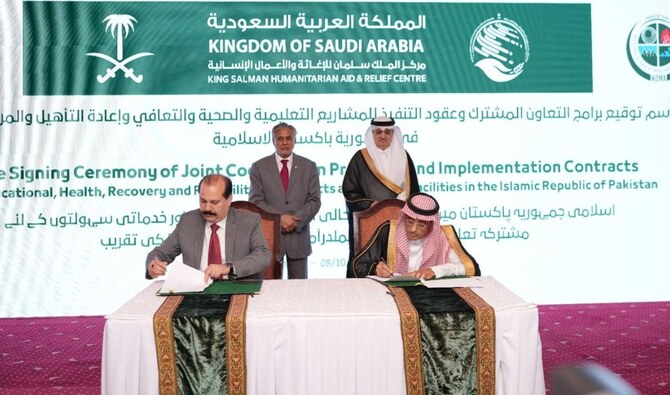


ISLAMABAD: The King Salman Humanitarian Aid and Relief Center (KSRelief) on Tuesday signed 12 agreements with different Pakistani institutions for a series of key public facilitation projects worth Rs4 billion ($14.41 million) aimed at rebuilding communities affected by natural disasters.
The Saudi organization has one of the largest humanitarian budgets available to any aid agency worldwide, which has allowed its officials to undertake a wide variety of projects in more than 100 countries.
Pakistan is the fifth-largest beneficiary of its aid and humanitarian activities and has greatly benefited from its assistance since the 2022 monsoon floods. The Saudi aid agency has completed 214 projects worth more than $184.6 million since 2005.
“Today, King Salman Relief Centre announced a series of key public facilitation projects worth about Rs4 billion aimed at rebuilding communities in Pakistan affected by natural disasters,” KSRelief said in a statement released after a ceremony in Islamabad.
Engineer Ahmed Ali Al-Baiz, Assistant Supervisor General of Operations at the aid agency, signed four different joint cooperation programs with Pakistan’s National Disaster Management Authority (NDMA), National Commission for Human Development (NCHD), Pakistan Red Crescent Society (PRCS), and the State Earthquake Reconstruction & Rehabilitation Authority (SERRA).
Additionally, eight different contracts for public facilitation projects were formalized.
The event was attended by Deputy Prime Minister Ishaq Dar, Saudi Ambassador to Pakistan Nawaf bin Said Al-Malki, representatives of NDMA, PRCS, and various UN missions in Pakistan.
Al-Baiz told Arab News on the sidelines of the event that the KSRelief office in Pakistan was one of the biggest outside the kingdom.
“The [recently signed] projects relate to health, education, housing, and disaster preparedness, where the King Salman Relief Center will spend more than $14 million,” he said.
KSRelief said it would focus on the construction of the national humanitarian response facility for NDMA, which will significantly enhance the country’s ability to store and distribute relief supplies during emergencies.
Additionally, it aims to build 1,000 permanent houses for families displaced by the 2022 floods, providing safe housing for nearly 7,000 individuals in Khyber Pakhtunkhwa and Punjab provinces.
The Saudi aid agency’s future projects also include the construction of 300 community feeder schools across Pakistan, particularly in underserved regions like Gilgit-Baltistan and Azad Kashmir.
“Upon completion, these schools will be handed over to the National Commission for Human Development (NCHD), ensuring long-term sustainability and management,” KSRelief added.
It also plans to renovate 22 critical facilities, including schools, health centers, and water projects previously constructed in response to the 2005 earthquake and 2010 floods, to improve access to education, healthcare, and clean water.
Addressing the ceremony, the deputy prime minister said the Saudi-Pakistan agreements reflect the time-tested and fraternal relations between the two states.
“The kingdom’s generous pledge to construct 1,000 housing units and 300 schools across Pakistan and rehabilitate 22 previously implemented projects showcases the scale of ongoing humanitarian assistance being offered and implemented,” he said.
Dar assured KSRelief of the government’s continued support and assistance in carrying out the important work they are doing for the people of Pakistan.
Idrees Mehsud, a senior NDMA official, said the new projects would go a long way in developing resilience within the country during times of disaster.
“Today’s agreements will be another milestone as the NDMA is being supported by KSRelief in its endeavors to shift its response-oriented approach to a more proactive one,” he added.
The Saudi ambassador said KSRelief was at the forefront of serving humanity, adding that it was continuing its support for Pakistan and its people.
“This project is over $14 million and is to build about 1,000 housing units, 300 schools, and four storage facilities,” he told Arab News.