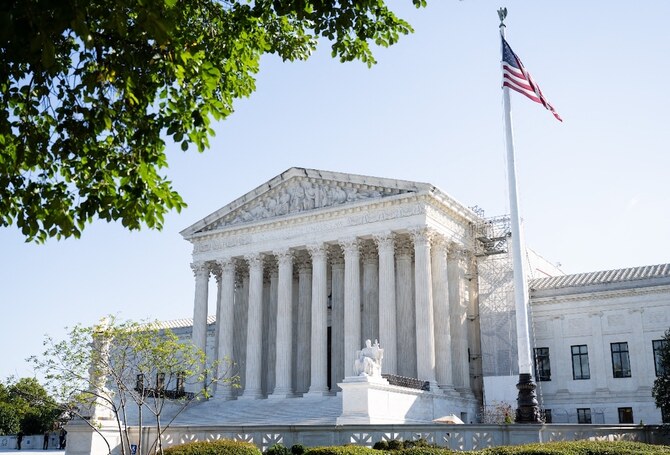
WASHINGTON: The US Supreme Court hears a challenge on Tuesday to federal regulation of “ghost guns” — firearms sold in easy-to-assemble kits.
Gun manufacturers and owners are objecting to a 2022 rule from the Bureau of Alcohol, Tobacco, Firearms and Explosives (ATF) that requires ghost guns, like other firearms, to have serial numbers and for purchasers to undergo background checks.
The ATF rule also requires commercial sellers of what are known as “buy-build-shoot” kits to be licensed and maintain records.
Attorney General Merrick Garland has defended the rule under the Gun Control Act of 1968, saying it makes it “harder for criminals and other prohibited persons to obtain untraceable guns.”
According to ATF figures, nearly 20,000 ghost guns were recovered at crime scenes in the United States in 2021, a tenfold increase from 2016.
Ghost guns, some of which include parts made by 3D printers, are sold online or in stores in kits that can be assembled at home.
Gunmakers and gun rights groups challenged the ATF rule. A federal judge in Texas ruled that the bureau had exceeded its authority and that such regulation is up to Congress.
The Biden administration appealed to the US Supreme Court after the district court ruling was upheld by a conservative-dominated appeals court panel.
The Supreme Court, by a slim 5-4 vote, stayed the order of the lower courts striking down the ATF rule pending Tuesday’s oral arguments in the case.
In their brief to the Supreme Court, the gun rights groups said “an incomplete collection of parts is not a ‘weapon’” and ghost gun kits should not be considered “firearms” under the Gun Control Act.
Solicitor General Elizabeth Prelogar, in her brief, said ghost gun manufacturers are seeking to get around the ATF rule using “trivial evasion” and included an analogy to the Swedish home goods giant IKEA.
“If a State placed a tax on the sale of tables, chairs, couches, and bookshelves, IKEA could not avoid paying by insisting that it does not sell any of those items and instead sells ‘furniture parts kits’ that must be assembled by the purchaser,” Prelogar wrote.
“So too with guns: A company in the business of selling kits that can be assembled into working firearms in minutes... is in the business of selling firearms.”
The Supreme Court is expected to deliver a decision in the case before the end of June 2025.

US Supreme Court to hear ‘ghost guns’ regulation case
Short Url
https://arab.news/mhq3n
US Supreme Court to hear ‘ghost guns’ regulation case
- The ATF rule also requires commercial sellers of what are known as “buy-build-shoot” kits to be licensed and maintain records
Tourists empty out of Cuba as US fuel blockade bites
- Several nations have advised against travel to Cuba since the US tightened a decades-old embargo
- The island of 9.6 million inhabitants has faced hard times since the US trade embargo took hold in 1962
HAVANA: With rolling power cuts, hotel closures, and flight routes suspended for lack of fuel, tourists are gradually emptying out of Cuba, deepening a severe crisis on the cash-strapped island.
Several nations have advised against travel to Cuba since the US tightened a decades-old embargo by choking vital oil imports.
“I found only one taxi,” said French tourist Frederic Monnet, who cut short a trip to a picturesque valley in western Cuba to head back to Havana.
“There might be no taxis afterward,” he said.
A petroleum shortage has led to regular hours-long power cuts, long queues at petrol stations, and has forced many airlines to announce that they will cancel regular services.
About 30 hotels and resorts across the island are being temporarily closed due to low occupancy and fuel rationing, according to an internal Tourism Ministry document obtained by AFP.
Since January, a flotilla of US warships have stopped Venezuelan tankers from delivering oil to Cuban ports.
Washington has also threatened Mexico and other exporter with punitive tariffs if they continue deliveries.
Several Canadian and Russian airlines are sending empty flights to Cuba to retrieve thousands of otherwise stranded passengers, and others are introducing refueling stops in the route home.
American tourist Liam Burnell contacted his airline to make sure he could get a flight back.
“There was a danger that I might not be able to return, because the airport says it doesn’t have enough fuel for the planes,” he said.
‘Critical, critical’
An absence of tourists is more than an inconvenience for the Cuban government.
Tourism is traditionally Cuba’s second major source of foreign currency, behind revenue from doctors sent abroad.
The revenue is vital to pay for food, fuel, and other imports.
And the 300,000 Cubans who make a living off the tourist industry are already feeling the pinch.
A hop-on, hop-off bus touring Havana’s sites on Thursday was virtually empty.
Horses idled in the shade of colonial buildings, waiting for carriages to fill with visitors.
“The situation is critical, critical, critical,” said 34-year-old Juan Arteaga, who drives one of the island’s many classic 1950s cars so beloved by tourists.
“There are few cars (on the street) because there is little fuel left. Whoever had a reserve is keeping it,” he said.
“When my gasoline runs out, I go home. What else can I do?” he said.
The island of 9.6 million inhabitants has faced hard times since the US trade embargo took hold in 1962, and in recent years the severe economic crisis has also been marked by shortages of food and medicine.
On Thursday, two Mexican navy ships arrived in Cuba with more than 800 tons of much-needed humanitarian aid — fresh and powdered milk, meat, cookies, beans, rice and personal hygiene items, according to the Mexican foreign ministry.
Musician Victor Estevez said because tourism has been “a lifeline for all Cubans...if that is affected, then we are really going to be in trouble.”
“The well-being of my family depends on me.”
The tourism sector had already been severely hit by the Covid-19 pandemic, experiencing a 70 percent decline in revenue between 2019 and 2025.
Tourism expert Jose Luis Perello said the island now faces the prospect of “a disastrous year.”
Several nations have advised against travel to Cuba since the US tightened a decades-old embargo by choking vital oil imports.
“I found only one taxi,” said French tourist Frederic Monnet, who cut short a trip to a picturesque valley in western Cuba to head back to Havana.
“There might be no taxis afterward,” he said.
A petroleum shortage has led to regular hours-long power cuts, long queues at petrol stations, and has forced many airlines to announce that they will cancel regular services.
About 30 hotels and resorts across the island are being temporarily closed due to low occupancy and fuel rationing, according to an internal Tourism Ministry document obtained by AFP.
Since January, a flotilla of US warships have stopped Venezuelan tankers from delivering oil to Cuban ports.
Washington has also threatened Mexico and other exporter with punitive tariffs if they continue deliveries.
Several Canadian and Russian airlines are sending empty flights to Cuba to retrieve thousands of otherwise stranded passengers, and others are introducing refueling stops in the route home.
American tourist Liam Burnell contacted his airline to make sure he could get a flight back.
“There was a danger that I might not be able to return, because the airport says it doesn’t have enough fuel for the planes,” he said.
‘Critical, critical’
An absence of tourists is more than an inconvenience for the Cuban government.
Tourism is traditionally Cuba’s second major source of foreign currency, behind revenue from doctors sent abroad.
The revenue is vital to pay for food, fuel, and other imports.
And the 300,000 Cubans who make a living off the tourist industry are already feeling the pinch.
A hop-on, hop-off bus touring Havana’s sites on Thursday was virtually empty.
Horses idled in the shade of colonial buildings, waiting for carriages to fill with visitors.
“The situation is critical, critical, critical,” said 34-year-old Juan Arteaga, who drives one of the island’s many classic 1950s cars so beloved by tourists.
“There are few cars (on the street) because there is little fuel left. Whoever had a reserve is keeping it,” he said.
“When my gasoline runs out, I go home. What else can I do?” he said.
The island of 9.6 million inhabitants has faced hard times since the US trade embargo took hold in 1962, and in recent years the severe economic crisis has also been marked by shortages of food and medicine.
On Thursday, two Mexican navy ships arrived in Cuba with more than 800 tons of much-needed humanitarian aid — fresh and powdered milk, meat, cookies, beans, rice and personal hygiene items, according to the Mexican foreign ministry.
Musician Victor Estevez said because tourism has been “a lifeline for all Cubans...if that is affected, then we are really going to be in trouble.”
“The well-being of my family depends on me.”
The tourism sector had already been severely hit by the Covid-19 pandemic, experiencing a 70 percent decline in revenue between 2019 and 2025.
Tourism expert Jose Luis Perello said the island now faces the prospect of “a disastrous year.”
© 2026 SAUDI RESEARCH & PUBLISHING COMPANY, All Rights Reserved And subject to Terms of Use Agreement.