

Pakistan calls for disaster preparedness, better infrastructure on 19th anniversary of deadly 2005 earthquake

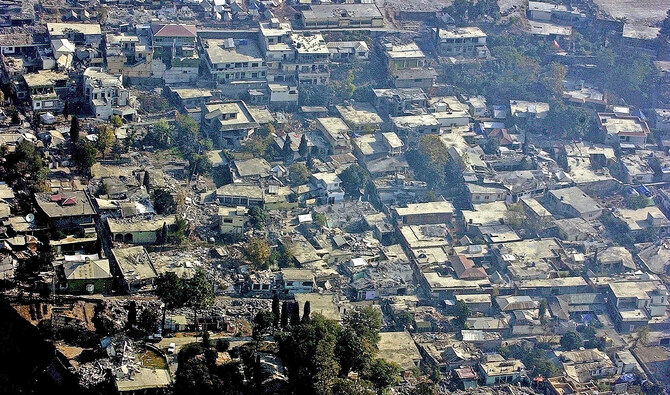
An aerial view of collapsed houses in the earthquake affected area of Muzaffarabad the capital of Pakistan-administered Kashmir, 08 December 2005. (AFP/File)
Short Url
Updated 08 October 2024
Follow

Pakistan calls for disaster preparedness, better infrastructure on 19th anniversary of deadly 2005 earthquake

  • Over 86,000 people were killed, 69,000 injured on Oct. 8, 2005 in Pakistan after 7.6-magnitude quake 
  • Pakistan is recognized as one of the most vulnerable countries to climate change effects in the world

KARACHI: Prime Minister Shehbaz Sharif stressed the need for improved disaster preparedness and safer infrastructure in the country to deal with natural disasters, including those that stem from climate change effects, state-run media reported on Tuesday as Pakistan marks the 19th anniversary of the 2005 deadly earthquake that killed thousands across the country. 

At least 86,000 people were killed and more than 69,000 injured in northern Pakistan on Oct. 8, 2005, when a 7.6-magnitude earthquake struck the country, razing thousands of buildings to the ground. It is considered the deadliest earthquake in South Asia, surpassing the 1935 Quetta earthquake which killed up to 60,000 people.

Pakistan is regarded as one of the most vulnerable countries to climate change effects. Heavy monsoon rains and melting of glaciers triggered flash floods in June 2022 that killed at least 1,700 people and washed away large swathes of crops. Pakistan says it suffered losses of over $30 billion due to the floods. 

“PM Sharif said the government’s policy initiatives should encompass various sectors, including safe infrastructure development, improved disaster preparedness, poverty alleviation, safer spatial land use planning, adherence to building codes, efficient water resource management, sound agricultural practices, and increased afforestation nationwide including coastal areas,” the state-run Associated Press of Pakistan (APP) said. 

Sharif urged all stakeholders to form synergy by understanding each other’s strengths and limitations, and by achieving interoperability among national, global, public and private sectors, the APP said. 

The prime minister stressed the need for “efficient and effective” coordination and the development of contingency plans to protect communities living in Pakistan’s remote areas. He lamented how Pakistan was facing the worst impacts of climate change despite being responsible for only 0.88 percent of the world’s greenhouse gas emissions. 

“Frequent recurrence of unpredictable extreme events have given a devastating blow to our struggling economy,” Sharif was quoted as saying by the APP. 


Pakistan to discuss regional issues, economic ties at UAE summit this week

Updated 12 December 2025
Follow

Pakistan to discuss regional issues, economic ties at UAE summit this week

  • Deputy PM Ishaq Dar to attend Sir Bani Yas Forum from Dec. 12-14, says Pakistan foreign office
  • Senior statemen, policymakers expected to discuss security and economic cooperation at summit

ISLAMABAD: Pakistan’s Deputy Prime Minister Ishaq Dar will attend the Sir Bani Yas Forum in the UAE from Dec. 12-14 to discuss regional issues with world leaders and explore economic partnerships, the foreign ministry said on Friday. 

The three-day summit features senior statesmen, policymakers and global experts from around the world with discussions likely to revolve around key regional and international issues such as peace, security and economic cooperation.

Dar, who is also Pakistan’s foreign minister, attended the 15th edition of the Bani Yas Forum last year. He is attending this year’s summit at the invitation of his UAE counterpart, Sheikh Abdullah bin Zayed Al Nahyan, the foreign office said. 

“During the Forum, the Deputy Prime Minister/Foreign Minister will engage with international leaders and experts on matters related to regional stability, sustainable development, and the expansion of economic partnerships,” the statement said. 

“He will also present Pakistan’s perspectives on promoting dialogue, addressing regional challenges, and fostering enhanced opportunities for economic cooperation.”

The Forum is expected to feature important discussions on Israel’s war in Gaza and the fragile ceasefire in the Middle East. 

Pakistan has consistently criticized Israel for violating the ceasefire in Gaza and has called on the international community to intervene and ensure the fragile agreement does not collapse. 

Islamabad has also been eyeing economic partnerships with regional allies, particularly Gulf countries, at such global summits in recent months. 

It has entered into economic, defense, trade and investment agreements with traditional allies such as China, Saudi Arabia, UAE, Qatar and Central Asian states in recent months.