
BEIRUT: Palestinian journalist Islam Al-Zaanoun was so determined to cover the war in Gaza that she went back to work two months after giving birth. But, like all journalists in Gaza, she wasn’t just covering the story — she was living it.
The 34-year-old, who works for Palestine TV, gave birth to a girl in Gaza city a few weeks after the beginning of the Israeli offensive last October.
She had to have a Caesarean section as Israeli airstrikes pounded the strip. Her doctors performed the operation in the dark with only the lights on their cellphones to guide them.
The next day she went home but the day after that she had to flee the fighting, driving further south with her three children. Nine days after giving birth, she was forced to abandon her car and continue on foot.
“I had to walk eight km (five miles) to get to the south with my children,” she said. “There were bodies and corpses everywhere, horrifying sight. I felt my heart was going to stop from the fear.”
Just 60 days later, she got back in front of the camera to report on the war, joining the ranks of Palestinian journalists who have provided the world’s only window on the conflict in the absence of international media, who have not been granted free access by Israeli authorities.
“Correspondents have reporting in their blood, they don’t learn it, so they cannot be far from the coverage too long,” Al-Zaanoun told the Thomson Reuters Foundation.
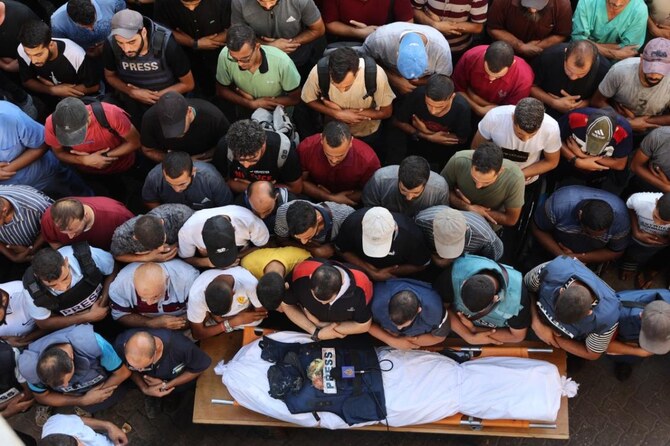
As of Oct. 4, at least 127 journalists and media workers had been killed since the conflict began, according to the US-based Committee to Protect Journalists.
This has made the past year the deadliest period on record for journalists since the press watchdog started keeping records in 1992.
Press freedom advocacy group Reporters Without Borders has recorded more than 130 Palestinian journalists killed in Gaza in the past year, including at least 32 media workers who it says were directly targeted by Israel.
To date, CPJ has determined that at least five journalists were directly targeted by Israeli forces in killings which CPJ classifies as murders.
They include Reuters journalist Issam Abdallah, 37, who was killed by an Israeli tank crew in southern Lebanon last October, a Reuters investigation has found.
CPJ is still researching the details for confirmation in at least 10 other cases that indicate possible targeting.
Lt. Col. Richard Hecht, the Israel Defense Forces’ international spokesman, said at the time of Abdallah’s killing: “We don’t target journalists.” He did not provide further comment.
More than 41,600 people have been killed in Gaza and almost 100,000 have been wounded since Oct. 7, according to Gaza’s health ministry.
Israel launched its offensive after Hamas stormed into southern Israel, killing about 1,200 people and taking more than 250 hostage, according to Israeli tallies.
’WHERE IS THE INTERNATIONAL LAW?’
For journalists like Al-Zaanoun, the challenges are not limited to staying safe while reporting. Like the rest of the 2.3 million people in the strip, media workers have been displaced multiple times, gone hungry, lacked water and shelter and mourned dead neighbors and friends.
Food is scarce, diapers are expensive, and medicine is lacking, Al-Zaanoun said. As well as her professional desire to keep reporting, she needs to put food on the table because her husband has not been able to work since the war started.
“If I don’t work, my kids will go hungry,” she said.
Like all Gazans, she fears for her safety and does not dare defy Israeli evacuation orders.
“We had no protection really. Had we decided to stay in the northern areas that would have definitely cost us a very high price and that is what happened to our friends,” she said.
The Israel-Hamas war falls under a complex international system of justice that has emerged since World War Two, much of it aimed at protecting civilians. Even if states say they are acting in self-defense, international rules regarding armed conflict apply to all participants in a war.
Article 79 of the Geneva Conventions treats journalists working in conflict settings as protected civilians if they don’t engage in the fighting.
In March, senior leaders at multiple global media outlets signed a letter urging Israeli authorities to protect journalists in Gaza, saying reporters have been working in unprecedented conditions and faced “grave personal risk.”
What CPJ has called “the most dangerous” war for journalists has reverberated across the world, striking fear into reporters who are concerned about the setting of deadly precedents.
Abdalle Ahmed Mumin, a veteran freelance reporter and the secretary general of the Somali Journalists Syndicate, said he had experienced violence before but was shocked by what was happening in Gaza.
“I have been targeted personally myself. I have been detained, I have been unjustly kidnapped several times,” he said in an interview with the Thomson Reuters Foundation.
“I know all these things, but I haven’t witnessed the kind of brutality that the journalists in Gaza have been going through.”
Since 1992, 18 of Mumin’s friends and colleagues have been killed in Somalia, where first warlords and later Al-Qaeda-linked Al-Shabab militants have caused years of conflict.
“I’m scared of being a journalist … because of the failure of the international protection mechanisms, the failure of the international community,” he said. “Where is the international law? Where is the international humanitarian law?“