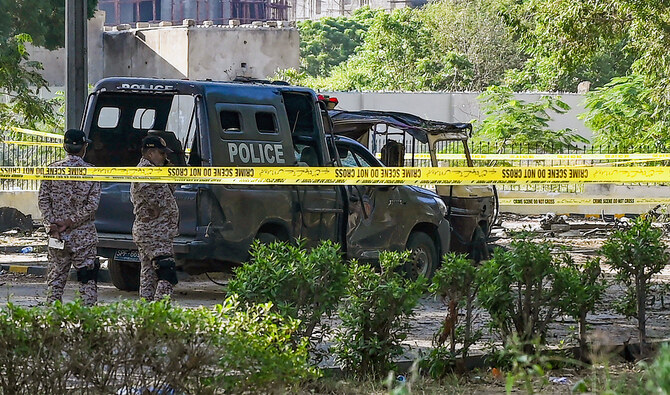
ISLAMABAD: Two Chinese nationals were killed in an explosion near the international airport of the southern Pakistani city of Karachi on Sunday night, the Chinese embassy in Pakistan said, in what it described as a “terrorist attack.”
Separatist militant group the Baloch Liberation Army (BLA) claimed responsibility for the attack, which they said had targeted Chinese nationals, including engineers. Here are some facts about the group, which has specifically targeted Chinese interests in the past.
WHAT ARE THE BLA’S GOALS?
The BLA seeks independence for Balochistan, a province located in Pakistan’s southwest and bordering on Afghanistan to the north and Iran to the west. It is the biggest of several ethnic insurgent groups that have battled the federal government for decades, saying it unfairly exploits Balochistan’s rich gas and mineral resources.
Balochistan is home to key mining projects, including Reko Diq, run by mining giant Barrick Gold and believed to be one of the world’s largest gold and copper mines. China also operates a gold and copper mine in the province.
WHAT ARE THE BLA’S TARGETS?
The BLA often targets key infrastructure projects and security posts in Balochistan, but has also launched attacks in other areas — most notably in Karachi, where a convoy from the Port Qasim Electric Power Company was attacked near the airport on Sunday.
In August, the BLA launched several coordinated attacks in Balochistan, killing more than 70 people.
The BLA specifically targets Chinese interests, in particular the strategic port of Gwadar on the Arabian Sea, accusing Beijing of helping Islamabad to exploit the province.
It has previously killed Chinese citizens working in the region and attacked Beijing’s consulate in Karachi. The BLA showed its muscle when it stormed army and naval bases in 2022, and has expanded its traditional use of guerrilla gunmen to include women suicide bombers, as seen in an attack on Chinese nationals on a university campus in Karachi, also in 2022. The group has also targeted both military and Chinese officials, including launching an attack on Gwadar in March. The BLA, separately, was also at the center of tit-for-tat strikes earlier this year between Iran and Pakistan over what they called militant bases on each other’s territory, which brought the two neighbors close to war.
THE ATTACK’S SIGNIFICANCE
Pakistan is preparing to host the Shanghai Cooperation Organization summit in the capital Islamabad next week, which authorities have vowed to secure, as high-level Chinese representation is expected, as well as the first visit to the country by an Indian foreign minister in a decade.
Beijing and Islamabad are working together in the aftermath of Sunday’s attack, with Pakistani Prime Minister Shehbaz Sharif saying that the country would “leave no stone unturned” to ensure the security and well-being of its “Chinese friends.”
Balochistan is an important part of China’s $65 billion investment in the China Pakistan Economic Corridor, a wing of President Xi Jinping’s Belt and Road initiative.
The decades-old insurgency has continued to keep the province of some 15 million people unstable and created security concerns around Pakistan’s plans to access untapped resources under Balochistan’s desert and mountainous terrain. It is Pakistan’s largest province by size, but the smallest by population and strategically located.
Balochistan also has a long Arabian Sea coastline in the south, not far from the Gulf’s Strait of Hormuz oil shipping lane. Hundreds of Balochs, many of them women, have protested in Islamabad and in Balochistan recently over alleged abuses by security forces — accusations the Pakistani government denies.


![]()

Who are Pakistan’s ethnic militants behind attack near Karachi airport?
Short Url
https://arab.news/wkegh
Who are Pakistan’s ethnic militants behind attack near Karachi airport?
- Separatist militant group the Baloch Liberation Army (BLA) claimed responsibility for the attack, which they said had targeted Chinese nationals
- The BLA specifically targets Chinese interests, in particular Gwadar port on Arabian Sea, accusing Beijing of helping Islamabad exploit Balochistan
Latest updates


© 2026 SAUDI RESEARCH & PUBLISHING COMPANY, All Rights Reserved And subject to Terms of Use Agreement.