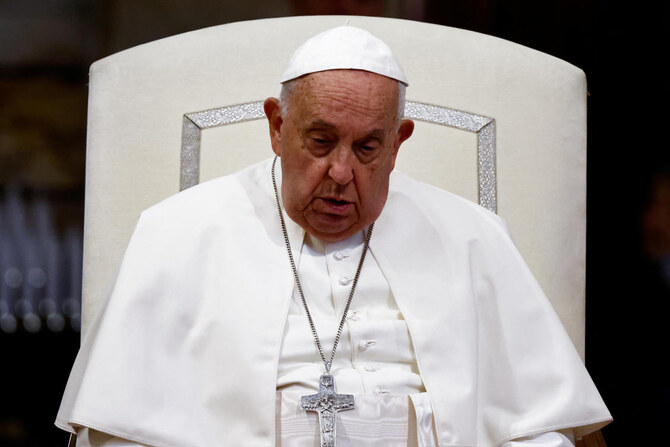
VATICAN CITY: Pope Francis on Monday slammed the “shameful inability” of world powers to end the conflict in the Middle East, on the first anniversary of Hamas’s deadly October 7 attack on Israel.
“A year ago, the fuse of hatred was lit; it did not sputter, but exploded in a spiral of violence, in the shameful inability of the international community and the most powerful countries to silence the weapons and put an end to the tragedy of war,” he said in an open letter to Catholics in the Middle East.
“Blood is still being shed, as are tears. Anger is growing, along with the desire for revenge, while it seems that few people care about what is most needed and what is most desired: dialogue and peace.”
The 87-year-old had previously declared Monday a global day for prayer and fasting for peace, following similar initiatives for other conflicts in recent years.
In his letter, the leader of the world’s almost 1.4 billion Catholics offered solidarity with followers in the region — “a small, defenseless flock” — on what he called “this sad day.”
But the pope also addressed “the men and women of every confession and religion who in the Middle East are suffering from the insanity of war: I am close to you, I am with you.”
“I am with you, who have no voice, for despite all the talk of plans and strategies, there is little concern for those who suffer the devastation of war, which the powerful impose on others; yet they will be subject to the inflexible judgment of God,” he added.

Pope slams ‘shameful’ failure of diplomacy in Mideast
https://arab.news/6cqg6
Pope slams ‘shameful’ failure of diplomacy in Mideast
- The 87-year-old had previously declared Monday a global day for prayer and fasting for peace, following similar initiatives for other conflicts in recent years
UN rights chief slams dangerous ‘tit-for-tat dynamic’ in Mideast war
- Turk deplored the extensive attacks in residential areas, on health facilities, schools, cultural property and water and energy infrastructure
- He stressed that “under the laws of war, civilians and civilian infrastructure must be protected at all costs“
GENEVA: The United Nations rights chief voiced alarm Tuesday at the Middle East conflict’s deepening impact on civilians, warning of the dangers of the seeming “tit-for-tat dynamic” between the warring sides.
The United States and Israel began striking Iran on February 28, prompting waves of Iranian strikes across the Gulf.
With hostilities intensifying, UN High Commissioner for Human Rights Volker Turk deplored the extensive attacks in residential areas, on health facilities, schools, cultural property and water and energy infrastructure.
“This apparent tit-for-tat dynamic, involving essential infrastructure with extremely significant civilian impacts, will only increase risks for civilian populations more broadly, with potentially dire consequences across the entire region,” he warned in a statement.
Turk stressed that “under the laws of war, civilians and civilian infrastructure must be protected at all costs.”
“All parties are bound by these rules, and must be held to account if they do not,” he said, warning: “the world is watching.”
The UN rights chief warned that “strikes against vital civilian infrastructure in the Middle East — as well as the widening geographic spread of strikes — are further increasing risks for populations across the region, and beyond.”
He pointed to strikes on a water desalination plant and fuel facilities in Iran over the weekend, igniting fires and reportedly disrupting water access for dozens of villages.
It also prompted warnings of “acid rain” that could cause chemical burns and serious lung damage.
“The foreseeable impacts on civilians and the environment of these strikes raise serious questions as to compliance of these attacks with the requirements of international humanitarian law of proportionality and precaution,” Turk said.
“This warrants careful legal scrutiny.”
He also highlighted the broader impact of the war.
The plunge in commercial shipping activity through the Strait of Hormuz was taking a severe toll on access to energy, food and fertilizer across the region and beyond — hitting the world’s most vulnerable people the hardest.
Turk raised concern about reports of detentions, charges and other forms of repression and intimidation against people in a number of countries, in connection with their expression of opinions around the Middle East conflict.
He demanded that all those arbitrarily detained be released immediately and unconditionally.
“States are reminded of their obligation under international human rights law to respect and protect people’s right to freedom of expression — particularly in times of crisis,” he said.


