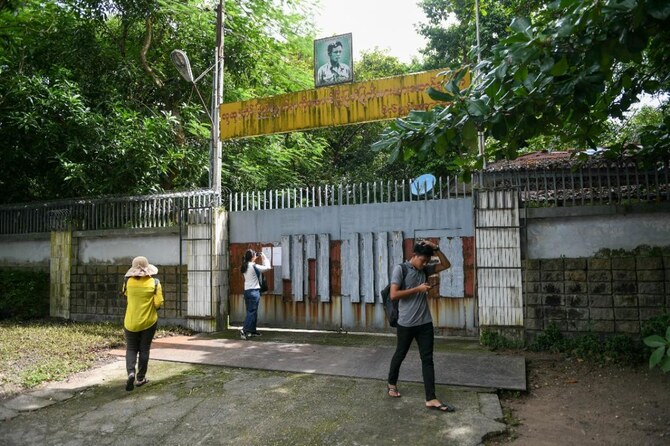
Close ally of Myanmar’s Suu Kyi dies of leukaemia: source

He was arrested following the military’s latest coup in 2021 and jailed for corruption. He was recently released on health grounds. (AFP)
Short Url
Updated 07 October 2024
Follow

Close ally of Myanmar’s Suu Kyi dies of leukaemia: source

YANGON: A close ally of detained Myanmar democracy leader Aung San Suu Kyi died of leukaemia on Monday, a party source told AFP, days after being released from junta custody on health grounds.
Zaw Myint Maung, 72, who spent around two decades in prison for defying Myanmar’s military, was a close confidante of Suu Kyi and a lynchpin of the National League for Democracy (NLD).
He was arrested following the military’s latest coup in 2021 and jailed for corruption. He was recently released on health grounds.
“We got confirmation of his death. It’s a big loss for us as he was one of our NLD vice-chairmen,” a senior party source told AFP, requesting anonymity to speak to the media.
The source said Zaw Myint Maung had died of leukaemia.
“Although we were prepared we might lose him one day, we are sorry for losing him in this difficult situation. We have to move forward for democracy with the leaders we have.”
Zaw Myint Maung was detained along with other senior NLD figures following the 2021 coup that upended a 10-year experiment with democracy and returned the Southeast Asian nation to military rule.
In 1988 he led a doctors’ strike as part of huge pro-democracy uprisings that thrust Suu Kyi into the spotlight in Myanmar — then called Burma.
In 1989 he left his job in a university biochemistry department and joined the NLD.
The military later imprisoned him for around two decades for his activism.
After the generals enacted democratic reforms and the NLD won a landslide in the 2015 elections, he became the chief minister of the Mandalay region.
The year before the putsch Suu Kyi described him as a “real hardcore and a comrade who has been together with us since the very beginning [of our party].”
The 2021 coup sparked widespread armed opposition to military rule that the junta has failed to crush more than three years later.
Almost three million people have been forced from their homes by the conflict, according to the United Nations.
The junta’s crackdown on dissent has decimated the senior ranks of the NLD.
Months after the coup Nyan Win, a former NLD spokesman and Suu Kyi confidante died of Covid-19 while being held in military custody for sedition.
In 2022 another former lawmaker was executed by the junta in Myanmar’s first use of capital punishment in decades.
In March last year, the junta dissolved the NLD for failing to re-register under a tough new military-drafted electoral law, removing it from polls it has indicated it may hold in 2025.
Suu Kyi, 79, is serving a 27-year prison sentence on charges ranging from corruption to not respecting Covid-19 pandemic restrictions.
Rights groups say her closed-door trial was a sham designed to remove her from the political scene.
Last month Italian media reported that Pope Francis has offered refuge on Vatican territory to Suu Kyi, who led the government ousted by the military in 2021.


Lawsuit challenges Trump administration’s ending of protections for Somalis

Updated 8 sec ago
Follow

Lawsuit challenges Trump administration’s ending of protections for Somalis

  • The lawsuit cites a series of statements Trump has made describing Somalis as “garbage” and “low IQ people” who “contribute nothing.”

BOSTON: Immigrant rights advocates filed a lawsuit on Monday seeking to stop US President Donald Trump’s administration from next ​week ending legal protections that allow nearly 1,100 Somalis to live and work in the United States. The lawsuit, brought by four Somalis and two advocacy groups, challenges the US Department of Homeland Security’s decision to end Temporary Protected Status for Somali immigrants, whom Trump has derided in public remarks. Outgoing Homeland Security Secretary Kristi Noem in January announced that TPS for Somalis would end on March 17, arguing that Somalia’s conditions had improved, despite fighting continuing between Somali forces and Al-Shabab militants. The plaintiffs, who ‌include the groups ‌African Communities Together and Partnership for the Advancement ​of ‌New ⁠Americans, in the ​lawsuit filed ⁠in Boston federal court argue the move was procedurally flawed and driven by a discriminatory, predetermined agenda.
The lawsuit cites a series of statements Trump has made describing Somalis as “garbage” and “low IQ people” who “contribute nothing.”
The plaintiffs said the administration is ending TPS for Somalia and other countries due to unconstitutional bias against non-white immigrants, not based on objective assessments of country conditions.
“The termination of TPS for Somalia is racism masking as immigration policy,” ⁠Omar Farah, executive director at the legal group Muslim Advocates, said ‌in a statement.
DHS did not respond to ‌a request for comment. It has previously said TPS ​was “never intended to be a de ‌facto amnesty program.”
TPS is a form of humanitarian immigration protection that shields eligible migrants ‌from deportation and allows them to work. Under Noem, DHS has moved to end TPS for a dozen countries, sparking legal challenges. The administration on Saturday announced plans to pursue an appeal at the US Supreme Court in order to end TPS for over 350,000 Haitians. It ‌also wants the high court to allow it to end TPS for about 6,000 Syrians.

SOMALI COMMUNITY TARGETED
Somalia was first designated ⁠for TPS in ⁠1991, with its latest extension in 2024. About 1,082 Somalis currently hold TPS, and 1,383 more have pending applications, according to DHS. Somalis in Minnesota in recent months had become a target of Trump’s immigration crackdown, with officials pointing to a fraud scandal in which many people charged come from the state’s large Somali community. The Trump administration cited those fraud allegations as a basis for a months-long immigration enforcement surge in Democratic-led Minnesota, during which about 3,000 immigration agents were deployed, spurring protests and leading to the killing of two US citizens by federal agents.
In November, Trump announced he would end TPS for Somalis in Minnesota, and a month later said ​he wanted them sent “back to where they ​came from.”
The US Department of State advises against traveling to Somalia, citing crime and civil unrest among numerous factors.