Top official of ex-PM Khan party resurfaces in provincial assembly session after going ‘missing’ in Islamabad

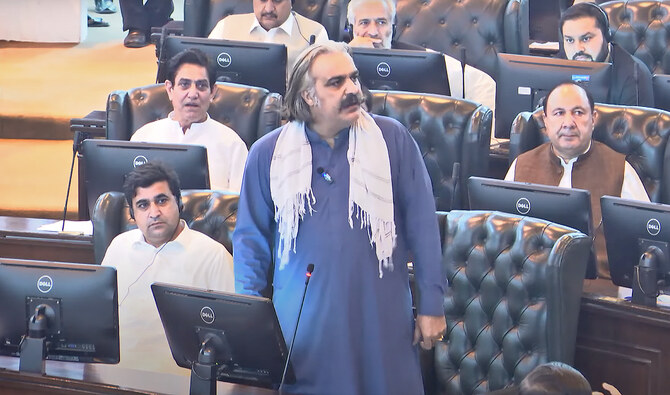
The screenshot taken from the KP Assembly Official live stream video on October 6, 2024, shows Ali Amin Gandapur, a key official of former prime minister Imran Khan’s Pakistan Tehreek-e-Insaf (PTI) opposition party, addressing Khyber Pakhtunkhwa (KP) provincial in Peshawar, Pakistan. ( KP Assembly Official/YouTube)
Short Url
Updated 07 October 2024
Follow

Top official of ex-PM Khan party resurfaces in provincial assembly session after going ‘missing’ in Islamabad

  • Ali Amin Gandapur, who heads the government of Khan's party in Khyber Pakhtunkhwa, went missing after leading thousands of Khan supporters to Islamabad
  • In a surprise turn of events, CM Gandapur resurfaced during a session of the KP assembly on Sunday evening amid cheers and applause from members of House

ISLAMABAD: Ali Amin Gandapur, a key official of former prime minister Imran Khan’s Pakistan Tehreek-e-Insaf (PTI) opposition party, resurfaced during a session of the Khyber Pakhtunkhwa (KP) provincial assembly on Sunday, after having gone missing during his party’s protest in Islamabad a day ago.

Gandapur, who heads the government of Khan’s party in KP, went missing after leading thousands of Khan supporters to the Pakistani capital to protest the government’s proposed constitutional amendments that the PTI claims are aimed at curtailing the independence of the judiciary, the government denies this. The PTI also aimed to mount pressure for the release of its leader who is in jail since August last year.

Mystery continued to surround the whereabouts of Gandapur on Sunday as the PTI protest entered its third day, with at least one policeman killed in clashes and almost 900 demonstrators arrested. The PTI alleged that CM Gandapur had been “kidnapped,” while Pakistan’s Interior Minister Mohsin Naqvi denied the PTI’s claims that the KP chief minister had been abducted by the Islamabad police or intelligence agencies.

In a surprise turn of events, Chief Minister Gandapur resurfaced during a session of the KP assembly on Sunday evening, amid cheers and applause from members of the House. Shortly afterward, he launched into a fiery speech in which he criticized the federal authorities for the road blockades and “torture” to prevent Khan supporters from entering Islamabad.

“We were protesting peacefully, they blocked the roads and tortured the workers,” he said. “Worst violence and shelling was done in Pathargarh, Burhan and other places. They used to say that we could not reach the D-Chowk [in Islamabad], but we reached there. Our protest was not a sit-in, we recorded the protest successfully.”

The KP chief minister accused the Islamabad Inspector-General Ali Nasir Rizvi of “attacking” the KP House, the provincial administration office in Islamabad where Gandapur had arrived on Saturday, with the help of police and paramilitary Rangers.

“When I reached KP House, IG Islamabad entered the KP House with police and Rangers. KP House is part of the KP province, the attack on it was an attack on the province,” he said. “IG Islamabad broke the windows of government vehicles and damaged property. He must be made accountable for damaging KP government property.”

Clashes erupted in Islamabad and nearby cities on Friday and Saturday as police tried to prevent Khan supporters protesters from entering the Pakistani capital, with federal officials accusing protesters accompanying Gandapur of firing tear gas at police. They said Gandapur was accompanied by serving police officers as well as heavy machinery to remove road blockades.

Earlier in the day, Interior Minister Naqvi said CM Gandapur was on the run and the Islamabad police would “deal with him as per law as they are definitely searching for him.”


Pakistan’s federal government has also constituted an inquiry committee to probe the use of resources of the Khyber Pakhtunkhwa (KP) provincial government for this week’s protest in Islamabad by Khan’s party, the Pakistani interior ministry said on Sunday.

Khan’s party says it is facing an over-year-long crackdown since protesters allegedly linked to the PTI attacked and damaged government and military installations on May 9, 2023, after the former premier’s brief arrest the same day in a land graft case.

Hundreds of PTI followers and leaders were arrested following the riots and many remain behind bars as they await trial. The military, which says Khan and his party were behind the attacks, has also initiated army court trials of at least 103 people accused of involvement in the violence.

Khan, who has been in jail since last August, was ousted from the PM’s office in 2022 in a parliamentary vote of no confidence after what is widely believed to be a falling out with Pakistan’s powerful military, which denies being involved in politics.


Pakistan’s OGDC ramps up unconventional gas plans

Updated 4 sec ago
Follow

Pakistan’s OGDC ramps up unconventional gas plans

  • Pakistan has long been viewed as having potential in tight and shale gas but commercial output has yet to be proved
  • OGDC says has tripled tight-gas study area to 4,500 square km after new seismic, reservoir analysis indicates potential

ISLAMABAD: Pakistan’s state-run Oil & Gas Development Company is planning a major expansion of unconventional gas developments from early next year, aiming to boost production and reduce reliance on imported liquefied natural gas.

Pakistan has long been viewed as having potential in both tight and shale gas, which are trapped in rock and can only be released with specialized drilling, but commercial output has yet to be proved.

Managing Director Ahmed Lak told Reuters that OGDC had tripled its tight-gas study area to 4,500 square kilometers (1,737 square miles) after new seismic and reservoir analysis indicated larger potential. Phase two of a technical evaluation will finish by end-January, followed by full development plans.

The renewed push comes after US President Donald Trump said Pakistan held “massive” oil reserves in July, a statement analysts said lacked credible geological evidence, but which prompted Islamabad to underscore that it is pursuing its own efforts to unlock unconventional resources.

“We started with 85 wells, but the footprint has expanded massively,” Lak said, adding that OGDC’s next five-year plan would look “drastically different.”

Early results point to a “significant” resource across parts of Sindh and Balochistan, where multiple reservoirs show tight-gas characteristics, he said.

SHALE PILOT RAMPS UP

OGDC is also fast-tracking its shale program, shifting from a single test well to a five- to six-well plan in 2026–27, with expected flows of 3–4 million standard cubic feet per day (mmcfd) per well.

If successful, the development could scale to hundreds or even more than 1,000 wells, Lak said.

He said shale alone could eventually add 600 mmcfd to 1 billion standard cubic feet per day of incremental supply, though partners would be needed if the pilot proves viable.

The company is open to partners “on a reciprocal basis,” potentially exchanging acreage abroad for participation in Pakistan, he said.

A 2015 US Energy Information Administration study estimated Pakistan had 9.1 billion barrels of technically recoverable shale oil, the largest such resource outside China and the United States.

A 2022 assessment found parts of the Indus Basin geologically comparable to North American shale plays, though analysts say commercial viability still hinges on better geomechanical data, expanded fracking capacity and water availability.

OGDC plans to begin drilling a deep-water offshore well in the Indus Basin, known as the Deepal prospect, in the fourth quarter of 2026, Lak said. In October, Turkiye’s TPAO with PPL and its consortium partners, including OGDC, were awarded a block for offshore exploration.

A combination of weak gas demand, rising solar uptake and a rigid LNG import schedule has created a surplus of gas that forced OGDC to curb output and pushed Pakistan to divert cargoes from Italy’s ENI and seek revised terms with Qatar.