Saudi project clears 1,579 Houthi mines in Yemen

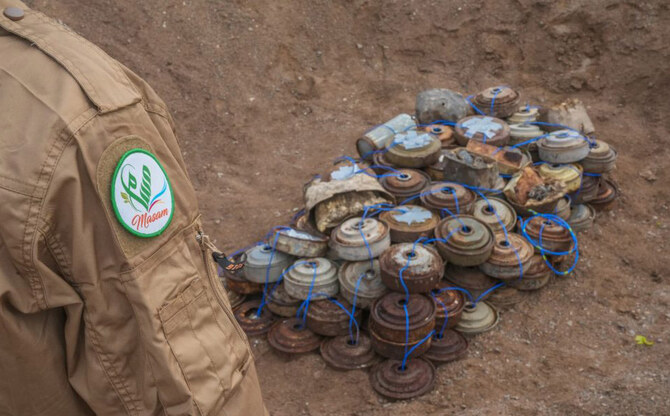
The initiative trains local demining engineers and provides them with modern equipment. (Supplied)
Short Url
Updated 06 October 2024
Follow

Saudi project clears 1,579 Houthi mines in Yemen

  • A total of 465,252 mines had been cleared since Masam's inception in 2018

RIYADH: Members of Saudi Arabia’s Project Masam removed 1,579 explosive devices from various regions of Yemen last week.

The total included five anti-personnel mines, 126 anti-tank mines, 1,442 unexploded ordnances and six explosive devices, according to a recent report.

Ousama Al-Gosaibi, the initiative’s managing director, said a total of 465,252 mines had been cleared since its inception in 2018.

The explosives were planted indiscriminately and posed a threat to civilians, including children, women and the elderly.

Project Masam is one of several initiatives undertaken by Saudi Arabia on the orders of King Salman to help the Yemeni people, clearing routes for humanitarian aid to reach the country’s citizens.

The demining operations took place in Marib, Aden, Jouf, Shabwa, Taiz, Hodeidah, Lahij, Sanaa, Al-Bayda, Al-Dhale and Saada.

The initiative trains local demining engineers and provides them with modern equipment. It also offers support to Yemenis injured by the devices.

Teams are tasked with clearing villages, roads and schools to facilitate safe movement for civilians and the delivery of humanitarian aid.

About 5 million people have been forced to flee their homes since the start of the conflict in Yemen, many of them displaced by the presence of land mines.


Traditional Saudi arts thrill visitors at Damascus fair

Updated 4 sec ago
Follow

Traditional Saudi arts thrill visitors at Damascus fair

RIYADH: As part of the Kingdom’s role as guest of honor at the Damascus International Book Fair, the Theater and Performing Arts Commission presented a series of live performances at the Saudi pavilion.

The pavilion showcased the diversity of traditional arts and introduced visitors to the richness and historical depth of the Kingdom’s cultural heritage, the Saudi Press Agency reported on Tuesday.

The program highlighted traditional art forms from different regions of the Kingdom, offering audiences a comprehensive cultural experience.

The performances demonstrated each art form’s distinctive rhythms, group movements, traditional costumes and tools, as well as their connection to social occasions and celebrations, reflecting Saudi values, history and diverse environments.

The commission’s pavilion saw strong visitor engagement; audiences interacted with the performances and enjoyed their varied rhythms.

It reflects the commission’s efforts to represent the Kingdom in major international cultural forums, and to reinforce Saudi national identity at Arab and international events.

The Saudi pavilion at the fair, which runs until Feb. 16, showcases creativity and fosters cultural dialogue, supporting Vision 2030’s goals of knowledge exchange and cultural leadership.