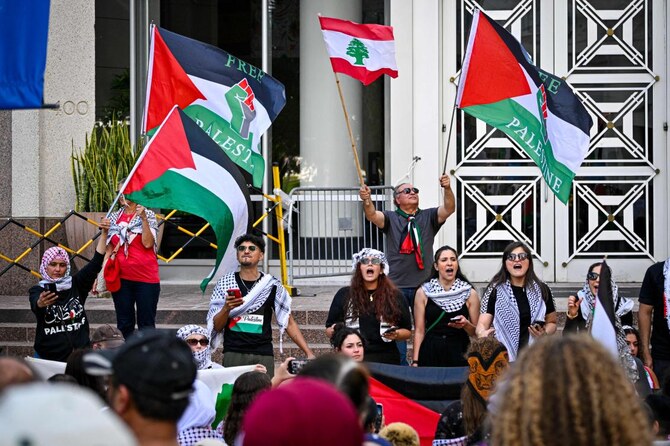
PARIS/WASHINGTON: Thousands of protesters took to the streets in major cities around the world on Saturday demanding an end to bloodshed in Gaza and the wider Middle East as the start of Israel’s war in the Palestinian enclave approaches its first anniversary.
About 40,000 pro-Palestinian demonstrators marched through central London while thousands gathered in Paris, Rome, Manila, Cape Town and New York City. Demonstrations were also held near the White House in Washington, protesting US support for its ally Israel in military campaigns in Gaza and Lebanon.
Protesters at Times Square in New York City wore the black-and-white keffiyeh scarf and chanted slogans like: “Gaza, Lebanon you will rise, the people are by your side.” They held banners demanding an arms embargo against Israel.
The latest bloodshed in the decades old Israeli-Palestinian conflict was triggered when Palestinian Hamas militants attacked southern Israel on Oct. 7, 2023, killing 1,200 people and taking about 250 as hostages, according to Israeli tallies.
Israel’s subsequent military assault on Gaza has killed nearly 42,000 Palestinians, according to Gaza’s health ministry. It has also displaced nearly all of the enclave’s 2.3 million people, caused a hunger crisis and led to genocide allegations at the World Court that Israel denies.
“Unfortunately, in spite of all our good will, the Israeli government does not take any notice, and they just go ahead and continue their atrocities in Gaza, now also in Lebanon and in Yemen, and also probably in Iran,” said protester Agnes Kory in London.
“And our government, our British government, unfortunately is just paying lip service and carries on supplying weapons to Israel,” she added.
In Jakarta, the capital of Indonesia, the world’s most populous Muslim-majority country, at least 1,000 pro-Palestinian protesters gathered on Sunday morning near the US embassy demanding that Washington stop supplying weapons to Israel.
In London, counter-demonstrators waved Israeli flags as pro-Palestinian marchers walked by. There were 15 arrests on the sidelines of the protests, according to police, who did not specify whether those detained were from either group.
In Rome, police fired tear gas and water cannons after clashes broke out. Around 6,000 protesters defied a ban to march in the city center ahead of the Oct. 7 anniversary of Hamas’ attack.
In Berlin, a protest drew about 1,000 demonstrators with Palestinian flags, who chanted: “One Year of Genocide.”
German demonstrators also criticized what they called police violence against pro-Palestinian protesters. Israel supporters in Berlin protested against rising antisemitism. Scuffles broke out between police and pro-Palestinian protesters.
Over the past year, the scale of the killing and destruction in Gaza has drawn some of the biggest global protests in years, including in the US, that saw weeks of pro-Palestinian college campus encampments.
Advocates have raised concerns over alarming antisemitic and Islamophobic rhetoric in some protests and counter-protests related to the conflict. Rights advocates have warned about rising threats against Muslims and Jews around the world.
Israel’s supporters have expressed offense over some slogans that they say question Israel’s right to exist as a nation. Pro-Palestinian protesters point to violence such as an incident in which a mob in California attacked an encampment of demonstrators in April.
The war in Gaza has spread through the region, drawing in Iran-backed groups in Lebanon, Yemen and Iraq. Israel has sharply escalated a campaign in recent weeks in Lebanon that has killed hundreds, wounded thousands and displaced over a million. Israel says it is attempting to dismantle Lebanese Iran-backed Hezbollah militants.
Iran launched a barrage of missiles against Israel this week to which Israel has not yet responded. Israeli operations have also escalated in the Israeli-occupied West Bank since the start of the war in Gaza.
In Paris, Lebanese-French protester Houssam Houssein said: “We fear a regional war, because there are tensions with Iran at the moment, and perhaps with Iraq and Yemen.” Houssein added: “We really need to stop the war because it’s now become unbearable.”
Israel has faced wide international condemnation over its actions in Gaza, and now over its bombarding of Lebanon. Prime Minister Benjamin Netanyahu says his government is acting to prevent a repeat of the Oct. 7 assault by Hamas and Washington says it supports Israel’s right to self-defense.
US government agencies warned on Friday that the anniversary of Hamas’ Oct. 7 attacks may motivate individuals to engage in violence. Officials in some states, including New York, raised security measures out of caution.
In Manila, activists clashed with anti-riot police after they were blocked from holding a demonstration in front of the US embassy in the Philippine capital against Washington’s support for Israel.
International diplomacy backed by the US has so far failed to clinch a ceasefire deal in Gaza. Hamas wants an agreement that ends the war while Israel says fighting can end only when Hamas is eradicated.


Thousands around the world protest Middle East war as Oct. 7 anniversary nears
https://arab.news/zqqqf
Thousands around the world protest Middle East war as Oct. 7 anniversary nears

- 40,000 pro-Palestinian demonstrators marched in London
- Protesters oppose Israel’s Gaza actions, worry about spreading conflict

Aoun hails disarmament progress: ‘Lebanon achieved in 1 year what it had not seen in 4 decades’
- President Joseph Aoun highlights achievements during first year in office despite many challenges
- Army announced this month it had successfully disarmed Hezbollah in the south of the country
BEIRUT: Lebanese President Joseph Aoun confirmed on Tuesday that the country’s armed forces “are now the sole operational authority south of the Litani River, despite doubts, accusations of treason, insults and slander.”
Speaking at the Presidential Palace in Baabda during a traditional New Year meeting with members of the diplomatic corps and the heads of international missions, he highlighted what he viewed as Lebanon’s achievements since he took office on Jan. 9, 2025.
The government’s approval in August and September last year of plans to bring all weapons in the country under state control, and ensure the authority of the state across all Lebanese territory using its own forces, was “no minor detail,” he said.
“Lebanon achieved in one year what it had not seen in four decades,” he added, as he recalled taking office in a “deeply wounded state” that has suffered decades of institutional paralysis and economic crises.
Despite campaigns of distortion, intimidation and misinformation, and Israel’s failure to abide by the November 2024 ceasefire agreement, the changed reality on the ground over the past 12 months speaks for itself, he said.
“The truth is what you see, not what you hear,” Aoun said, pointing out that “not a single bullet was fired from Lebanon during my first year in office, except for two specific incidents recorded last March, the perpetrators of which were swiftly arrested by official authorities.”
The army carried out “extensive operations” to clear large areas of the country of illegal weapons regardless of who controlled them, the president continued, in line with the terms of the Nov. 27 ceasefire agreement with Israel, which he described as “an accord Lebanon respects and that was unanimously endorsed by the country’s political forces.”
These efforts reflected a determination to spare the country a return to the “suicidal conflicts that have come at a heavy cost in the past,” he added.
Aoun stressed his commitment during the second year of his presidency to restoring control of all Lebanese territory to the exclusive authority of the state, securing the release of prisoners, and the reconstruction of war-ravaged areas.
He said that southern Lebanon, like all of the country’s international borders, would fall under the sole control of the Lebanese Armed Forces, putting a definitive end to any attempts “to draw us into the conflicts of others, even as those same parties pursue dialogue, negotiations and compromises in pursuit of their own national interests.”
The Lebanese Army Command announced early this month the completion of the first phase of its plans to disarm nonstate groups south of the Litani River. The government is now awaiting an army report next month detailing its next steps.
Gen. Rodolphe Haykal, the army’s commander, has said that the plan “does not have a specific time frame for completing this phase, which encompasses all Lebanese regions.”
A Lebanese official confirmed to Arab News that the army now has exclusive control of territory south of the Litani River, and no other armed forces or military factions have a presence there.
Aoun’s affirmation of his determination to “stay on course” came two days after Hezbollah leader Naim Qassem gave a sharply worded speech that delivered both implicit and explicit rebukes aimed at the president and Foreign Minister Youssef Raji.
His criticisms focused on their efforts to take control of weapons north of the Litani River, following a declaration by Aoun that “the time for arms is over,” a position that Hezbollah vehemently rejects in what appears to be an attempt to derail the gradual, phased disarmament strategy embraced by the Lebanese government and the international community.
Progress in the efforts of the military to take control of all weapons in the country hinges on securing vital logistical support for the country’s armed forces, a condition tied to the International Conference for Supporting the Lebanese Army and Internal Security Forces, which is due to take place on March 5 in Paris.
Aoun told the diplomats that the conference is the result of efforts led by the international Quintet Committee supporting Lebanon: the US, Saudi Arabia, France, Qatar and Egypt.
Archbishop Paolo Borgia, the papal ambassador to Lebanon, speaking in his role as dean of the diplomatic corps, said that the current crisis in the country serves “as a harsh test” that must remind political leaders of their duty to prevent history from repeating itself.
He called for respect for all electoral processes as a vital part of any nation’s democratic life, and for “genuine peace without weapons, one that can disarm enemies through the convincing power of goodness and the strength of meeting and dialogue.”
He added: “Those holding the highest public offices must give special attention to rebuilding political relationships peacefully, both nationally and globally, a process grounded in mutual trust, honest negotiations and faithful adherence to commitments made.”


