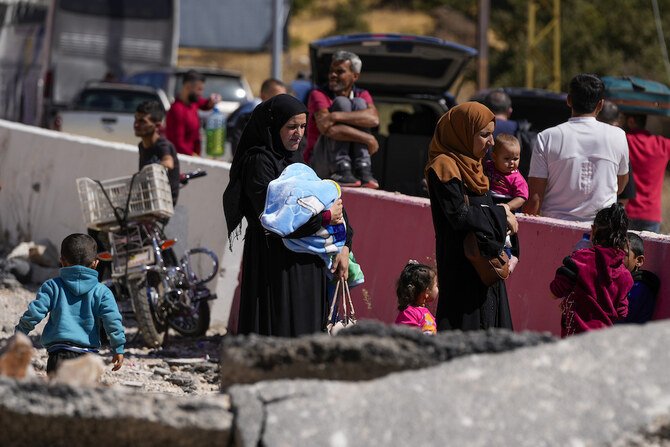

ANKARA: A surge in the number of Syrian refugees fleeing violence in Lebanon and attempting to reach Turkish-controlled areas in northern Syria is raising concerns over how Turkiye will manage a new influx of refugees.
Lebanon, which hosts more than 1.5 million Syrian and Palestinian refugees, is witnessing an exodus as security conditions worsen as a result of Israel’s bombing campaign.
Turkiye, which currently shelters around 3.1 million registered Syrian refugees, now faces pressure to accommodate more.
Ankara is also helping to evacuate foreign nationals from Lebanon via Turkiye, following requests from around 20 countries.
On Thursday, Deniz Yucel, spokesperson for the main opposition Republican Peoples’ Party (CHP), submitted a parliamentary question concerning the potential impact of the Israel-Lebanon war on Turkiye.
“There is growing concern that the ongoing conflict in our southeastern border could trigger a massive wave of migration,” he said in his address to Interior Minister Ali Yerlikaya. “(This) would not only increase our population but also lead to a rise in unemployment, rent, and property prices while disrupting social order and demographic balance in a country already turned into the world’s refugee camp. The minister of interior must urgently inform the public about the possibility of a new migration wave.”
Turkiye, Yucel continued, “is not anyone’s refugee camp. We will never allow the Turkish people to become alienated in their homeland. We will close the borders and save the country.”
Metin Corabatir, president of the Research Center on Asylum and Migration in Ankara, said that there is great uncertainty about the options ahead for Turkiye in terms of migration management from Lebanon.
“A significant number of Lebanese and Syrian refugees are evacuating the country or are crossing into Syria,” he told Arab News. “If Lebanon becomes a battleground, there may be pressure on Turkiye.”
The Turkish government “is pursuing a policy to fight against irregular migration. If there is a new wave of migration, I don’t think Turkiye will opt for an open-border policy, because it will greatly affect domestic politics,” he added.
Some 77 percent of Turks favor closing borders to refugees — significantly more than the global average of 44 percent — according to the results of a recent survey by IPSOS and the UN refugee agency, UNHCR.
According to Corabatir, if there is a large wave of migration, the Turkish government will be expected to cooperate with the international community to develop formulas based on international humanitarian law rather than accepting offers to once again transform Turkiye into a buffer against migration waves.
“The absorption capacity of northern Syria has reached its full capacity for hosting more refugee flow. In that case, these people can transit through Syrian soil in a controlled manner and pass to other countries via Turkiye,” he said.
Turkiye, which has a 911 km-long border with Syria, became the country hosting the most refugees in the world in 2011 when the Syrian conflict began.
However, experts do not anticipate a similar influx through the border at present because, since then, Turkiye has imposed tight controls by building a security wall.
“Considering many European countries have already closed their doors to the migration flow, Turkiye will not be expected to operate an open-door policy like it did in the past. But it will cooperate in the conditional and controlled evacuation of refugees in case a large-scale humanitarian crisis erupts,” Corabatir said.
According to Dr. Oytun Orhan, coordinator of Levant studies at ORSAM, an Ankara-based think tank, as tensions escalate in Lebanon and Syria a new wave of migration is likely to be triggered from the latter, where airstrikes targeting Hezbollah and Iran-backed militias are increasing.
“This could further destabilize Syria, potentially prompting a fresh migration wave from the south to the north of the country. Turkiye’s primary advantage is managing the influx in designated safe zones,” he told Arab News.
However, these areas are already overfilled. In Idlib alone, 3.5 million people reside, while other regions house another 1.5 million, most of whom have been internally displaced within Syria.
Dr. Orhan believes Syria’s rising instability, chaotic conditions, and the risk of a new migration wave may force Turkiye to strengthen its border defenses.
“Expanding the safe zones is one potential outcome, but that remains a last resort,” he said.
“A military operation to close off the remaining unsecured areas of the safe zone is the worst-case scenario, particularly if the conflict in Gaza or Lebanon spills into Syria. Should this happen, Turkiye is expected to take preventive measures to address any potential border-security risks.
It remains to be seen how this new flow of refugees will affect the slow but ongoing normalization process between Ankara and Damascus.”
In July, Turkish President Recep Tayyip Erdogan said he might invite Syrian leader Bashar Assad to Turkiye “at any moment” to restore relations to the level of the past.
That statement came after Assad said Damascus was open to “all initiatives” to restore Turkish-Syrian ties “as long as they are based on respecting the sovereignty of the Syrian state over all its territory and fighting all forms of terrorism.”
For Dr. Orhan, there are two options ahead. “Initially, the spread of conflict into Syria might accelerate negotiations, as Damascus faces increased pressure and Iran’s influence in the region weakens,” he said, adding that Russia would likely back such peace efforts in case of further clashes and a migration surge.
“However, if Ankara is obliged to conduct any cross-border military action to secure its borders, it could disrupt normalization talks until tensions subside,” he added.