

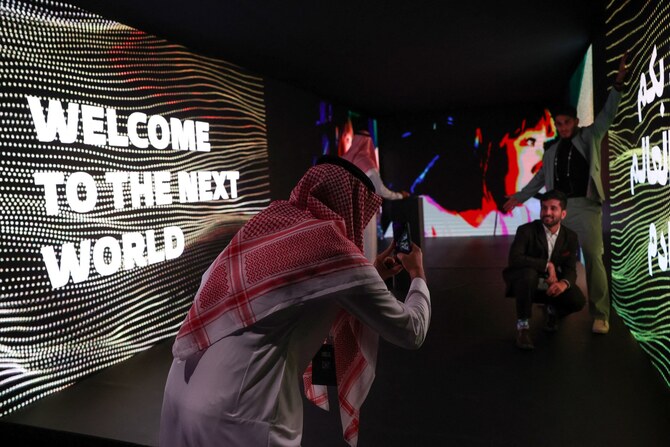

RIYADH: History was made in July when the International Olympic Committee decided to create Olympic Esports Games, with the first edition being set to be held in 2025 in Saudi Arabia.
The event is set to be a game-changer for competitive gaming globally, with the industry’s value expected to reach over $1 trillion by 2032, growing at a compound annual growth rate of 11.60 percent during the forecast period 2023-2032, according to market research firm Inkwood Research.
With this event expected to be held at the same level as the Winter and Summer Olympics, it will position the Middle East as a major player in digital entertainment, leveraging the country’s young, tech-savvy population and strong government support.
The Esports Olympics is also set to attract international talent and showcase advanced gaming technology, highlighting the region’s potential as a global esports hub.
Impact and opportunities on global esports industry
According to Shahid Khan, partner and global head of Media, Entertainment, Sports, and Culture at international management consulting firm Arthur D. Little, the hosting of the Esports Olympics in the Kingdom legitimizes the pastime on an international stage and aligns it more closely with traditional sports.
“This event will likely accelerate investment in esports infrastructure, not just in Saudi Arabia but across the Middle East and beyond. It presents opportunities for game developers, tournament organizers, and esports teams to expand their presence in the region. Additionally, it could spark increased interest in esports careers among young people in the Middle East,” Khan said.
The substantial prize pool of $62.5 million, will undoubtedly elevate the profile of esports in the Middle East and globally, he added.
“This event could reshape perceptions of esports, particularly in regions where it’s still gaining mainstream acceptance. It positions Saudi Arabia as a serious player in the global esports landscape and could inspire other countries in the region to invest more heavily in their esports ecosystems,” the Arthur D. Little partner said.
Firms contributing to the growth of the gaming and esports industry in the region
Numerous companies in Saudi Arabia and the Middle East are actively participating in advancing and prospering the gaming and esports sector across the Kingdom and the wider region.
One such firm is Dubai-headquartered Shaffra.
The technology, information and Internet company is looking to redefine productivity and innovation, crafting a future where work is not just a place you go, but a space you shape and share, according to the company’s co-founder and Chief Technology Officer Marc Wehbi.
He told Arab News: “Our AI-driven Workforce solutions are tailored to handle complex tasks such as managing in-game analytics, optimizing player performance, and generating engaging content.”
Wehbi went on to say that through the integration of advanced technologies, Shaffra’s objective is to strengthen the region’s esports infrastructure and position it as a global leader in technological innovation and competitive gaming.
Another illustration of this is MENATech Entertainment, a technology company with projects related to the video games and education sector.
The firm’s CEO Mario Perez told Arab News that his firm recognizes the government’s significant push to cultivate a strong gaming and esports environment, complemented by private initiatives that open a wide range of opportunities for consumers.
“By leveraging our global experience and success, particularly through initiatives like Amazon UNIVERSITY Esports, which has seen a 57 percent growth in student participation in Saudi Arabia, we aim to foster talent and enhance the esports ecosystem in the region,” he said.
Perez explained that his firm has expanded its reach to over 220 universities across the region, which contributes to the region’s economic and cultural upliftment and helps position Saudi Arabia and the broader Middle East as leading players in the global esports arena.
Similarly, the Sports Lead Partner at PwC Middle East Nick Oakley shed light on how the firm has been extensively involved in the esports sector for the past five years and have delivered several strategic projects which have had a real impact in growing the industry.
“We are continuing to collaborate with key partners in the industry, including the Saudi Esports Federation, on various joint initiatives,” Oakley said.
Managing consulting company Kearney is also seen to be contributing to the rise of the gaming and esports industry, as is global law firm Reed Smith.
According to Jamie Ryder, partner at Entertainment and Media Industry Group at Reed Smith, the company has team members throughout the US, Europe, the Middle East and Asia with gaming and esports expertise which allows it to provide advice and guidance in line with international best practice and learnings from different territories.
“Our footprint allows us to combine international best practice with our local experience which is always crucial in understanding how and why things may need to be done differently in different territories,” Ryder told Arab News.
Arthur D. Little’s Khan said the benefits of hosting major events, such as the Esports Olympics, help Saudi Arabia in a financial regard – with an increase in tourism – but also enhance the Kingdom’s image as a modern, tech-savvy nation.
“The gaming and esports industry can play a crucial role in realizing Vision 2030 goals by fostering innovation, attracting foreign investment, and creating high-skilled jobs for young Saudis. Moreover, as a digital-first industry, it supports the Kingdom’s ambitions to become a leading digital economy,” Khan said.
From MENATech Entertainment’s perspective, Saudi Arabia hosting the Esports World Cup, Esports Olympics and the construction of Qiddiya City Esports Arena are “monumental steps toward” realizing the Kingdom’s digital economy goals.
Pérez said: “KSA’s esports market is projected to soar to $6.8 billion by 2030, with the rollout of the National Gaming and Esports Strategy expected to contribute SR50 billion to the nation’s GDP, create 39,000 new jobs, generate over 30 competitive games within local studios and make KSA one of the top three nations in professional esports.”
The CEO went on to say how these initiatives are not just milestones in realizing Vision 2030 but also elevate Saudi Arabia’s global status, embedding esports into the cultural and economic fabric of the region, driving tourism, infrastructure development, and international investment.
Hadi Hammoud, partner in the Communications, Media, and Technology Practice at Kearney Middle East and Africa, argued that as Vision 2030 focuses on both economic and social transformation, the gaming and esports industry can play a crucial role in both.
“Socially, it enhances the Quality-of-Life Program by fostering a dynamic, youth-driven culture and promoting digital literacy. By aligning with Vision 2030, the industry supports economic diversification, creates new opportunities for young Saudis, and positions Saudi Arabia as a leader in the global digital economy,” he said.


