Dozens of health workers killed in Lebanon over past day, WHO says

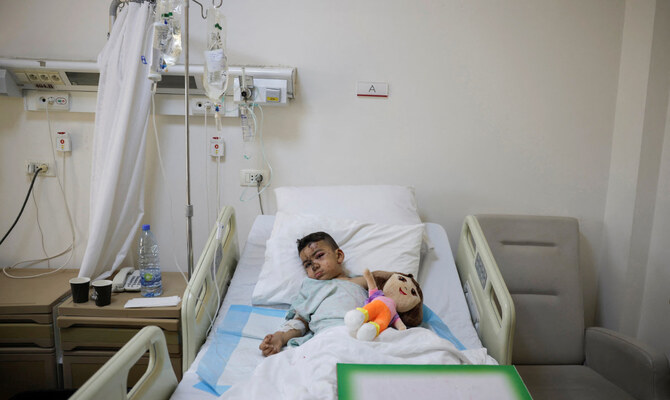
4-year-old Qassem Hussein, who lost his father in an Israeli airstrike, is treated at the Maritime Hospital in the town of Jbeil, north of Beirut, Lebanon, September 26, 2024. (Reuters)
Short Url
Updated 03 October 2024
Follow

Dozens of health workers killed in Lebanon over past day, WHO says

  • “Many (other) health workers are not reporting to duty and fled the areas where they work due to bombardments,” Director-General Tedros Adhanom Ghebreyesus said
  • “This is severely limiting the provision of mass trauma management and continuity of health services”

GENEVA: At least 28 on-duty medics have been killed in the past 24 hours in Lebanon, where Israel has launched airstrikes and sent troops to fight Hezbollah in an escalating conflict, the World Health Organization chief said on Thursday.
“Many (other) health workers are not reporting to duty and fled the areas where they work due to bombardments,” Director-General Tedros Adhanom Ghebreyesus told an online press briefing, calling for stronger protections for health workers.
“This is severely limiting the provision of mass trauma management and continuity of health services,” he said.
The global health agency will not be able to deliver a large planned shipment of trauma and medical supplies to the country on Friday due to flight restrictions, he added.
WHO’s representative in Lebanon Dr. Abdinasir Abubakar told the briefing that all of the health care workers killed in the past day had been on duty, helping with the wounded.
A total of nearly 2,000 people have been killed, including 127 children, and 9,384 injured since the start of Israeli attacks on Lebanon over the last year, the country’s health ministry said.
“Hospitals have been already evacuated. I think what I can say for now is the capacity for mass casualty management exists, but it’s just a matter of time until the system actually reaches its limit,” said the WHO’s Abubakar.


Tunisians revive protests in Gabes over pollution from state chemical plant

Updated 59 min 53 sec ago
Follow

Tunisians revive protests in Gabes over pollution from state chemical plant

  • People chanted mainly “Gabes wants to live“
  • The powerful UGTT union has called for a nationwide strike next month

TUNIS: Around 2,500 Tunisians marched through the coastal city of Gabes on Wednesday, reviving protests over pollution from a state-owned phosphate complex amid rising anger over perceived failures to protect public health.
People chanted mainly “Gabes wants to live,” on the 15th anniversary of the start of the 2011 pro-democracy uprising that sparked the Arab Spring movement against autocracy.
The protest added to the pressure on President Kais Saied’s government, which is grappling with a deep financial crisis and growing street unrest, protests by doctors, journalists, banks and public transport systems.


The powerful UGTT union has called for a nationwide strike next month, signalling great tension in the country. The recent protests are widely seen as one of the biggest challenges facing Saied since he began ruling by decree in 2021.
Protesters chanted slogans such as “We want to live” and “People want to dismantle polluting units,” as they marched toward Chatt Essalam, a coastal suburb north of the city where the Chemical Group’s industrial units are located.
“The chemical plant is a fully fledged crime... We refuse to pass on an environmental disaster to our children, and we are determined to stick to our demand,” said Safouan Kbibieh, a local environmental activist.
Residents say toxic emissions from the phosphate complex have led to higher rates of respiratory illnesses, osteoporosis and cancer, while industrial waste continues to be discharged into the sea, damaging marine life and livelihoods.
The protests in Gabes were reignited after hundreds of schoolchildren suffered breathing difficulties in recent months, allegedly caused by toxic fumes from a plant converting phosphates into phosphoric acid and fertilizers.
In October, Saied described the situation in Gabes as an “environmental assassination”, blaming policy choices made by previous governments, and has called for urgent maintenance to prevent toxic leaks.
The protesters reject the temporary measures and are demanding the permanent closure and relocation of the plant.