US bans new types of goods from China over allegations of forced labor against Muslim minorities

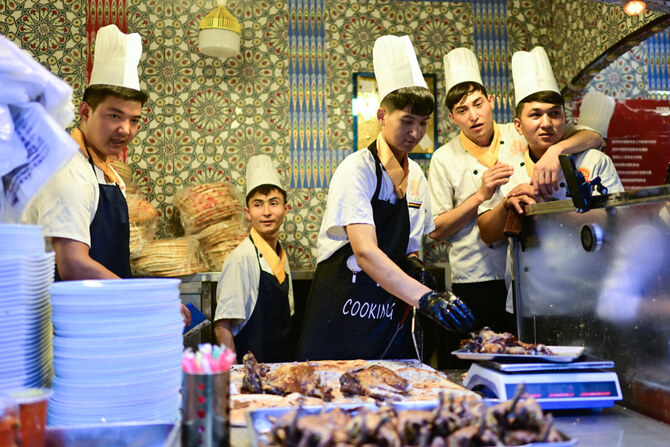
This picture taken on July 16, 2023, shows cooks at a restaurant in Yarkant in northwestern China's Xinjiang region. (AFP)
Short Url
Updated 03 October 2024
Follow

US bans new types of goods from China over allegations of forced labor against Muslim minorities

  • Ban covers products of Chinese steel manufacturer and a maker of artificial sweetener accused of using forced labor from China’s far-west region of Xinjiang
  • Despite China's denial that it was using force labor, the entity list has grown since 2022 to a total of 75 companies accused of using forced labor

WASHINGTON: The Department of Homeland Security announced Wednesday that it would ban the import of goods from a Chinese steel manufacturer and a Chinese maker of artificial sweetener, accusing both of being involved in the use of forced labor from China’s far-west region of Xinjiang.
The action broadens the scope of the US effort to counter products from entering the country that the government says are tied to human rights abuses.
The additions to the entity list under the Uyghur Forced Labor Prevention Act marks the first time a China-based steel company or aspartame sweetener business have been targeted by US law enforcement, DHS said.
“Today’s actions reaffirm our commitment to eliminating forced labor from US supply chains and upholding our values of human rights for all,” said Robert Silvers, undersecretary of Homeland Security for policy. “No sector is off-limits. We will continue to identify entities across industries and hold accountable those who seek to profit from exploitation and abuse.”
The federal law that President Joe Biden signed at the end of 2021 followed allegations of human rights abuses by Beijing against members of the ethnic Uyghur group and other Muslim minorities in Xinjiang. The Chinese government has refuted the claims as lies and defended its practice and policy in Xinjiang as fighting terror and ensuring stability.
The new approach marked a shift in the US trade relationship with China to increasingly take into account national security and human rights. Beijing has accused the US of using human rights as a pretext to suppress China’s economic growth.
Enforcement of the law initially targeted solar products, tomatoes, cotton and apparel, but over the last several months, the US government has identified new sectors for enforcement, including aluminum and seafood.
“That’s just a reflection of the fact that sadly, forced labor continues to taint all too many supply chains,” Silvers told a trade group in June when marking the two-year anniversary of the creation of the entity list. “So our enforcement net has actually been quite wide from an industry-sector perspective.”
He said the law “changed the dynamic in terms of putting the onus on importers to know their own supply chains” and that its enforcement had showed that the US could “do the right thing” without halting normal trade.
Since June 2022, the entity list has grown to a total of 75 companies accused of using forced labor in Xinjiang or sourcing materials tied to that forced labor, Homeland Security said.
Baowu Group Xinjiang Bayi Iron and Steel Co. Ltd. and Changzhou Guanghui Food Ingredients Co. Ltd. were the Chinese companies newly added to the list.


US talks with hard-line Venezuelan minister Cabello began months before raid

Updated 11 sec ago
Follow

US talks with hard-line Venezuelan minister Cabello began months before raid

NEW YORK/MIAMI/WASHINGTON: Trump administration officials had been in discussions with Venezuela’s hard-line interior minister Diosdado Cabello months before the US operation to seize President Nicolas Maduro, and have been in communication with him since then, according to multiple people familiar with the matter.
The officials warned Cabello, 62, against using the security services or militant ​ruling-party supporters he oversees to target the country’s opposition, four sources said. That security apparatus, which includes the intelligence services, police and the armed forces, remains largely intact after the January 3 US raid.
Cabello is named in the same US drug-trafficking indictment that the Trump administration used as justification to arrest Maduro, but was not taken as part of the operation.
The communication with Cabello, which has also touched on sanctions the US has imposed on him and the indictment he faces, dates back to the early days of the current Trump administration and continued in the weeks just prior to the US ouster of Maduro, two sources familiar with the discussions said. The administration has also been in touch with Cabello since Maduro’s ouster, four of the people said.
The communications, which have not been previously reported, are critical to the Trump administration’s efforts to control the situation inside Venezuela. If Cabello decides to unleash the forces that he controls, it ‌could foment the kind ‌of chaos that Trump wants to avoid and threaten interim President Delcy Rodriguez’s grip on power, according ‌to ⁠a source ​briefed on ‌US concerns.
It is not clear if the Trump administration’s discussions with Cabello extended to questions about the future governance of Venezuela. Also unclear is whether Cabello has heeded the US warnings. He has publicly pledged unity with Rodriguez, whom Trump has so far praised.
While Rodriguez has been seen by the US as the linchpin for US President Donald Trump’s strategy for post-Maduro Venezuela, Cabello is widely believed to have the power to keep those plans on track or upend them.
The Venezuelan minister has been in contact with the Trump administration both directly and via intermediaries, one person familiar with the conversations said.
All of the sources were granted anonymity to speak freely about sensitive internal government communications with Cabello.
The White House and the government of Venezuela did not immediately respond to requests for comment.

CABELLO HAS BEEN MADURO LOYALIST
Cabello has long been seen ⁠as Venezuela’s second most powerful figure. A close aide of late former President Hugo Chavez, Maduro’s mentor, he went on to become a long-time Maduro loyalist, feared as his main enforcer of repression. Rodriguez and Cabello have ‌both operated at the heart of the government, legislature and ruling socialist party for years, but ‍have never been considered close allies of each other.
A former military officer, ‍Cabello has exerted influence over the country’s military and civilian counterintelligence agencies, which conduct widespread domestic espionage. He has also been closely associated with pro-government militias, notably ‍the colectivos, groups of motorcycle-riding armed civilians who have been deployed to attack protesters.
Cabello is one of a handful of Maduro loyalists Washington has relied on as temporary rulers to maintain stability while it accesses the OPEC nation’s oil reserves during an unspecified transition period.
But US officials are concerned that Cabello — given his record of repression and a history of rivalry with Rodriguez — could play the spoiler, according to a source briefed on the administration’s thinking.
Rodriguez has been working to consolidate her own power, installing loyalists in key positions ​to protect herself from internal threats while meeting US demands to boost oil production, Reuters interviews with sources in Venezuela have shown.
Elliott Abrams, who served as Trump’s special representative on Venezuela in his first term, said many Venezuelans would expect Cabello to be removed ⁠at some point if a democratic transition is to advance.
“If and when he goes, Venezuelans will know that the regime has really begun to change,” said Abrams, now at the Council on Foreign Relations think tank.

US SANCTIONS AND INDICTMENT
Cabello has long been under US sanctions for alleged drug trafficking.
In 2020, the US issued a $10 million bounty for Cabello and indicted him as a key figure in the “Cartel de los Soles,” a group the US has said is a Venezuelan drug-trafficking network led by members of the country’s government.
The US has since raised the award to $25 million. Cabello has publicly denied any links to drug trafficking.
In the hours after Maduro’s ouster, some analysts and politicians in Washington questioned why the US didn’t also grab Cabello — listed second in the Department of Justice indictment of Maduro.
“I know that just Diosdado is probably worse than Maduro and worse than Delcy,” Republican US Representative Maria Elvira Salazar said in an interview with CBS’s “Face the Nation” on January 11.
In the days following, Cabello denounced American intervention in the country, saying in a speech that “Venezuela will not surrender.”
But media reports of residents being searched at checkpoints — sometimes by uniformed members of the security forces and sometimes by people in plain clothes — have become less frequent in recent days.
And both Trump and the Venezuelan government have said many detainees who are considered ‌by the opposition and rights groups to be political prisoners will be released.
The government has said that Cabello, in his role as interior minister, is overseeing that effort. Rights groups say the liberations are proceeding extremely slowly and hundreds remain unjustly detained.