

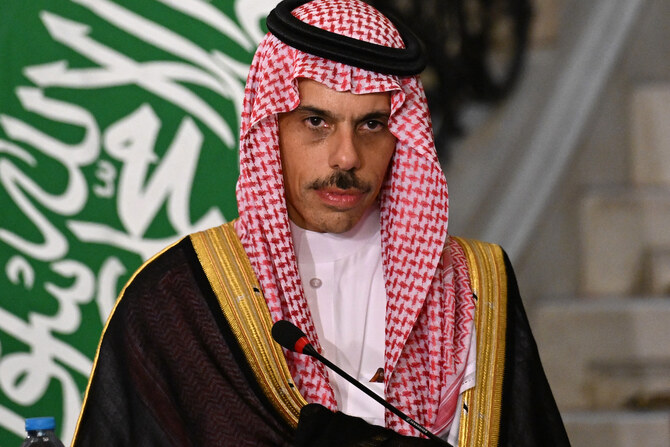

LONDON: Now is the time to embark on an irreversible path to resolving the conflict between Israelis and Palestinians that culminates in the establishment of two independent states in which the peoples can live side by side in peace, Saudi Arabia’s foreign minister said.
In an op-ed published in the Financial Times on Wednesday, Prince Faisal bin Farhan wrote that a two-state solution is the only viable way to ensure the long-term security of Palestine, Israel and the wider region.
The Kingdom will work tirelessly to help create an independent Palestinian state, with East Jerusalem as its capital, and will not establish diplomatic relations with Israel until this happens, he added. His comments echoed a reaffirmation of the Saudi stance by Crown Prince Mohammed bin Salman during a recent address to the Shoura Council.
Prince Faisal said an independent Palestinian state would deliver the dividends the Kingdom seeks: regional stability, integration and prosperity. His op-ed follows a sharp escalation in the conflict between Israel and Hezbollah in Lebanon in recent weeks, and an Iranian missile attack against Israel on Tuesday.
“It is essential to understand that the true obstacles to peace are not the Palestinians and Israelis, who yearn for stability and coexistence, but rather the radicals and warmongers on both sides who reject a just resolution and seek to spread this conflict across our region and beyond,” he wrote.
“These extremists should not dictate the future of our peoples or force war upon them. The voices of moderation must rise above the din of conflict, and it is our collective responsibility to ensure that they are heard.”
Prince Faisal said self-determination is a right the Palestinian people deserve and are entitled to, and Saudi Arabia and other countries are working to secure global recognition of Palestine as a sovereign state. He encouraged those nations that have privately expressed a willingness to do this to do so publicly, because now is the “time to stand on the right side of history.”
He continued: “Merely recognizing Palestine is not enough. We must demand more accountability, in line with International Court of Justice opinions. This includes the implementation of UN resolutions, the imposition of punitive measures against those that work to undermine Palestinian statehood, and incentives for those who support it.”
He said the continuing assault on Gaza, expansion of settlements in the occupied West Bank and imposition of restrictions on movement by Israeli authorities “creates a reality that diminishes prospects for a sovereign Palestinian state.”
Israeli “intransigence only exacerbates tensions and erodes trust, making diplomatic negotiations increasingly difficult, prolonging the suffering of both sides and pushing the region ever closer to wider war,” he added.
The prince called for support of the Palestinian Authority, which he said has shown perseverance “in maintaining calm in the occupied West Bank despite unrelenting obstacles.”
He continued: “Its commitment to non-violence and cooperation must be supported. A lasting resolution cannot be achieved without both Gaza and the occupied West Bank being under PA control.
“Palestinian statehood is a prerequisite for peace, rather than its by-product. This is the only path that can lead us out of this cycle of violence and into a future where both Israelis and Palestinians can live in peace, with security and mutual respect. Let us not delay any longer.”


