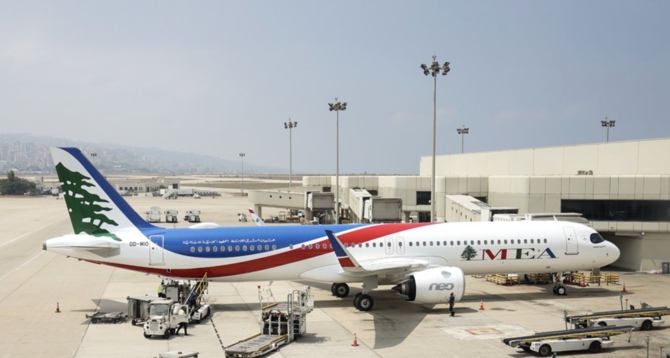
WASHINGTON: The United States organized a flight from Beirut to Istanbul on Wednesday to allow Americans to leave Lebanon amid the escalating conflict between Israel and Hezbollah, State Department spokesperson Matthew Miller said.
Miller told a press briefing that around 7,000 US citizens in Lebanon had registered with the US government to receive information about leaving the country, although not all of those are looking for assistance to leave.
The flight on Wednesday had a capacity of about 300 and carried around 100 Americans and their family members, Miller said, adding Washington had been working with airlines since Saturday to make seats available to Americans on commercial flights.

US organized a flight out of Beirut as Americans seek to leave Lebanon, says State Dept
Short Url
https://arab.news/7n3se
US organized a flight out of Beirut as Americans seek to leave Lebanon, says State Dept
- The flight on Wednesday had a capacity of about 300 and carried around 100 Americans
South Sudan says its troops are guarding strategic Heglig oil field in Sudan
NAIROBI: South Sudan has sent its troops to neighboring Sudan to guard the strategic Heglig oil field near the border, its military head said on Thursday, days after the paramilitary Rapid Support Forces (RSF) took control of it.
Heglig houses the main processing facility for South Sudanese oil, which makes up the bulk of South Sudan’s public revenues. Some oil has continued to flow through Heglig, though at much reduced volumes.
Sudanese government forces and workers at the Heglig oil field withdrew from the area on Sunday to avoid fighting that could have damaged facilities there, government sources told Reuters on Monday.
General Paul Nang, South Sudan chief of defense forces, said the troop deployment was agreed between South Sudan’s President Salva Kiir, Sudan Army Chief General Abdel Fattah Al-Burhan and RSF head Mohamed Hamdan Dagalo.
“The three agreed that the area of Heglig should be protected because (it) is a very important strategic area for the two countries,” Nang said in comments on state-owned South Sudan Broadcasting Radio.
“Now it is the forces of South Sudan that are in Heglig.”
Oil is transported through the Greater Nile pipeline system to Port Sudan on the Red Sea for export, making the Heglig site critical both for Sudan’s foreign exchange earnings and for South Sudan, which is landlocked and relies almost entirely on pipelines through Sudan.
Another pipeline, Petrodar, runs from South Sudan’s Upper Nile State to Port Sudan.
The war that started in April 2023 between the Sudanese army and the RSF has repeatedly disrupted South Sudan’s oil flows, which before the conflict averaged between 100,000 and 150,000 barrels per day for export via Sudan.
Heglig houses the main processing facility for South Sudanese oil, which makes up the bulk of South Sudan’s public revenues. Some oil has continued to flow through Heglig, though at much reduced volumes.
Sudanese government forces and workers at the Heglig oil field withdrew from the area on Sunday to avoid fighting that could have damaged facilities there, government sources told Reuters on Monday.
General Paul Nang, South Sudan chief of defense forces, said the troop deployment was agreed between South Sudan’s President Salva Kiir, Sudan Army Chief General Abdel Fattah Al-Burhan and RSF head Mohamed Hamdan Dagalo.
“The three agreed that the area of Heglig should be protected because (it) is a very important strategic area for the two countries,” Nang said in comments on state-owned South Sudan Broadcasting Radio.
“Now it is the forces of South Sudan that are in Heglig.”
Oil is transported through the Greater Nile pipeline system to Port Sudan on the Red Sea for export, making the Heglig site critical both for Sudan’s foreign exchange earnings and for South Sudan, which is landlocked and relies almost entirely on pipelines through Sudan.
Another pipeline, Petrodar, runs from South Sudan’s Upper Nile State to Port Sudan.
The war that started in April 2023 between the Sudanese army and the RSF has repeatedly disrupted South Sudan’s oil flows, which before the conflict averaged between 100,000 and 150,000 barrels per day for export via Sudan.
© 2025 SAUDI RESEARCH & PUBLISHING COMPANY, All Rights Reserved And subject to Terms of Use Agreement.


