

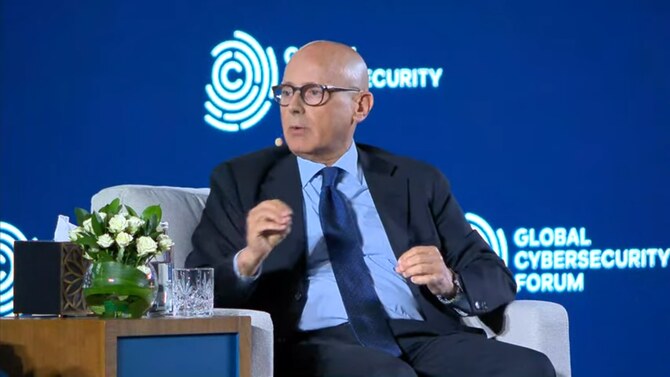

RIYADH: In light of rapidly advancing technology outpacing regulatory measures, experts at an event in Riyadh emphasized the steps needed to address cyber risks and foster responsible state behavior.
The Global Cybersecurity Forum showcased speakers discussing the evolving landscape of cyber diplomacy and the imperative for collective action.
Robin Geiss, director of the UN Institute for Disarmament Research, noted that discussions around cybersecurity at the UN have been ongoing for over 25 years. “Technology is not that new for the UN anymore... it’s a dialogue between everyone,” he stated, underscoring that this dialogue serves as a confidence- and transparency-building measure.
Geiss pointed out the difficulty in measuring the impact of these dialogues, saying, “When things escalate, we see directly the cost of human life... But of course, we don’t see so clearly what we’ve prevented.” He stressed the complexities of keeping pace with technology, adding, “Diplomacy and progress at the multilateral level move at the speed of trust.”
Highlighting the current geopolitical climate, Geiss observed a significant trust deficit that complicates multilateral mechanisms in cybersecurity. “What we really need is more progress in action than in theory or proclamations,” he asserted. “We know what we need to do... So how do we move forward at the implementation stage? That is really the challenge.” He praised initiatives like the GCF that unite diverse entities and individuals, while emphasizing that universal bodies like the UN are essential for effective coordination.
Concrete effort
Massimo Marotti, managing director for Strategies and Cooperation at Italy’s National Cybersecurity Agency, highlighted the necessity of concrete collective efforts within Europe.
“You mentioned concrete effort—that’s exactly what we do at the European level. We have 27 agencies for cybersecurity, and our regular meetings lead to concrete measures,” Marotti said.
He cited a recent meeting in Athens, where they addressed the post-quantum cryptography threat, warning, “In a few years, the computer revolution will make all the codes and keys we use today useless unless we change them.” He emphasized the importance of coordinated action, as Europe’s interconnected infrastructure means insecurity in one nation can pose risks for others. Marotti also mentioned forthcoming European regulations designed to enhance cybersecurity across the continent, stating, “We also work with partner countries, not only the EU. For instance, we recently signed a cooperation agreement with Albania.”
Adam Hantman, deputy director of the Bureau of Cyberspace and Digital Policy at the US Department of State, discussed ongoing global efforts to establish cybersecurity norms. “Essentially, what we’re doing here as a community is mapping out the rules of the road to govern a completely new domain,” he explained. He drew parallels to the dawn of the nuclear age, noting, “It took decades for the international community to establish norms and rules governing state roles in that space.”
Hantman emphasized the UN's critical role in cyber diplomacy and highlighted the Counter Ransomware Initiative in Washington, which now includes nearly 70 countries and organizations focused on combating ransomware.
In a separate panel, Heidi Crebo-Rediker, a senior fellow at the Council on Foreign Relations, expressed skepticism about the UN as the central platform for cybersecurity discussions. “I think the UN’s probably not the right place, but there are a lot of mini-lateral spaces where this is very active,” she remarked, suggesting alternative frameworks may be more effective for addressing cybersecurity challenges.


