

Saudi POS transactions surge 11% in late September to reach $3bn

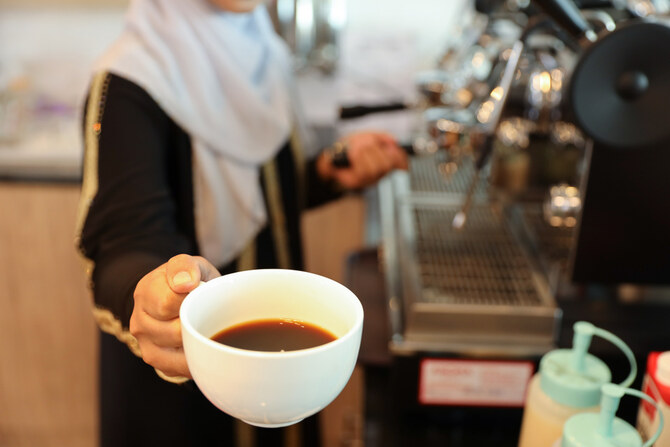
The food and beverages sector saw the largest share of the POS transactions. Shutterstock
Short Url
Updated 20 November 2024
Follow

Saudi POS transactions surge 11% in late September to reach $3bn

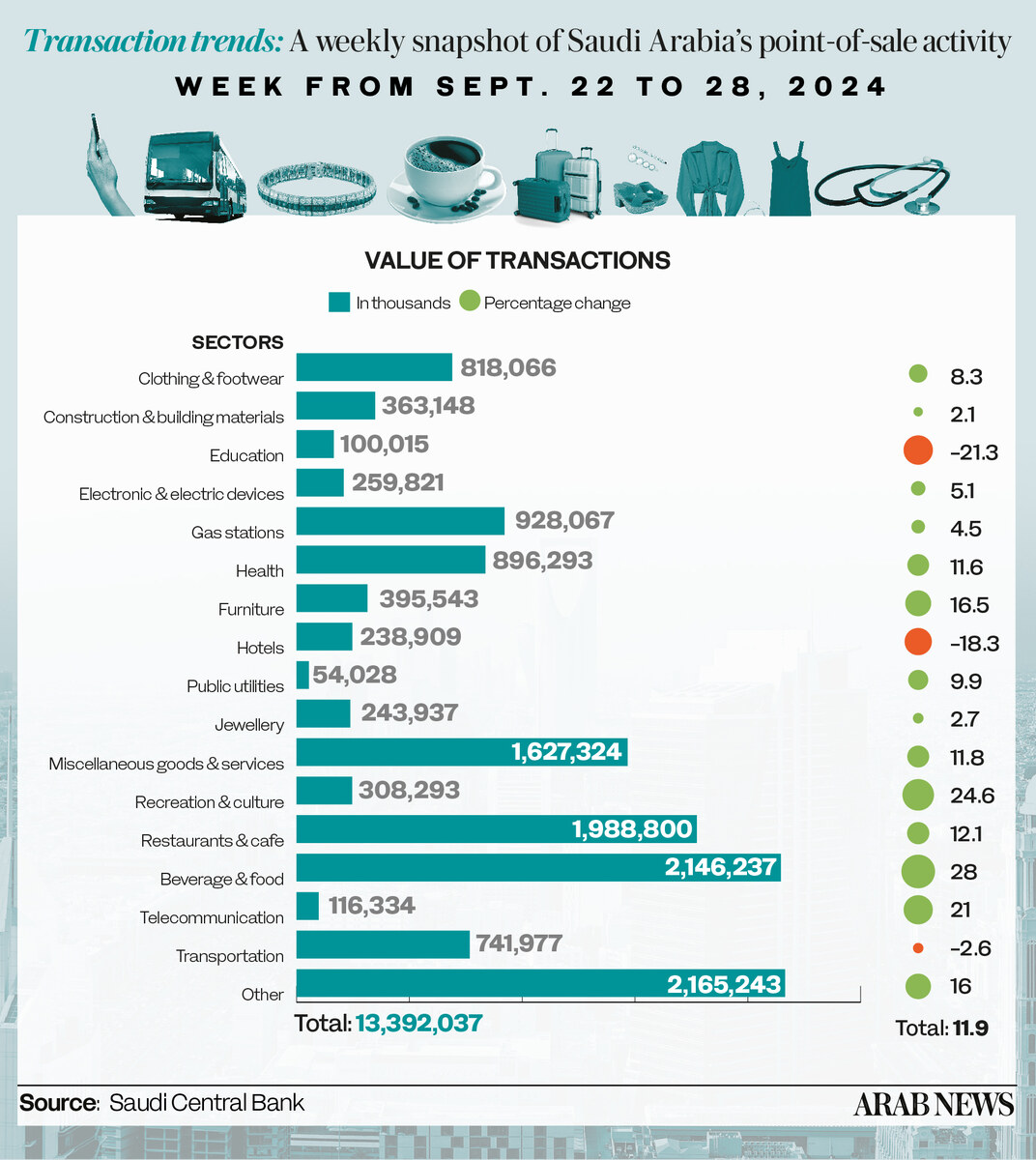
RIYADH: Saudi Arabia’s point-of-sale transactions surged 11.9 percent in the last week of September, reaching SR13.3 billion ($3.4 billion), with the food and beverages sector leading the uptick.

The latest figures from the Saudi Central Bank, also known as SAMA, showed that spending in this sector during the week from Sept. 22-28 recorded the highest increase at 28 percent, with total transactions reaching SR2.14 billion.

Spending on recreation and culture followed with a 24.6 percent increase to SR308.2 million. The telecommunications division recorded the third largest uptick with a 21 percent positive change, reaching SR116.3 million. 

Expenditure on education recorded the most significant decline at 21.3 percent, coming in at SR100 million during this period. The latest figures showed that spending in the education sector continued its downfall trajectory for over a month after surging for four consecutive weeks, coinciding with the start of the academic year on Aug. 18.

Saudis spent SR238.9 million on hotels in the seven-day period, reflecting an 18.3 percent drop frrom the previous week, and SR741.9 million on transportation, marking a 2.6 percent decrease.

Only those three sectors experienced declines this week, with most other industries seeing growth. 

The food and beverages sector saw the largest share of the POS, followed by restaurants and cafes at SR1.98 billion and miscellaneous goods and services at SR1.62 billion.

Spending in the top three categories accounted for approximately 43 percent or SR5.7 billion of this week’s total value.

Geographically, Riyadh dominated POS transactions, representing 33.5 percent of the total, with spending in the capital reaching SR4.49 billion — an 8.4 percent increase from the previous week. 

Jeddah followed with a 6.8 percent surge to SR1.82 billion, accounting for 13.6 percent of the total, and Dammam came in third at SR658.7 million, up by 7.1 percent.
Tabuk saw the most significant increase in spending, up by 23 percent to SR265.1 million. Hail and Abha came in second and third places, with expenditures surging 22.5 percent and 11 percent to SR220.9 million and SR167.8 million, respectively.

In terms of the number of transactions, Tabuk recorded the highest increase at 10.9 percent, reaching 4.7 million transactions. Makkah recorded the smallest increase at 2.2 percent, reaching 8.2 million.


PIF-backed AviLease achieves revenue of $664m and 19% growth in 2025

Updated 27 February 2026
Follow

PIF-backed AviLease achieves revenue of $664m and 19% growth in 2025

RIYADH: Saudi Arabia’s Public Investment Fund-backed AviLease achieved exceptional performance and sustainable business growth during 2025, supported by the strategic expansion of its global platform.

According to its financial results for 2025, AviLease recorded total revenues of $664 million, an annual increase of 19 percent, driven by disciplined growth in its asset portfolio and strong performance in aircraft remarketing amid sustained global demand for modern, fuel-efficient aircraft, the Saudi Press Agency reported.

Profit before tax doubled compared to the previous year, reaching $122 million. The year witnessed an expansion in AviLease’s portfolio, reaching 202 owned and managed aircraft, leased to over 50 airline companies in more than 30 countries. 

The total value of the company’s assets stabilized at $9.3 billion. AviLease maintained a 100 percent fleet utilization rate, reflecting the resilience of its business model, the efficiency of its asset management, and the strength of its strategic relationships with airlines around the world.

AviLease concluded purchase agreements for aircraft from Airbus, including the A320neo family and A350F, and Boeing 737 aircraft, aiming to enhance its future asset portfolio with modern, fuel-efficient aircraft. This step will contribute to supporting future growth and meeting increasing customer demand for the latest aircraft, aligning with the Kingdom’s ambitions to become a leading global aviation hub.

AviLease strengthened its prestigious credit standing by obtaining a strong Baa2 credit ratings from Moody’s and BBB from Fitch, reflecting its financial solidity, managerial discipline, and efficiency in managing leverage. The company also successfully issued senior unsecured bonds worth $850 million last November under Regulation 144A/RegS. This issuance contributed to diversifying its funding sources and enhancing its financial flexibility.

Commenting on the results, AviLease CEO Edward O’Byrne said: “This exceptional performance reflects the quality of the company’s investment portfolio, the strength of its partnerships with airlines, and its strategic focus on responsibly deploying capital into highly sought-after, efficient, modern aircraft assets.”

He added: “As aviation markets continue to grow, AviLease is strategically positioned to continue its expansion plans and deliver sustainable long-term value for shareholders, contributing to the Kingdom’s ambitions.”

Throughout 2025, AviLease continued to play a pivotal role in the Kingdom’s growing aviation sector and contributed directly to the launch and scaling of the new national carrier, Riyadh Air, by completing a sale and leaseback transaction for a Boeing 787-9 aircraft, which thereby became the first aircraft to join the airline’s fleet.

AviLease also established a strategic partnership with Hassana Investment Co. This partnership aims to provide an opportunity for local and international investors to enter the aircraft financing asset class and benefit from AviLease’s technical expertise and operational capabilities to support partnership growth and enhance performance. 

Hassana Investment Co. has agreed to acquire an initial portfolio of 10 modern aircraft from AviLease.