Six dead in Tel Aviv gun, knife attack: Israel police

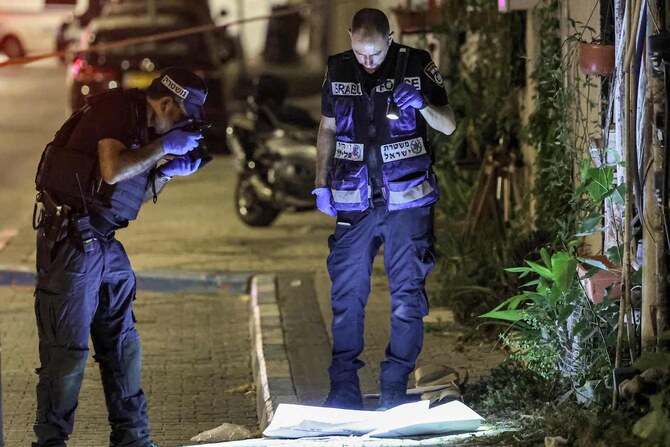
Members of the Israeli police's forensics department document the scene of a shooting attack in Jaffa, south of Tel Aviv on October 1, 2024. (AFP)
Short Url
Updated 02 October 2024
Follow

Six dead in Tel Aviv gun, knife attack: Israel police

  • Police described the attack as a shooting and stabbing attack that occurred shortly before Iran fired a barrage of some 180 missiles at targets around Tel Aviv

TEL AVIV: At least six people were killed in a suspected attack in Israel’s commercial hub Tel Aviv on Tuesday, police said, adding the two assailants had been “neutralized.”
Police described the attack as a shooting and stabbing attack that occurred shortly before Iran fired a barrage of some 180 missiles at targets around Tel Aviv.
“Six civilians were killed in a stabbing and shooting terror attack and nine civilians were injured with varying degrees of injury according to medical sources,” police said in a statement.
The attack began when two gunmen attacked passengers on the city’s light rail network and then fled on foot before being “neutralized” by police and citizens present using personal firearms, the statement said.
Footage posted online showed people lying on the street in Tel Aviv following the attack.
No group has claimed responsibility.


Israel begins demolishing residential buildings in West Bank camp

Updated 4 sec ago
Follow

Israel begins demolishing residential buildings in West Bank camp

  • The 25 buildings were home to about 100 families in the Nur Shams refugee camp
  • Israeli military claims demolitions are part of effort to root out armed groups in northern areas of the territory
NUR SHAMS, occupied West Bank: Israeli bulldozers began demolishing 25 buildings housing Palestinians in a refugee camp on Wednesday, in what the military said was an effort to root out armed groups in northern areas of the occupied West Bank.
The buildings, home to some 100 families, are in the Nur Shams camp, a frequent site of clashes between Palestinian militants and Israeli forces.
Israeli military bulldozers and cranes tore through the structures early Wednesday, sending thick plumes of dust into the air, an AFP journalist reported. Many residents watched from a distance.
The military said the demolitions were part of an operation against militants.
“Following ongoing counterterrorism activity by Israeli security forces in the area of Nur Shams in northern Samaria, the commander of the Central Command, Major General Avi Bluth, ordered the demolition of several structures due to a clear and necessary operational need,” the military told AFP in a statement.
“Areas in northern Samaria have become a significant center of terrorist activity, operating from within densely populated civilian areas.”
Earlier this year, the military launched an operation it said was aimed at dismantling Palestinian armed groups from camps in northern West Bank — including Nur Shams, Tulkarem and Jenin.
“Even a year after the beginning of IDF operations in the area, forces continue to locate ammunition, weapons, and explosive devices used by terrorist organizations, which endanger IDF soldiers and impair operational freedom of action,” the military said on Wednesday.
Earlier in December, AFP reported residents of the targeted buildings retrieving their belongings, with many saying they had nowhere to go.
The demolitions form part of a broader Israeli strategy aimed at easing access for military vehicles within the densely built refugee camps of the West Bank.
Israel has occupied the Palestinian territory since 1967.
Nur Shams, along with other refugee camps in the West Bank, was established after the creation of Israel in 1948, when hundreds of thousands of Palestinians were displaced from their homes in what is now Israel.
With time, the camps they established inside the West Bank became dense neighborhoods not under their adjacent cities’ authority. Residents pass on their refugee status from one generation to the next.
Many residents believe Israel is seeking to destroy the idea of the camps themselves, turning them into regular neighborhoods of the cities they flank, in order to eliminate the refugee issue.